
Reacher – Season 2: A Lean, Punchy Return That Doesn’t Quite Hit Season 1’s Highs
Based on *Bad Luck and Trouble*, Season 2 opens strong—especially Episode 1—then settles into a solid, slightly uneven groove. Alan Ritchson remains the perfect Reacher, and the 110th’s chemistry delivers. Not as tight as Season 1, but still a worthwhile, bruising watch.
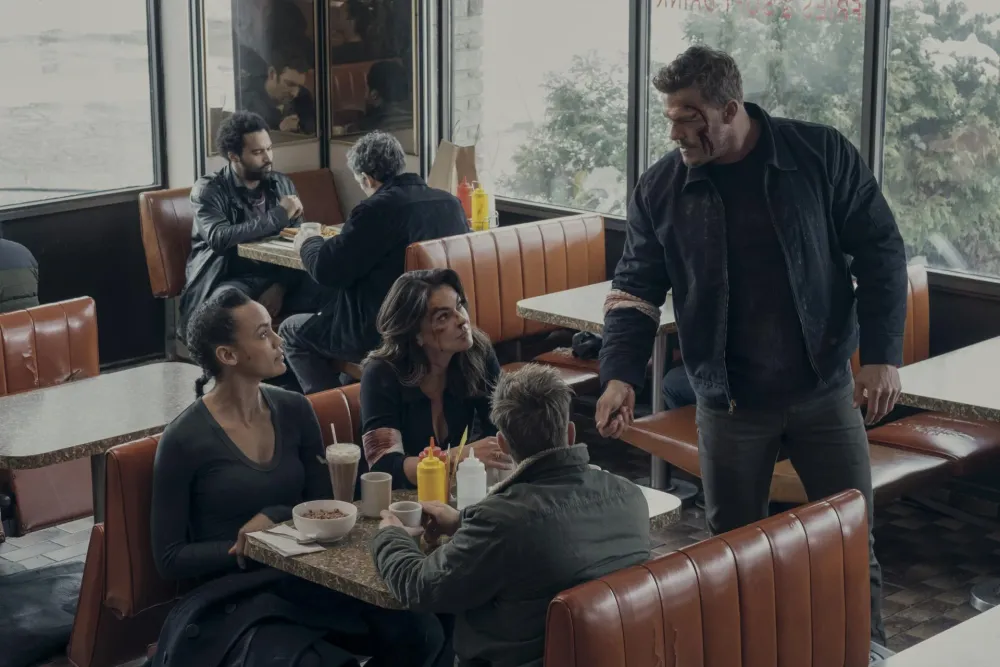
Photo Credit: Brooke Palmer/Prime Video. © Amazon MGM Studios.
This post contains affiliate links. We may earn a commission if you make a purchase, at no extra cost to you. As an Amazon Associate, Dadnology earns from qualifying purchases.
This review is part of the Lee Child – Jack Reacher Book Series hub on Dadnology, where we cover every novel and screen adaptation in order.
📺 Introduction
👊 This review is part of our Jack Reacher Master Hub – every Reacher book, film and season in one place, in the right order.
Season 1 proved the books could translate without losing their silhouette: competence, consequence, and a taciturn drifter who does math before mayhem. Season 2 carries that banner forward, adapting Bad Luck and Trouble into a team-focused revenge thriller that reunites members of the 110th. We watched as a couple and tore through episodes quickly—especially the opener, which lands with confidence and clarity.
Is it as tight as the first season? No. But it’s still muscular, readable television with plenty to enjoy.
AdBad Luck and Trouble (Jack Reacher, Book 11) (opens in a new tab)
The hard-hitting thriller that inspired Season 2. A must-read for fans of the show.

🧩 Story & Structure – The 110th Comes Home
Bad Luck and Trouble is a unit story: old comrades targeted, a trail of bodies and breadcrumbs, and Reacher dragging the truth into daylight by leveraging loyalty as both motivation and weapon. The show keeps that spine, front-loading a strong inciting crime, then layering investigation, extraction, and retaliation in clean beats. We appreciated how the writers convert book exposition into tasks—stakeouts, recon, improvised kit—so forward motion never fully stalls.
The trade-off: a midseason stretch spreads focus across multiple antagonists, diluting urgency. The logic holds; the tension curve just softens before the endgame rallies.
👤 Jack Reacher – The Silhouette Still Dominates
Alan Ritchson remains page-true. The size, the stillness, the dry asides—he changes the physics of each room by simply being in it. Why he works where two Tom Cruise films did not is a longer argument, and it holds up across every season. More importantly, he plays the thinking again: the glass-panel check, the exit mapping, the probability math before a punch is thrown. Small details continue to delight fans: the toothbrush travel rule, the buy-new-clothes habit, the quiet politeness with decent folks, and the absolute absence of it with predators.

Watch on Prime Video (opens in a new tab)
Stream the second season of Reacher.
When Reacher leads the 110th, you feel why they follow: competence, clarity, and a moral algorithm that prioritizes fairness over formality.
🫡 The 110th – Chemistry, Banter, and Tactical Rhythm
Season 2’s secret sauce is the team. The 110th’s rhythm—silent signals, fast role assignments, shared backstory—gives the season a different texture from the lone-wolf cadence of Season 1. We loved the competent banter: who takes overwatch, who runs the approach, who handles extraction. The camaraderie sharpens the action, turning brawls into orchestrations where timing matters as much as strength.
When the unit fractures under stress, the storytelling lands the emotional cost—even if one reconciliation resolves quicker than it should.
🧯 Action – Bruising but Legible
Reacher fights are short, decisive essays on leverage. Season 2 honors that grammar: preemptive strikes, joint control, broken balance, done. The camera stays steady, geography reads clearly, and sound design sells impact without wallowing. Gunfights obey sightlines and reloads; chases honor distance and terrain. We noticed a couple of midseason dust-ups that cut faster than Season 1’s best, but the finale returns to clean choreography that lets decisions drive outcomes.
AdReacher - Season 2 (Blu-ray) (opens in a new tab)
Add Season 2 to your physical collection.
🧠 Adaptation Choices – Serving Screen Without Betraying Page
As with Season 1, the series trims and rearranges while preserving motivation. Some book detours compress into composite scenes; a few minor beats slide earlier to maintain TV momentum. The show resists twist-for-twist’s-sake and mostly plays fair with clues. It keeps the Lee Child ethos intact: problems solved by observation, leverage, and the willingness to do the necessary, not the polite.
🎬 Pacing – Hot Start, Hiccups, Strong Finish
The first episode is a statement of intent: clean hook, sharp tone, confident blocking. Episodes two through five mix investigation with measured violence; the season then experiences a mild sag where the board spreads and stakes feel anticipated more than felt. The last stretch tightens screws, pays off plantings, and delivers a satisfying showdown—if not quite the thunderclap of Season 1’s best crescendos.
👨👩👧 A Dad/Fan Perspective – Still Great Couple TV
We paused often to spot book echoes and argue tactics—perfect couple-binge behavior. The violence earns our 16+ guidance (intense, not gratuitous), and the show remains admirably clear about consequences. If you loved seeing the toothbrush-and-new-clothes detail honored in Season 1, you’ll smile again here. Even with pacing dips, the moments are plentiful and fun to share.
🧱 Where It Stumbles (A Bit)
- A midseason subplot lands with less buildup than its payoff deserves.
- Antagonist focus diffuses urgency for an episode or two.
- Editing in a couple of fights leans choppier than Season 1’s crisp standard.
None of these break the season; they just notch it below the debut.
📚 Lee Child’s Blueprint: Why Bad Luck and Trouble Is a Strong Adaptation Base
Here is what the showrunners got right before a single frame was shot: they picked the right book for a second season.
Killing Floor works as a debut because Reacher enters the story as a stranger — all mystery, no context. But returning for a second season with the same lone-wolf template would have felt like a cover version of something you already owned. Bad Luck and Trouble solves that problem structurally. It is a unit story: six distinct characters with defined roles, shared history, and real stakes — not just a man walking alone into trouble, but a team that trusts each other in ways that cost something when tested. For television, that is enormously useful. You get four-plus characters with clear functions (the numbers specialist, the reconnaissance instinct, the logistics, the controlled violence), each giving the writers a lens to rotate through. A lone-wolf episode has one emotional axis. A team episode has six.
The military brotherhood theme also travels well. You don’t have to have served to understand loyalty-until-it-costs-you. Parenting will do. Watching someone cover for a colleague at their own expense, or step into a dangerous doorway so the person behind them doesn’t have to — that lands broadly, and the show earns those beats because the 110th’s history is stated economically and then demonstrated rather than explained at length.
Where does Bad Luck and Trouble sit in the Lee Child canon? Honestly: solid mid-tier. It is not Persuader, with its ratcheted paranoia and double-bluff tension. It is not Killing Floor, with the primal simplicity of its revenge architecture. It sits comfortably in the upper-middle of the series — a reliable, well-structured thriller that benefits from the unit concept. The show’s approach fits the book’s level: committed, professional, respectful, not transcendent. That is exactly the right treatment.
If the season has made you curious about the novels, do yourself a favour: start with Killing Floor or Persuader, not Bad Luck and Trouble. Those set the bar. Once you know what peak Reacher reads like, Season 2’s source material earns its place in the lineup without carrying expectations it was never designed to meet.
🛋️ Who Should Watch Reacher Season 2?
Let’s be direct about the fit, because not every action show suits every viewer.
Good match: Couples who burned through Season 1 and want more of the same energy. Dads who read crime thrillers — the procedural logic and tactical problem-solving will feel like home. Lee Child fans who want to see the 110th on screen and hear the dialogue delivered with Ritchson’s dry precision. Anyone who enjoyed Strike Back, The Boys, or similar ensemble action shows and wants something with a cleaner moral framework.
Mismatch: If you’re hoping for slow-burn detective work — sustained ambiguity, complex investigative threads, red herrings that pay off across six episodes — this is not that show. Reacher identifies, plans, and acts. The mystery solves itself through competence, not anxiety. That is a feature for the target audience and a misaligned expectation for anyone expecting True Detective pacing.
The team dynamic also creates something that a lone-wolf season structurally can’t: something to argue about between episodes. Who made the right call? Should they have trusted that contact? That scene where Reacher defers to the unit — was that character growth or tactical pragmatism? That is exactly the texture that makes a couple-binge work well: not passive consumption, but active disagreement over a show that gives you enough material to hold an opinion.
Age guidance: firm 16+. The violence is grounded rather than gory, but the menace is unambiguously adult — there are no sanitised consequences here.
Pros
- Alan Ritchson remains the definitive, page-accurate Jack Reacher
- 110th unit chemistry adds tactical depth and satisfying camaraderie
- Strong opening episode and a rallying endgame; action stays legible
- Faithful adaptation spirit—motivation and causality remain clear
- Plenty of fan-pleasing details and quotable, dry humor
Cons
- Midseason pacing dip; antagonist focus spreads tension thin
- One subplot resolves faster than its setup
- Editing occasionally choppier than Season 1’s best
🔩 Conclusion
Reacher Season 2 is a solid, bruising adaptation of Bad Luck and Trouble: confident opener, satisfying team dynamics, and a lead who embodies the books. It’s not as relentlessly tight as Season 1, and a midseason lull keeps it a step down overall—but the highs land, the unit clicks, and the details fans care about are respected. We had fun, we argued tactics, and we’ll be back for more — and if you’ve already finished it, Season 3 is the franchise at its sharpest.
📺 Movie night sorted: thousands of films and shows are streaming on Prime Video — free for 30 days. Worth a look before you buy the disc.
Related Dadnology review: Jack Reacher: Never Go Back – A Man on the Run, Again
📌 FAQ – Frequently Asked Questions
Do I need to read *Bad Luck and Trouble* first?
Is Season 2 as good as Season 1?
How violent is it?
What’s the best part?
Do I need to watch Season 1 before Season 2?
Which Lee Child book should I read first if the show got me interested?
Keep this in your inbox
One email a week: what we actually watched, built and reviewed — the stuff worth a dad's time. No hype, no daily spam.
Dadnology Weekly
One email a week: the LEGO, gaming and movie news worth a dad's time — plus what we actually reviewed. No hype, no daily spam.
Disclaimer: This review and its visuals were created with the help of AI. Some links may be affiliate links – we may earn a commission if you make a purchase, at no extra cost to you.
You might also like

Reacher – Season 1: A Faithful, Heavy-Hitting Start That Finally Feels Like Jack
If the films never matched your mental image of Jack Reacher, Season 1 will. Alan Ritchson looks and moves like the book’s drifter—measured, intimidating, and wry—and the adaptation hits beloved details like the toothbrush and the buy-fresh-clothes habit. Fights are bone-crunching but coherent, the mystery tracks cleanly, and the Southern setting feels lived in. As a screen version of *Killing Floor*, it’s both respectful and brisk. We had a blast watching together. Rating: 4/5.

Reacher – Season 4: The Season Without a Single Weak Episode
Gone Tomorrow gives season 4 a clean structure — a stranger, a strange city, a subway mystery that spirals into something bigger — and the show never lets go of the tension for eight episodes. There is no bad hour here, which is rare for a season this long. Alan Ritchson is, once again, exactly the Reacher the books built: watchful, dry, and terrifying only when the math says so. Rating: 4.5/5.
New Movies & Shows Coming in September 2026: Our Top Picks
September 2026 is the strongest streaming month of the year so far. The Mandalorian and Grogu hits Disney+ two days into the month, both Spider-Man sequels land two days after that, Slow Horses returns for a sixth season, and the first Reacher spin-off finally arrives. Add the entire Rocky and Creed run plus Deep Impact on Paramount+ and LEGO ONE PIECE closing out the month, and there is a genuine reason to open the TV guide.