
Reacher – Season 3: Persuader Brought to Life With Relentless Clarity
Based on Lee Child’s *Persuader*, Season 3 is the series at its best—clean stakes, surgical action, and a focused undercover premise that never loses tension. Alan Ritchson delivers his sharpest Reacher yet, and the adaptation lands beats that even outpace the novel.
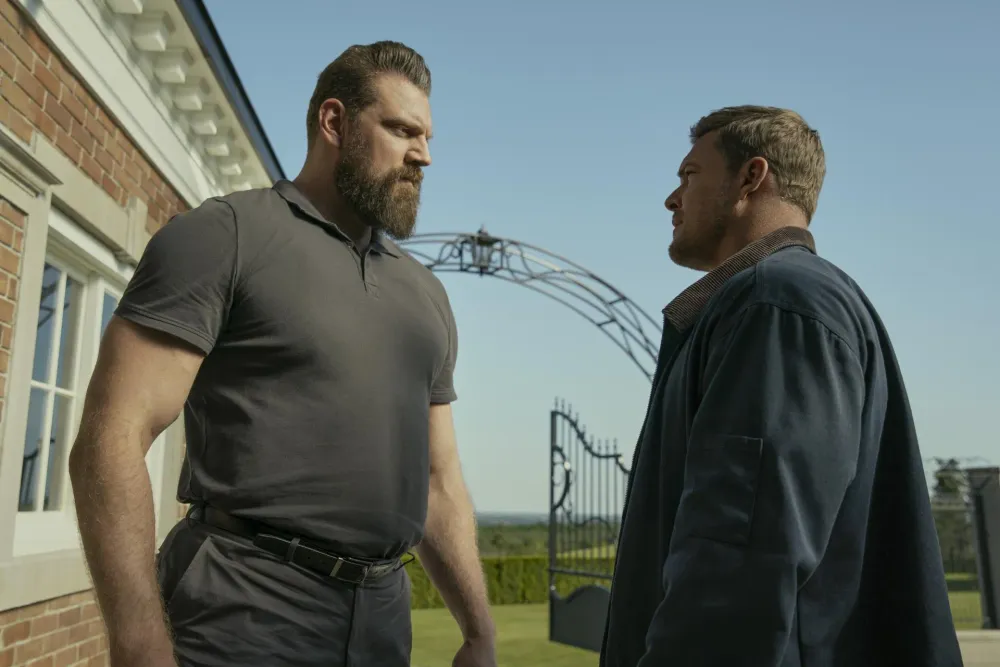
Photo Credit: Jasper Savage/Prime. © Amazon Content Services LLC.
This post contains affiliate links. We may earn a commission if you make a purchase, at no extra cost to you. As an Amazon Associate, Dadnology earns from qualifying purchases.
This review is part of the Lee Child – Jack Reacher Book Series hub on Dadnology, where we cover every novel and screen adaptation in order.
📺 Introduction
👊 This review is part of our Jack Reacher Master Hub – every Reacher book, film and season in one place, in the right order.
Some stories suit Reacher better than others; Persuader is a bullseye. Season 3 locks onto the novel’s undercover premise—Reacher burrowing into a criminal ecosystem to pull a man out and settle accounts—and refuses to blink. From the first sting to the last standoff, momentum never dips. We watched together and kept saying the same thing: this is the version of the show we hoped for from day one—focused, punishing, and smart.
As fans of the book, we’re happy to say the season is, yes, a tick better. The TV structure trims fat, heightens consequence, and makes the cat-and-mouse legible without over-explaining. It’s a ruthless eight-episode machine.
AdPersuader (Jack Reacher, Book 7) (opens in a new tab)
The gritty, undercover thriller that inspired Season 3. One of Lee Child's best.

🧩 Story & Structure – Undercover With Real Consequences
The spine is classic Persuader: Reacher inserts himself into a dangerous family operation, plays multiple angles, and stalks the objective with patience and precision. Season 3 respects the book’s why while optimizing the how for television:
- Immediate premise: A surgical opening that sets stakes, motive, and target with almost no exposition.
- Clear phases: Penetration → trust-building → pressure cooker → extraction → reckoning.
- Honest obstacles: Each step costs Reacher something—blood, time, leverage.
The key improvement over the novel is information flow. The show parcels out intel in practical tasks—surveillance, recon, dead-drops—so you feel advancement without a single lore dump. Cause-and-effect is king.
👤 Jack Reacher – Presence, Math, and Mercy (In That Order)
Alan Ritchson has never felt more book-true. He plays Reacher as a moral instrument: quiet until necessary, overwhelming when required, and constantly computing. You watch him measure rooms—doors, sightlines, head counts—before the first sentence lands. The performance is muscular but not loud; jokes are dry, the patience is terrifying, and the empathy is earned, not advertised.
Beloved details remain: travel light (toothbrush), buy fresh clothes, show courtesy to decent people, and zero to do with predators. It’s the Reacher silhouette rendered in steel and math.
If you want to see Ritchson swing the other way — broad, goofy dad-comedy instead of controlled menace — our Playdate (2025) review covers that side of his range, and Alan Ritchson, action hero explained puts the whole run together.
🧯 Action – Surgical, Short, and Story-First
Season 3’s fights are essays in leverage:

- Preemption: Strike first when the math demands it.
- Angles: Control hips, break balance, end quickly.
- Environment: Use rails, doors, and furniture as tools, not props.
Choreography is readable—steady cameras, coherent geography, decisive takedowns. Gunfights honor reloads and line-of-sight; chases respect distance and terrain. Impact sells without gore. When Reacher wins, you saw the decision tree. When he absorbs damage, you saw why the trade was necessary.
AdWatch on Prime Video (opens in a new tab)
Stream the best season of Reacher yet.
🧠 Adaptation Choices – Faithful Spirit, Sharper TV
The writers keep the motivation and tone of Persuader intact while streamlining subplots and reordering beats to sustain tension. Flashbacks are used sparingly and purposefully—context, not crutch. Antagonists gain clearer operational logic; allies acquire jobs that matter in the plan. It’s not twist-addicted TV; it’s consequence-addicted TV. That’s very Lee Child.
🎬 Pacing – No Filler, All Pressure
Eight episodes, zero waste. Each hour advances at least two vectors (plot and character, character and world, world and stakes). The “breathers” aren’t speed bumps; they’re recalibrations where Reacher audits options and costs. The result is the rare season with no mid-run sag. Start strong, stay strong, end stronger.
🎭 Supporting Cast – Tools, Foils, and Fault Lines
Reacher works best when the locals aren’t cardboard. Season 3 delivers a network of allies and adversaries whose competence drives scenes. People make choices that either help or hinder for reasons we understand, which makes betrayals sting and assists satisfying. A couple of secondary arcs resolve quickly, but even those pay off the season’s central thesis: ability + intent = consequence.

👨👩👧 A Dad/Fan Perspective – Best Couple Binge of the Series
We loved the book; we loved this more. It’s our pick for the most couple-friendly season because it rewards shared attention: one of you clocks a detail at the docks; the other remembers a line three episodes back; the theory you build together pays off in the next hour. It’s intense—hence 16+—but grounded rather than sadistic. The after-episode debriefs are half the fun.
🧱 Where It Stumbles (A Little)
- Two secondary character beats resolve a touch fast for the emotional load they carry.
- One late-episode reveal is telegraphed if you’re tracking props closely—not a bug for us, but seasoned viewers will be ahead of it.
These are nits on an otherwise top-tier season.
📖 Persuader on Page vs. Screen: Where the Show Edges the Novel
Persuader is widely considered one of Lee Child’s best novels — and that reputation is earned. The premise is genuinely clever: Reacher manufactures a near-death spectacle to deceive a man he has personal reasons to destroy, then spends the rest of the book surviving long enough to finish it. On the page it’s taut, occasionally brutal, and satisfying in the way only Lee Child’s precision plotting can be. So when we say Season 3 edges it, we mean that with full respect to the source. Here’s specifically why.
Structure: the flashback problem. The novel opens in medias res and then — fairly early — pulls you back to explain how Reacher ended up in this situation. These flashback sequences are well-written, but they arrest the forward momentum at precisely the moment you’ve just bought in. It’s the literary equivalent of a cold open followed by a lengthy “previously on.” The show converts this into compressed in-scene context: a conversation here, an exchanged look there. You understand the stakes because the scene shows them, not because a chapter stops to recap them. That choice alone makes the TV version feel propulsive in a way the novel only achieves intermittently.
Antagonist logic. The criminal organization in the novel operates on a certain deliberate vagueness — what they’re doing, who answers to whom, and how the network runs is often implied rather than mapped. That ambiguity serves atmosphere in a book, where Reacher’s partial information is part of the tension. On screen, operational clarity matters more: you need the audience to understand the machine in order to appreciate how Reacher is dismantling it. The show builds the org chart legibly, which makes every extraction of leverage feel earned rather than convenient.
The climax. The novel’s ending contains a couple of moments that strain cause-and-effect — elements arriving at useful times in ways that owe more to fortune than to Reacher’s planning. The show converts those into logical consequences of earlier decisions: something Reacher noticed two episodes back, an asset he quietly secured, a door left open for a reason. That’s the difference between a satisfying ending and a tight one.
Where the novel wins. Reacher’s internal monologue. Child’s prose gives you access to the problem-solving process — the real-time arithmetic of threat assessment, option analysis, and decision — in a way no camera can fully replicate. Watching Ritchson measure a room is compelling; reading Reacher’s mind do the same thing is its own pleasure. The novel wins on interiority. The show wins on plotting. As a piece of television, Season 3 is the tighter machine.
🏆 Where Does Season 3 Rank Against the Best TV Thrillers?
Let’s be honest about what Reacher is, because category clarity matters here. It is not prestige television in the Breaking Bad or The Wire sense — it makes no claim to social realism, moral ambiguity about its protagonist, or the novelistic sprawl of those shows. What it is: excellent, committed genre television, and that is a distinct and valuable thing. A great action thriller that keeps its promises is rarer than a prestige drama that mistakes length for depth.
In that field, Season 3 sits near the top. It is the best action series on Prime Video — by a significant margin over anything else they’ve produced. In the broader streaming landscape, it competes directly with the best seasons of 24 (the show that defined sustained-tension episode structures) and the finest runs of Justified in terms of character-consistent plotting: every decision follows from who the character is, not from what the plot needs next. The action choreography is a tier above most streaming competitors, closer to theatrical stunt work than the usual network-TV phone-it-in exchanges.
For the specific audience this show serves — the busy dad with 45 minutes before sleep — it is exactly the right density. Each episode resolves enough to satisfy (you can stop here if you have to) while advancing the arc enough to guarantee you will not stop here if you don’t have to. That’s hard to engineer. Season 3 does it every episode.
If you want to see Ritchson stretch outside the Reacher formula entirely, Motor City — his nearly-wordless 1970s revenge thriller — hit theaters in July 2026 to a much more divisive critical reception.
Pros
- Best pacing of the series: eight episodes, zero filler
- Alan Ritchson’s sharpest, most book-true Reacher yet
- Undercover structure keeps tension high from start to finish
- Readable, surgical action with honest cause-and-effect
- Smart adaptation choices that streamline Persuader without losing soul
Cons
- A couple of secondary arcs resolve a beat too quickly
- One late reveal is predictable if you’re hyper-attentive
🔩 Conclusion
Reacher Season 3 turns Persuader into a model for the franchise: ruthless focus, coherent action, and character decisions that drive every outcome. It’s leaner than Season 2, more complete than Season 1, and it never loses pressure. We liked the book and think the show edges it—tighter arcs, cleaner geography, and a finale that lands with authority. The definitive season so far.
📺 Movie night sorted: thousands of films and shows are streaming on Prime Video — free for 30 days. Worth a look before you buy the disc.
📌 FAQ – Frequently Asked Questions
Do I need to read *Persuader* first?
Is Season 3 better than Season 1 and 2?
How violent is it?
What makes this adaptation special?
Is Persuader the best Jack Reacher novel to start with?
How many seasons of Reacher are planned?
Keep this in your inbox
One email a week: what we actually watched, built and reviewed — the stuff worth a dad's time. No hype, no daily spam.
Dadnology Weekly
One email a week: the LEGO, gaming and movie news worth a dad's time — plus what we actually reviewed. No hype, no daily spam.
Disclaimer: This review and its visuals were created with the help of AI. Some links may be affiliate links – we may earn a commission if you make a purchase, at no extra cost to you.
You might also like

Reacher – Season 4: The Season Without a Single Weak Episode
Gone Tomorrow gives season 4 a clean structure — a stranger, a strange city, a subway mystery that spirals into something bigger — and the show never lets go of the tension for eight episodes. There is no bad hour here, which is rare for a season this long. Alan Ritchson is, once again, exactly the Reacher the books built: watchful, dry, and terrifying only when the math says so. Rating: 4.5/5.

Reacher – Season 1: A Faithful, Heavy-Hitting Start That Finally Feels Like Jack
If the films never matched your mental image of Jack Reacher, Season 1 will. Alan Ritchson looks and moves like the book’s drifter—measured, intimidating, and wry—and the adaptation hits beloved details like the toothbrush and the buy-fresh-clothes habit. Fights are bone-crunching but coherent, the mystery tracks cleanly, and the Southern setting feels lived in. As a screen version of *Killing Floor*, it’s both respectful and brisk. We had a blast watching together. Rating: 4/5.

New Movies & Shows Coming in September 2026: Our Top Picks
September 2026 is the strongest streaming month of the year so far. The Mandalorian and Grogu hits Disney+ two days into the month, both Spider-Man sequels land two days after that, Slow Horses returns for a sixth season, and the first Reacher spin-off finally arrives. Add the entire Rocky and Creed run plus Deep Impact on Paramount+ and LEGO ONE PIECE closing out the month, and there is a genuine reason to open the TV guide.