
The Grand Budapest Hotel Review: Wes Anderson's Masterpiece
Wes Anderson's most awarded film is also his most complete — a perfectly framed caper of murder, friendship, and pastry that earned four Oscars. Rating: 4.5/5.
This post contains affiliate links. We may earn a commission if you make a purchase, at no extra cost to you. As an Amazon Associate, Dadnology earns from qualifying purchases.
🛎️ Introduction
When The Grand Budapest Hotel (2014) opens, it does not so much begin a story as open a Russian doll. A girl visits a writer’s memorial. The writer (Tom Wilkinson, then Jude Law) recalls meeting an old man. The old man (F. Murray Abraham) recalls being a boy. And only then, four layers deep, do we arrive at the candy-pink hotel itself and the man who ran it: M. Gustave, concierge, poet, scoundrel, and one of the great comic creations of the last twenty years.
We watched Asteroid City a few days ago and loved it — Wes Anderson at his strangest, most demanding, most willing to lose you in the first half hour. So it felt like the right moment to finally fill the embarrassing gap in our Anderson education and sit down with the film everyone insists is his best. And here is the honest verdict before we go any further: they are right. The Grand Budapest Hotel is even better than Asteroid City — not because it is stranger, but because it is complete. A genuine 4.5/5, and the rare comedy that earned four Academy Awards without ever feeling like it was trying to.
AdThe Grand Budapest Hotel (Blu-ray) (opens in a new tab)
The format for rewatches — and you will rewatch this. The production design alone rewards pausing on nearly every frame, and the bonus features unpack how Anderson built Zubrowka from miniatures.

For the Dadnology community, this is the Anderson film to start with. It is funny enough to enjoy with zero homework, deep enough to reward a fifth viewing, and so beautiful that you will catch yourself pausing on individual frames just to look at them. After Asteroid City asked for our patience, The Grand Budapest Hotel simply asks for our attention — and gives back far more than it takes.
That awards haul is the headline, but it undersells what is actually happening on screen. This is a film that is genuinely, laugh-out-loud funny while also being about the death of a gentler, more civilised Europe. That balance — slapstick on top, melancholy underneath — is the hardest trick in cinema, and Anderson lands it here better than he ever has.
The Story: A Concierge, a Lobby Boy, and a Stolen Painting
The engine of the film is a friendship. M. Gustave (Ralph Fiennes) is the impeccable, perfume-drenched concierge of the Grand Budapest, a mountaintop resort in the fictional Republic of Zubrowka. He runs the place with military precision, recites poetry mid-sentence, and provides certain personal services to his elderly, wealthy, blonde clientele. Into this world arrives Zero Moustafa (Tony Revolori), a refugee with no family and nothing to his name, hired as a lobby boy.
When one of Gustave’s favourite guests, the ancient Madame D (Tilda Swinton under astonishing makeup), turns up dead, she leaves Gustave a priceless Renaissance painting — Boy with Apple. Her monstrous son Dmitri (Adrien Brody) is not pleased. What follows is a genuine caper: a framing for murder, a prison break, a chase across snowfields with Willem Dafoe’s knuckle-dustered assassin in pursuit, and a secret society of concierges who answer the call when one of their own is in trouble.
For all the velocity, the heart of it is two people: an older man with a code he refuses to abandon even as the world coarsens around him, and a young one learning that loyalty is the only inheritance worth having. For dads, that lands. The Grand Budapest Hotel is, underneath the pink paint, a film about what we pass on — manners, decency, a way of treating people — to someone who started with nothing.
| M. Gustave | Zero Moustafa | |
|---|---|---|
| Role | Legendary concierge | Refugee lobby boy |
| Defining Trait | Impeccable manners, comic vanity | Quiet, fierce loyalty |
| What He Offers | A code, a craft, a mentor | Devotion, and a future to protect |
| Arc | Holding civility against barbarism | Learning what family can mean |
| Defining Moment | Reciting poetry as the train guards close in | Choosing Gustave over safety, every time |
The chemistry between Fiennes and Revolori is the film’s secret weapon. Fiennes — known almost entirely for drama before this — turns out to be a stunning comic actor, all clipped diction and sudden profanity, and Revolori plays the perfect straight man: wide-eyed, deadpan, completely sincere. You believe this friendship, and that belief is what makes the film’s final act quietly devastating rather than merely clever.
The Production Design: The Real Star of the Film
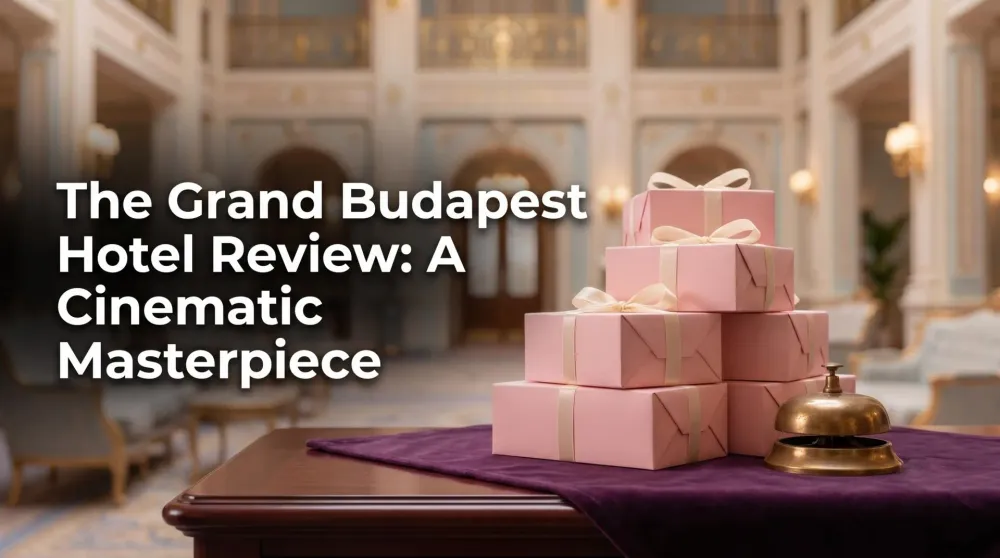
Here is where The Grand Budapest Hotel moves from “great” to “untouchable,” and it is exactly where the film floored us. The production design is, frankly, a work of art — and the Academy agreed, handing Adam Stockhausen the Oscar for it. Every set is a hand-built, jewel-box composition: the lobby with its red carpet and brass, the Mendl’s patisserie boxes tied with string, the funicular climbing the mountain, the spa, the prison, the snowbound observatory. Nothing here looks rented. Everything looks made.
Anderson and his team famously used miniatures and matte paintings rather than leaning on CGI — the hotel itself is a doll’s-house model, the cable car a tiny rig, the ski chase a deliberately, gloriously artificial diorama. The effect is not “fake.” It is storybook. You are not watching a place that exists; you are watching a memory of a place, the way Zero remembers it decades later, which is precisely the point. The artifice is the emotion.
The single cleverest formal choice is the use of three different aspect ratios for three time periods. The bulk of the film — the 1930s — is shot in a boxy, almost square 1.37:1, the format of the era it depicts. The 1960s framing scenes widen to 2.35:1; the 1980s bookends sit in between. You do not need to notice it consciously for it to work on you. The frame literally changes shape as you travel through time, and your eye feels the shift before your brain explains it.
AdThe Wes Anderson Collection: The Grand Budapest Hotel (opens in a new tab)
The official companion book — concept art, storyboards, and Anderson's own notes on building the hotel. Essential for anyone who wants to understand how that production design actually came together.
Add Milena Canonero’s Oscar-winning costumes — the purple Grand Budapest livery, Gustave’s wardrobe, Madame D’s furs — and Alexandre Desplat’s Oscar-winning score, all balalaikas and music-box menace, and you have a film where every single craft department is operating at the top of its game simultaneously. This is what four Oscars actually means: not one standout element, but a total, unified vision executed flawlessly. As a visual object, it is the most beautiful thing Anderson has ever made.
Better Than Asteroid City? Yes — and Here’s Why
We came to this straight off Asteroid City, so the comparison is unavoidable. Both are nested stories — films about stories within stories. Both are dazzling to look at. But where Asteroid City uses its nesting to keep you at arm’s length, to make grief feel as inexplicable as it actually is, The Grand Budapest Hotel uses its nesting to pull you closer. Each layer of frame is a layer of nostalgia, and by the time we are deep inside Zero’s memory, we are fully, emotionally invested.
That is the difference, and it is why this is the better film. Asteroid City is a brilliant puzzle that rewards patience. The Grand Budapest Hotel is a brilliant puzzle that also makes you laugh out loud, breaks your heart, and never once loses you. It is the more generous film. If you have only the appetite for one Wes Anderson movie in your life, it should be this one — and if it converts you, Asteroid City is waiting for round two.
The Format Benchmark: Watching on Apple Vision Pro
For the modern dad, the home theatre keeps evolving, and The Grand Budapest Hotel is a near-perfect test piece for a premium screen.
- Colour and detail: The pastel palette and pin-sharp symmetry reward an OLED or a lossless headset display more than almost any film we can name. Every Mendl’s box, every uniform button, every matte-painted vista holds up under scrutiny.
- The aspect-ratio trick: On a large, properly calibrated screen, the format changes between eras register exactly as intended — boxy intimacy for the 1930s, widescreen for the framing devices.
- Dad Alert: This is a fantastic “after the kids are down” film — short (99 minutes), endlessly rewatchable, and the kind of thing a partner who claims to dislike “weird” movies will actually love. Lead with this one, not the stranger Anderson films.
The Sonic Signature: Desplat’s Music-Box Menace
A storybook needs a storybook sound, and Alexandre Desplat delivered the score that won him his first Academy Award. It is built on Eastern European folk textures — balalaikas, zithers, a male choir, plucked strings that tick like a clock running down. It is playful and propulsive during the capers, then turns elegiac in the quiet moments, mirroring the film’s whole architecture: comedy on the surface, loss underneath.
- Thematic engineering: The main theme is light, almost toy-like, but it carries an undertow of melancholy that pays off completely by the finale.
- The world it builds: Desplat’s music does as much as the production design to make Zubrowka feel real — a place with its own folk music, its own history, its own about-to-be-lost culture.
Asteroid City (Blu-ray + DVD + Digital) (opens in a new tab)
If The Grand Budapest Hotel makes you an Anderson convert, this is the natural next step — his strangest, most formally adventurous film, and a fascinating companion piece.
Pros
- Production design and costumes so good they won Oscars — every frame is a hand-built work of art
- Ralph Fiennes is a revelation: a career-best comic performance with real warmth underneath
- The three-aspect-ratio time travel is the smartest formal trick in Anderson's filmography
- Balances genuine laugh-out-loud comedy with real melancholy — the hardest trick in cinema
- The perfect entry point to Wes Anderson: accessible on first watch, deeper on every rewatch
Cons
- The whiplash tonal shifts — sudden violence inside the whimsy — won't be for everyone
- Anderson's stylisation is so total that style-resistant viewers may still bounce off it
- The nested framing means it takes a few minutes to reach the actual story
Conclusion: The One That Earns Every Award
With four Academy Awards and a reputation as the film that converts Anderson skeptics, The Grand Budapest Hotel is not just a great Wes Anderson film — it is the great Wes Anderson film. It is the rare comedy where every craft department peaks at once, where the laughs and the heartbreak share the same frame, and where the artifice is not a barrier but the entire emotional point.
It is also, simply, a joy. Where Asteroid City makes you work, this makes you fall in love — and then, in its final layer of nostalgia, quietly breaks your heart. It is the best of Anderson, and one of the best films of its decade.
The Final Word: Everyone should see this at least once. A non-negotiable 4.5/5 and the only correct place to start with Wes Anderson.
📺 Movie night sorted: thousands of films and shows are streaming on Prime Video — free for 30 days. Worth a look before you buy the disc.
Frequently Asked Questions
Is The Grand Budapest Hotel worth watching?
How many Oscars did The Grand Budapest Hotel win?
Who directed The Grand Budapest Hotel?
Is The Grand Budapest Hotel suitable for kids?
What is The Grand Budapest Hotel about?
Should I watch The Grand Budapest Hotel or Asteroid City first?
Keep this in your inbox
One email a week: what we actually watched, built and reviewed — the stuff worth a dad's time. No hype, no daily spam.
Dadnology Weekly
One email a week: the LEGO, gaming and movie news worth a dad's time — plus what we actually reviewed. No hype, no daily spam.
Disclaimer: This review and its visuals were created with the help of AI. Some links may be affiliate links – we may earn a commission if you make a purchase, at no extra cost to you.
You might also like
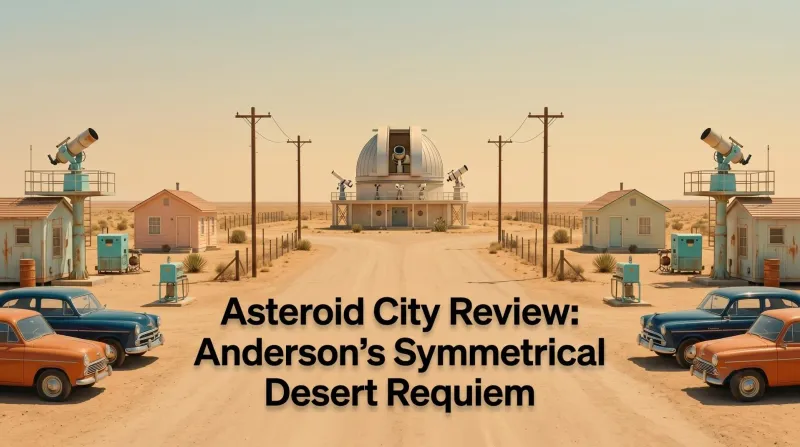
Asteroid City Review: Wes Anderson at His Strangest – and Best
Asteroid City punishes impatience and rewards commitment. Baffling in structure, beautiful in imagery, profound in theme — this is Wes Anderson refusing to coast. A film about grief, the compulsion to make art, and why those two things are probably the same. 4/5.
In the Grey Review: An Hour of Planning, Then 30 Minutes That Rock
Not a film for everyone, and the critics were lukewarm. We had a great time. Gyllenhaal and Cavill are both on form, the first hour builds the plan with Ritchie's usual swagger, and the last half hour is pure action payoff. A grown-up Friday-night film. Rating: 4/5.
Toy Story 5 Review: The Tablet Arrives, and Pixar Finds Its Heart
I went in sceptical after Toy Story 4 and came out with a big, warm, childhood feeling I did not expect. The animation is jaw-dropping, especially on Apple Vision Pro, the screen-time theme lands for parents, and the scary stuff from the older films is gone. It takes a while to grab you, and then it does not let go. Rating: 4.5/5.