
Assassin's Creed II review: The game that launched a golden era
Our review of Assassin's Creed II — the game that fixed everything the original got wrong and launched the franchise's golden era with Ezio Auditore.
This post contains affiliate links. We may earn a commission if you make a purchase, at no extra cost to you. As an Amazon Associate, Dadnology earns from qualifying purchases.
Fixing everything the original got wrong
The first Assassin’s Creed had a brilliant idea trapped inside a frustrating game. The promise was intoxicating — scale a real historical city, vanish into the crowd, end a target with a single hidden blade. The execution was repetitive: the same handful of investigation activities, recycled over and over, wrapped around a protagonist nobody much cared about.
Then Assassin’s Creed II arrived in 2009 and did something rare. It listened.
Almost every complaint about the original was answered, often comprehensively. The thin, monotonous mission loop was replaced with genuine variety. The cold, distant protagonist was swapped for one of gaming’s most charismatic heroes. The empty world gained an economy, a home base, gear to buy, and reasons to explore beyond the next objective marker.
This is the game that turned a promising-but-flawed experiment into a franchise people fell in love with. It launched the golden era — the run of games we at Dadnology still mean when we say “Assassin’s Creed the way we love it.” And it did it on the back of one man’s revenge.
Meet Ezio Auditore — A coming-of-age story
The single biggest fix AC II made was its protagonist. Where the original gave us a blank, humorless cipher, AC II gives us Ezio Auditore da Firenze — and the difference is night and day.
When you first meet him, Ezio is a cocky, privileged young nobleman in late-15th-century Florence. He brawls with rival families, chases women, delivers letters for his father, and has no idea that his bloodline carries a secret legacy. The game spends real, unhurried hours in this carefree life before pulling the rug out.
His father and two brothers are arrested on trumped-up charges and publicly executed in a political conspiracy. In a single afternoon, the impulsive young noble loses everything and is forced to flee the city with the surviving members of his family.
What follows is a coming-of-age story in the truest sense. Ezio doesn’t start as an assassin — he becomes one, painfully, over the course of the game, learning the order’s ways as he hunts the men responsible for his family’s murder. The revenge arc works precisely because the game made you live in his old life first. By the time you’re crossing names off the list, the vendetta feels earned, not assigned.
Renaissance Italy — The real star
If Ezio is the soul of AC II, Renaissance Italy is its body, and it remains one of the most atmospheric settings ever built in a video game.
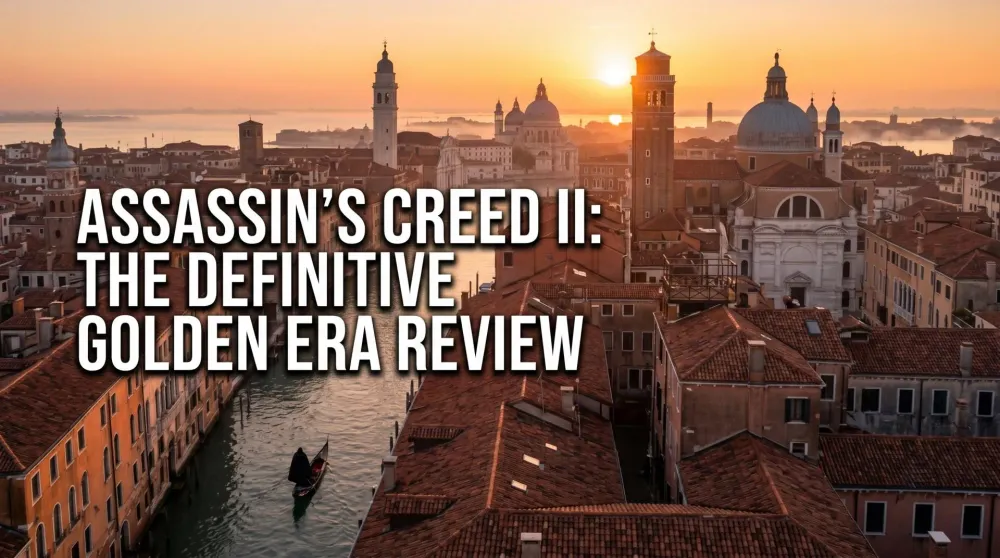
You move through a meticulously recreated Florence, all terracotta rooftops and the impossible bulk of the Duomo. You navigate the canals of Venice, climbing bell towers and sprinting along rooftops above the water. And you roam the rolling hills, vineyards, and crumbling ruins of the Tuscan countryside in between.
What makes these cities special is that the architecture isn’t decoration — it is the gameplay. Every building is a climbable puzzle. Every crowded plaza is a chance to melt away from pursuers. The world rewards you for thinking vertically, for treating a cathedral as a route rather than a landmark.
The historical detail is extraordinary for its era, and it’s wrapped in a conspiracy-thriller plot that ties real Renaissance figures into the Assassin-Templar war. Leonardo da Vinci is your gadget-builder and an absolute delight, decoding the codex pages that upgrade your arsenal. The Medici, the Pazzi conspiracy, the Borgia — actual history threads through the fiction in a way that’s both educational and genuinely thrilling. You come away knowing more about 15th-century Italy than you did going in, which is not something you can say about most action games.
Deeper traversal, missions, and gear
The original AC could climb and stab. AC II built an entire game’s worth of systems around those bones.
Traversal got deeper. The free-running is more fluid and forgiving, with new moves, the leap of faith into haystacks refined into a signature, and the swimming added so Venice’s canals don’t kill you on contact. Climbing the tallest structures to unlock the map became a ritual the series would keep for a decade — and it started feeling good here.
Missions got varied. Gone is the repetitive investigate-then-assassinate loop of the first game. AC II throws racing sequences, escort jobs, infiltration set pieces, optional assassin tombs that double as platforming challenges, and elaborate scripted assassinations at you. Not every variation lands — more on that below — but the sheer range is a world apart from the original’s monotony.
Then there’s the economy and gear. This is the game where Assassin’s Creed got RPG-lite in the best, leanest way. You earn florins, buy better armor and blades, upgrade your hidden weapons, and pour money into restoring Monteriggioni, the family villa that serves as your home base. Watching that run-down estate slowly come back to life — shops reopening, income rising, art and treasures filling its walls — is one of the most satisfying progression loops the series ever had. It gives you a reason to care about money beyond the next purchase: you’re rebuilding a home.
The pure, focused formula
Here’s the thing modern Assassin’s Creed forgot, and why AC II still hits so hard for those of us who grew up with it.
This game respects your time in a way the later entries don’t. There are no enemy levels gating you out of districts. No 80-hour grind to outscale a boss. No three competing currencies and a battle pass. You climb, you sneak, you stab, you escape — and the loop is clean. A mission is a self-contained set piece, not a checklist item buried under a map of icons.
For a dad with ninety minutes after bedtime, this matters enormously. You can sit down, complete a meaningful chunk of story, restore another corner of Monteriggioni, and feel like you accomplished something — without committing to a second job. The later games (Origins, Odyssey, Valhalla) are bigger and in some ways more beautiful, but they ask for a level of investment that simply doesn’t fit a parent’s life. AC II gives you the entire fantasy — historical assassin, gorgeous cities, satisfying parkour, a real story — in tidy, digestible portions.
This is the formula a lot of us still mean when we say “Assassin’s Creed.” Not the RPG sprawl. This.
The Animus — The divisive sci-fi framing
We can’t talk about AC II honestly without addressing the elephant in the simulation: the modern-day Animus framing.
For the uninitiated, you’re not really Ezio. You’re Desmond Miles, a present-day bartender strapped into a machine called the Animus that lets him relive his ancestor’s genetic memories. Every so often the Renaissance fantasy pauses and yanks you back to a sterile sci-fi facility for plot exposition about a shadowy modern conspiracy.
Opinions on this are genuinely split, and ours is no exception. On one hand, the conspiracy-thriller framing gives the series a unique identity and a reason for its time-hopping structure to exist at all. On the other, every cut back to the present pulls you out of the historical world you actually came for. Just as you’re fully immersed in 1480s Florence, you’re standing in a dull modern warehouse listening to lore.
It’s a defining part of Assassin’s Creed’s DNA, and AC II handles it better than most. But it is, undeniably, a thing you tolerate rather than enjoy — and it’s one of the reasons this is a 4.5 and not a 10.
An honest look — What hasn’t aged
We rated AC II a 4.5, not a 5, and integrity demands we explain the gap. This is a near-perfect game with a couple of real, dated blemishes.
The tailing missions. This was the era of the dreaded follow-at-walking-pace mission — trail a target inside an invisible bubble, and restart the whole sequence if you stray too far or get spotted. AC II has too many of these, and they were tedious in 2009. Time has not been kind to them. They’re the single most dated part of an otherwise sharp game, and they sap momentum every time one appears.
The eavesdropping and rigid scripting. Closely related, some missions ask you to sit on a bench and listen, or hew to an exact scripted path that fails you the instant you deviate. It clashes with the freedom the parkour otherwise promises. The combat, too, is a slow, counter-heavy rhythm — effective, but you’ll spend a lot of fights waiting to parry rather than driving the action.
But the atmosphere is untouchable. Jesper Kyd’s score, the Renaissance crowds, the sun on Florentine rooftops, the sheer place-ness of these cities — none of it has dated a day. And Ezio remains one of gaming’s most charismatic protagonists from his first cocky grin to his hardened final hours. The handful of dated systems are real, and we won’t pretend otherwise, but they’re scratches on a masterpiece. That’s exactly what a 9 means: brilliant, essential, and honestly imperfect.
The dad angle — How and when to play it
AC II is rated M for Mature, so the usual caveats apply: stabbing-based combat, blood, and some sexual themes mean it’s not a co-op-with-the-toddler situation. It’s an after-bedtime game. That said, the violence is far tamer than a modern open-world title, and the historical setting is genuinely educational — an older teen with an interest in the Renaissance can get real value from it.
For us specifically, the appeal is the bite-sized structure. You don’t need to remember a sprawling questline from three weeks ago. You boot it up, climb a tower, do a mission or two, restore another shop in Monteriggioni, and stop clean. The main story runs around 18 to 22 hours — long enough to feel substantial, short enough to actually finish — and it never feels like an obligation because each session stands on its own.
The best way to play it today is via the Ezio Collection, the remaster that bundles AC II with its two sequels. If you have a PlayStation 5, it runs flawlessly via backward compatibility, with load times short enough that the wind-down stays a wind-down. Throw on a decent headset for Jesper Kyd’s score and the ambient bustle of Renaissance Italy, and you’ve got the ideal game for a tired Tuesday night.
Pros
- Fixed nearly every flaw of the original — varied missions, real story, deeper systems
- Ezio Auditore's revenge-driven coming-of-age is one of gaming's great character debuts
- Florence, Venice, and Tuscany are gorgeous, atmospheric, fully climbable historical cities
- The economy, gear, and Monteriggioni rebuild add a genuinely satisfying progression loop
- The pure, focused pre-RPG formula respects your time — clean missions, no grind, no bloat
Cons
- Dated tailing and eavesdropping missions are tedious and break the momentum
- The divisive modern-day Animus framing keeps pulling you out of the historical fantasy
- Slow, counter-heavy combat and rigidly scripted insta-fail sequences show their age
The final verdict — Where the golden era began
Assassin’s Creed II is the game that fixed everything the original got wrong and launched the franchise’s golden era. It took a brilliant-but-frustrating idea and gave it a soul — a memorable hero in Ezio Auditore, a meticulously realized Renaissance Italy, deeper traversal, and an economy and gear system that finally made the world feel worth living in.
It isn’t flawless. The tailing missions are tedious, the combat is dated, and the modern-day Animus framing remains divisive. But the atmosphere, the revenge story, and Ezio himself are timeless. This is the blueprint the series would follow for a decade, and it’s still one of the most purely enjoyable historical adventures gaming has ever produced — bite-sized, focused, and built for exactly the kind of after-bedtime session a dad actually has time for.
Final Rating: 4.5/5 — Where the Golden Era of Assassin’s Creed Began
Related Dadnology review: Assassin’s Creed Revelations Review — Ezio’s Swan Song
Part of a lifelong saga
AC II is only the beginning of Ezio’s story. His arc continues across Brotherhood and Revelations, aging from vengeful young assassin into a wise old Master — one of the only character journeys in gaming told across three full games.
Want the whole saga? Read our full Assassin’s Creed: The Ezio Collection review to see how all three games hold up together.
FAQ — The Assassin’s Creed II questions
Is Assassin's Creed II better than the first game?
How long does Assassin's Creed II take to beat?
Do I need to play the first Assassin's Creed before AC II?
Why is the modern-day Animus story in Assassin's Creed II?
Is Assassin's Creed II appropriate for kids?
Keep this in your inbox
One email a week: what we actually watched, built and reviewed — the stuff worth a dad's time. No hype, no daily spam.
Dadnology Weekly
One email a week: the LEGO, gaming and movie news worth a dad's time — plus what we actually reviewed. No hype, no daily spam.
Disclaimer: This review and its visuals were created with the help of AI. Some links may be affiliate links – we may earn a commission if you make a purchase, at no extra cost to you.
Current deals in Gaming
Verified live discounts tracked on Amazon

Gaming · Tested by Dadnology
Marvel’s Spider-Man 2 (PS5)
5/5“Bigger, bolder, near-perfect superhero storytelling”Read our review
Gaming · Tested by Dadnology
God of War Ragnarök (PS5)
4.5/5“The bold reinvention that rocked the PlayStation”Read our reviewPrice as of Oct 21, 09:11 PM UTC

Gaming · Tested by Dadnology
The Last of Us Part I (PS5)
5/5“A masterpiece rebuilt for the modern era”Read our reviewYou might also like
Assassin's Creed Brotherhood review: Peak Ezio in Rome
An honest 4.5/5. Brotherhood is peak Ezio — a focused single-city epic in Rome with the best traversal in the trilogy and the brilliant assassin-recruit system. It iterates rather than reinvents, and its multiplayer is long dead, but the campaign is Assassin's Creed at its most confident.
Assassin's Creed Revelations review — Ezio's swan song
An honest 4/5. Revelations is the weakest game mechanically in the Ezio trilogy — the formula was tiring and Den Defense is a misstep — but as a farewell for gaming's best assassin, tying Ezio and Altair together, it lands with real emotional weight.
Assassin's Creed: The Ezio Collection review — The franchise at its best
An honest 4/5. The Ezio trilogy is Assassin's Creed at its absolute best — gorgeous historical cities, a lifelong character arc, and the pure, focused formula before the series ballooned. Dated mission design and aged controls hold it back from perfection, but the atmosphere and Ezio himself are timeless.