
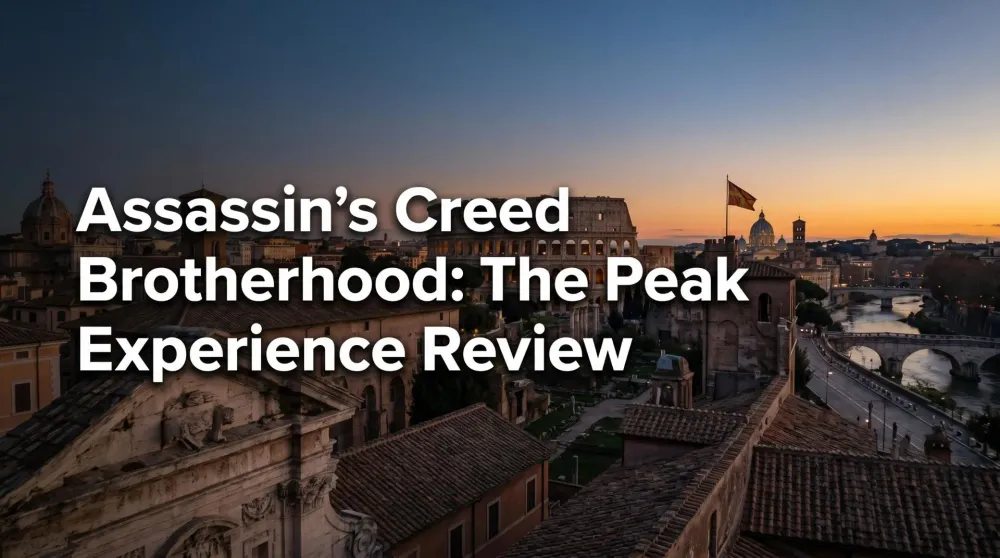
Assassin's Creed Brotherhood review: Peak Ezio in Rome
Our review of Assassin's Creed Brotherhood — peak Ezio in Rome, where you stop being a lone assassin and rebuild an entire Brotherhood of your own.
This post contains affiliate links. We may earn a commission if you make a purchase, at no extra cost to you. As an Amazon Associate, Dadnology earns from qualifying purchases.
The sequel that had no right to be this good
🗡️ This review is part of the Assassin’s Creed: The Ezio Collection – play Ezio’s complete trilogy in order.
Most games would have killed for the ending Assassin’s Creed II earned. Ezio Auditore had grown from an impulsive, grieving young noble into a Master Assassin, climbed the Vatican itself, and confronted the man who tore his family apart. It was a complete arc. A studio could have walked away, satisfied.
Instead, Ubisoft did something braver — and smarter. Assassin’s Creed Brotherhood doesn’t try to top AC II’s revenge story with a bigger one. It tells a quieter, more confident tale about what a man does after his quest for vengeance is over: he builds something that outlasts him. And it does it in a single city, rendered with more love than the entire previous game gave to three.
At Dadnology, this is the entry we’d point to when someone asks which classic Assassin’s Creed plays the best. AC II is the more important game historically; Brotherhood is the more accomplished one. It’s peak Ezio. Our verdict is an honest 4.5/5 — and we’ll be upfront about the one point we held back. Let’s get into it.
A gut-punch opening
Brotherhood does not ease you in. Within the first hour, the comfortable life Ezio fought so hard to reach in AC II is torn down — his family villa at Monteriggioni, the home base you spent the previous game building up and caring for, is attacked. People you knew don’t make it out. It’s a brutal, deliberate reset, and it works precisely because you remember the previous game.
This is why we tell people to play AC II first. The opening of Brotherhood is engineered to hurt, and it only lands if you’ve already spent dozens of hours with these characters and this place. A newcomer sees a dramatic action sequence. A returning player feels the floor drop out.
From those ashes, the game finds its real subject. Ezio is older now. The fire of pure revenge has burned down to something steadier and more purposeful. He’s no longer a young man with a grudge — he’s a leader, whether he wanted the job or not. And the city that becomes his battlefield is the perfect stage for it.
One city, done properly
Where AC II hopped between Florence, Venice, and the Tuscan countryside, Brotherhood makes a bold bet: the entire game takes place in and around Rome. No loading into separate cities. No fragmented map. Just one enormous, living capital, broken under the rule of the Borgia and waiting to be reclaimed.
It’s the best decision the game makes. Concentrating everything into a single location means Rome feels dense in a way the AC II cities never quite did. You learn its districts. You recognize rooftops. You develop a mental map of the fastest route from the Tiber to the Colosseum. The city stops being a backdrop and starts being a place you know.
And it’s not static. Rome under the Borgia begins choked and oppressed — shops shuttered, citizens cowed, Borgia towers casting a shadow over each district. As you topple those towers and reinvest your money into the city, Rome visibly comes back to life. Districts reopen. Shops return. The change is gradual and earned, and watching a neighborhood you liberated come back to life is one of the quietly satisfying loops in the whole trilogy.
The best traversal in the trilogy
If you’ve played all three Ezio games, you can feel the difference the moment you start running. Brotherhood has the smoothest, most responsive traversal of the trilogy — and given how central climbing and rooftop chases are to Assassin’s Creed, that matters enormously.
The parkour is faster and more forgiving. Ezio reads the geometry better, snags fewer ledges he shouldn’t, and flows over Rome’s varied architecture with a confidence AC II only hinted at. Add the new ability to ride horses through the city — not just the countryside — and the moment-to-moment movement feels genuinely liberating.
Combat got the same treatment. AC II’s defensive, counter-heavy fighting could grind to a stop against a crowd of guards. Brotherhood introduces kill-streak chaining: land a clean kill and you can flow straight into the next, and the next, turning a swarm into a brutal, balletic sequence. It’s not deep by modern standards, but it’s satisfying, and it finally makes Ezio feel like the apex predator the story keeps insisting he is.
You don’t just play an Assassin — You build a Brotherhood
Here is the wrinkle that gives the game its name and its identity. For the first time in the series, Ezio isn’t a lone wolf. He recruits.
Across Rome, you’ll find citizens being brutalized by Borgia guards. Step in, save them, and you can offer them a place in your fledgling Brotherhood. From there, you train them, send them on contracts across Europe that level them up off-screen, and — best of all — call them down into a fight with a tap of a button.
It’s a fantastic feeling. You’re perched on a rooftop, surveying a target ringed by guards, and instead of diving in alone, you summon a hail of your own assassins from the crowd to do the work for you. The system turns Ezio from a single blade into the head of a network, and it reinforces the entire theme of the game: this is a story about legacy, about building something larger than yourself.
No other Assassin’s Creed nailed this idea quite as cleanly. It’s mechanically simple, but thematically it’s the perfect expression of where Ezio is in his life — and it’s a genuine highlight of the trilogy.
Iteration, not reinvention — and the dead multiplayer
Now the honest part, because that’s the only kind of review we write.
Brotherhood is the most polished Ezio game, but it earns a 4.5 and not a 5 for a clear reason: it iterates rather than reinvents. Everything here is AC II made better — sharper traversal, smarter combat, the recruit system on top. That’s a wonderful thing to play. It is not a leap the way AC II was a leap from the 2007 original. If you bounced off the core Assassin’s Creed loop in AC II, Brotherhood won’t change your mind; it refines a formula rather than rethinking it.
The dated edges are still here, too. The infamous tailing and eavesdropping missions persist, and the instant-fail stealth that pads them out has aged about as gracefully as you’d expect. The modern-day Animus framing — Desmond reliving Ezio’s memories — gets more screen time and ends on a wild, divisive cliffhanger that some players love and others find an intrusion on the historical fantasy.
And then there’s the elephant: the multiplayer is gone. Brotherhood launched in 2010 with a genuinely clever asymmetric online mode — players hunting each other in a crowd, every face a potential target. It was novel and well-liked at the time. Today the servers are dead, and the Ezio Collection ships the campaign only. A real piece of what shipped in the box no longer exists. It doesn’t hurt the single-player game one bit — the campaign was always the reason to be here — but an honest review has to say it: part of this product is no longer available.
👨 The dad angle — When and how to play Brotherhood
Brotherhood is not a co-op or family game. It’s rated M for Mature and earns it — the combat is stabbing-based and bloody, and there are sexual themes and language throughout. This is an after-bedtime game, ideally with a headset, in the sessions you carve out for yourself once the house is quiet.
But it’s also one of the more dad-friendly classic AC games in terms of structure. Rome is broken into districts, the recruit contracts run in the background, and the Borgia-tower loop gives you clean, self-contained 30-to-45-minute chunks of progress. You don’t need a four-hour block to feel like you got somewhere — knock out a tower, train a recruit, do a memory, and put the controller down. For a parent whose gaming time arrives in unpredictable fragments, that rhythm is a quiet gift.
On time investment: the main story runs roughly 15 to 18 hours, and you can double that if you chase the collectibles and the assassin network. There’s no urgency mechanic forcing you forward, so it’s easy to play a chapter at a time over weeks. And thematically, this is the entry that hits hardest in your 30s and 40s — it’s not a power fantasy about a young man’s revenge anymore. It’s about an older man building something to leave behind. That’s territory worth a few late nights.
On setup: via the Ezio Collection on a modern console it runs cleanly with fast loads, and a decent headset does real work here. Jesper Kyd’s score and the ambient bustle of Renaissance Rome are half the atmosphere — give them the audio they deserve.
Pros
- Peak Ezio — the most confident, polished game in the trilogy
- The best traversal and combat flow of the three Ezio games
- A single, dense, beautifully realized Rome that visibly comes back to life
- The brilliant assassin-recruit system no other AC nailed as well
- A gut-punch opening and a memorable, emotional arc
Cons
- Iterates on AC II rather than reinventing — it's refinement, not a leap
- The once-praised multiplayer is now defunct and removed
- Dated tailing/eavesdropping missions and instant-fail stealth persist
Final verdict
Assassin’s Creed Brotherhood is the franchise at its most confident. By trading AC II’s three cities for one immaculately built Rome, sharpening the traversal and combat, and handing Ezio his own Brotherhood to lead, Ubisoft made the best-playing game in the classic era.
It iterates rather than reinvents, and the multiplayer that once shipped alongside it is long dead — that’s why it’s a 9 and not higher. But the campaign is Assassin’s Creed at its absolute peak, and Ezio’s arc from lone avenger to mentor of an order is the trilogy’s emotional high point.
Final Rating: 4.5/5 — Peak Ezio, and the Best-Playing Game in the Trilogy
Related Dadnology review: Assassin’s Creed Revelations Review — Ezio’s Swan Song
FAQ
Is Assassin's Creed Brotherhood better than AC II?
Do I need to play AC II before Brotherhood?
How long does Assassin's Creed Brotherhood take to beat?
Does the Brotherhood multiplayer still work?
Is Assassin's Creed Brotherhood appropriate for kids?
Keep this in your inbox
One email a week: what we actually watched, built and reviewed — the stuff worth a dad's time. No hype, no daily spam.
Dadnology Weekly
One email a week: the LEGO, gaming and movie news worth a dad's time — plus what we actually reviewed. No hype, no daily spam.
Disclaimer: This review and its visuals were created with the help of AI. Some links may be affiliate links – we may earn a commission if you make a purchase, at no extra cost to you.
Current deals in Gaming
Verified live discounts tracked on Amazon

Gaming · Tested by Dadnology
Marvel’s Spider-Man 2 (PS5)
5/5“Bigger, bolder, near-perfect superhero storytelling”Read our review
Gaming · Tested by Dadnology
God of War Ragnarök (PS5)
4.5/5“The bold reinvention that rocked the PlayStation”Read our reviewPrice as of Oct 21, 09:11 PM UTC

Gaming · Tested by Dadnology
The Last of Us Part I (PS5)
5/5“A masterpiece rebuilt for the modern era”Read our reviewYou might also like
Assassin's Creed II review: The game that launched a golden era
An honest 4.5/5. Assassin's Creed II fixed everything the original got wrong and launched the franchise's golden era. Ezio's revenge arc and Renaissance Italy are timeless; dated tailing missions and the divisive sci-fi framing are the only blemishes on a near-perfect game.
Assassin's Creed Revelations review — Ezio's swan song
An honest 4/5. Revelations is the weakest game mechanically in the Ezio trilogy — the formula was tiring and Den Defense is a misstep — but as a farewell for gaming's best assassin, tying Ezio and Altair together, it lands with real emotional weight.
Assassin's Creed: The Ezio Collection review — The franchise at its best
An honest 4/5. The Ezio trilogy is Assassin's Creed at its absolute best — gorgeous historical cities, a lifelong character arc, and the pure, focused formula before the series ballooned. Dated mission design and aged controls hold it back from perfection, but the atmosphere and Ezio himself are timeless.