
Assassin's Creed Revelations review — Ezio's swan song
Our review of Assassin's Creed Revelations — Ezio's swan song in Constantinople, tying together his story and Altair's into a moving farewell.
This post contains affiliate links. We may earn a commission if you make a purchase, at no extra cost to you. As an Amazon Associate, Dadnology earns from qualifying purchases.
The last climb of a legend
🗡️ This review is part of the Assassin’s Creed: The Ezio Collection – play Ezio’s complete trilogy in order.
There is a particular kind of melancholy that hangs over Assassin’s Creed Revelations, and it is entirely deliberate. When you meet Ezio Auditore here, he is no longer the cocky young noble of Assassin’s Creed II or the confident order-builder of Brotherhood. He is an old man — grey-bearded, scarred, weary — and he has come to Constantinople not to start something, but to finish it.
At Dadnology, we adore the Ezio trilogy, and we have been honest about each piece of it. AC II is the most important. Brotherhood is the best to play. And Revelations is the one that makes you feel something on the way out the door. It is, mechanically, the runt of the litter — and we’ll be unflinching about why. But as a swan song for gaming’s best assassin, it does something almost no other franchise has the patience or the nerve to attempt.
Our verdict is an honest 4/5. Not higher, and we’ll explain the gap clearly. The formula was tiring by 2011 and the game knows it. But the ending it builds toward is worth the climb. The whole thing lives inside the Ezio Collection, where it belongs — as the third act of a story you’ve already invested in. Let’s get into it.
An older, wiser Ezio
The genius of the Ezio trilogy is that it ages its hero in real time across three games, and Revelations is where that gamble pays its final dividend.
The Ezio of Revelations is not chasing revenge anymore. The men who killed his family are long dead; the order he rebuilt is established. What he’s chasing now is meaning — an answer to why he was chosen, what the Assassin-Templar war was ever really for, and whether a life spent in the shadows added up to anything. He travels to Constantinople, a city straddling Europe and Asia at the crossroads of the old world, searching for the lost library of Altair Ibn-La’Ahad, the protagonist of the very first Assassin’s Creed.
That search is the emotional engine of the whole game. Watching a character we met as an impulsive twenty-something move with the deliberate weight of old age — slower, more reflective, more aware of his own mortality — is genuinely affecting. He flirts, but gently. He fights, but he tires. He philosophizes in a way the young Ezio never would have. Few games have the courage to let their action hero grow old on screen. Revelations does, and it is the single best thing about it.
Constantinople — A gorgeous change of scenery
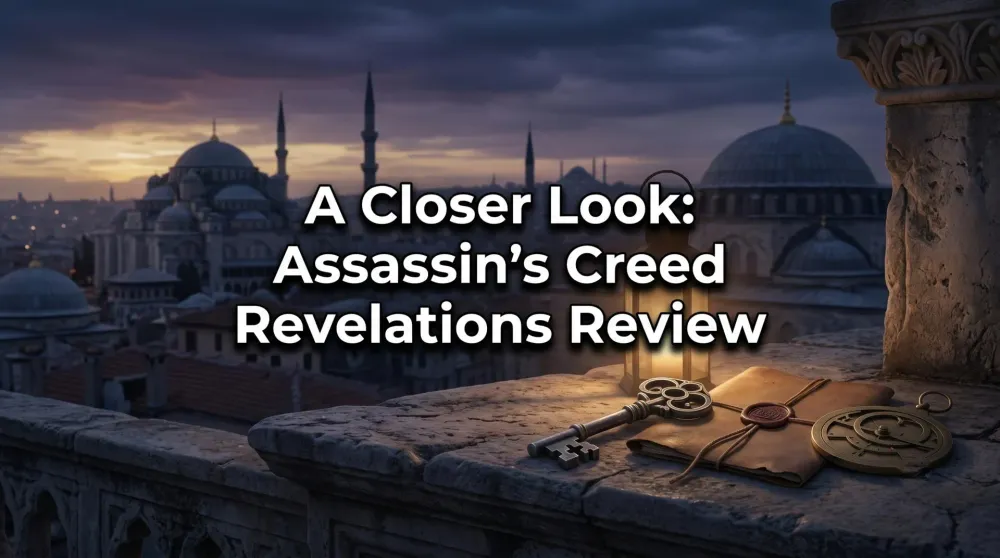
After three games of terracotta Italian rooftops, the move to Constantinople is a tonic. The city is one of the most atmospheric the series ever built: layered, dense, and alive with a cosmopolitan crowd of merchants, scholars, soldiers, and street performers from across the known world.
Where Florence and Rome traded in Renaissance grandeur, Constantinople trades in texture. Minarets and domes break up the skyline. The Grand Bazaar hums with trade. The Galata district feels distinct from the imperial heart of the city across the Golden Horn. Jesper Kyd and Lorne Balfe’s score leans into the setting, weaving Eastern instrumentation through the familiar Assassin’s Creed motifs in a way that makes the whole place feel both foreign and continuous with everything that came before.
The architecture is, as always, the gameplay. Every tower is a climbable puzzle, every plaza a chance to vanish into the throng. And it is gorgeous — the remaster cleans up the visuals enough that Constantinople at dusk remains a genuinely beautiful place to spend an evening. If the rest of the game had matched the ambition of its setting, we’d be talking about a higher score.
New toys — The hookblade and bomb-crafting
To its credit, Revelations doesn’t just coast on the established formula. It brings two new tools, and both are good ideas.
The hookblade is the standout. Bolted onto Ezio’s familiar hidden blade, it speeds up climbing, lets you grab ledges that were previously out of reach, and enables the zipline traversal that crisscrosses Constantinople’s rooftops. It’s a small change with a big effect: movement feels noticeably faster and more fluid than in the previous two games, which matters when traversal is half of what you do.
Bomb-crafting is the other addition. Instead of a fixed loadout, you gather components and mix your own bombs across three families — tactical, lethal, and diversion — tuning the casing, the powder, and the effect. It opens up the stealth toolkit in a way the trilogy hadn’t tried before, letting you lay smoke to slip a fight, scatter coins to draw a crowd, or drop something far nastier. In practice it’s slightly over-engineered for how often you actually need it, but the intent — more player expression in how you approach a target — is exactly right.
Both additions are genuinely welcome. Neither is enough, on its own, to disguise that the underlying loop is the same one you played twice before.
The honest problem — A formula running on fumes
We rated this a 4, not a 4.5 or a 5, and integrity demands we explain the gap. The short version: by 2011, the Ezio formula was visibly tiring, and Revelations is where the seams show.
This was Ubisoft’s annual-release era, and Revelations shipped one year after Brotherhood, which shipped one year after AC II. You feel that cadence in the bones of the game. The core loop — climb a viewpoint, sync the map, do a string of contextual missions, escape the guards — is by now deeply familiar, and Revelations doesn’t meaningfully evolve it. It reuses the recruit system from Brotherhood, the same combat rhythm, the same contextual climbing that occasionally misreads your inputs and sends Ezio leaping off a tower when you wanted him to shimmy. The pacing also sags badly in the middle, padding the runtime with busywork between the story beats that actually matter.
And then there’s the elephant in the room.
Den Defense — The misstep nobody wanted
Den Defense is the tower-defense minigame nobody asked for, and it is the clearest symptom of a series reaching for new ideas without the time to develop them properly.
The concept: when the Templars assault one of your captured city districts, you switch to a top-down view and place units — riflemen, barricades, cannons — along the rooftops to repel waves of advancing enemies, with Ezio barking orders from a vantage point. On paper, it ties into the city-control fantasy the trilogy had been building. In practice, it’s a tonal and mechanical mismatch. You don’t play Assassin’s Creed to manage a tower-defense grid; you play it to be the lone blade in the crowd. The minigame yanks you out of everything the series does well and drops you into a clumsy, half-baked strategy layer that feels like it belongs in a different game entirely.
Mercifully, you can largely avoid triggering it if you keep your notoriety low, which tells you everything: the best way to enjoy a feature is to engineer your playthrough so it never appears. That is not a feature working as intended. It’s the single most-criticized addition in the trilogy, and it earns that reputation.
Where revelations sits in the trilogy
| Feature | Revelations | vs The Trilogy |
|---|---|---|
| Setting | Constantinople | A welcome change from Renaissance Italy |
| Ezio's Stage | Wise, weary old Master | The end of a lifelong arc |
| Best At | Emotional send-off & Altair payoff | The most moving of the three |
| New Systems | Hookblade, bomb-crafting, Den Defense | Good ideas, one clear misfire |
| Length | ~12-15 hours | The shortest of the three |
| Our Verdict | The runt as a game, perfect as an ending | Weakest to play, strongest to finish |
The send-off — Tying Ezio and Altair together
Here is why, despite everything above, Revelations earns its 8 and its place in the trilogy.
The whole game is built around a quiet convergence. As Ezio searches Constantinople for Altair’s library, the memories he unlocks let you play as Altair at key moments across his entire life — from young, arrogant Assassin in the first game through to old age and the fall of his order. It is a love letter to anyone who started this journey back in 2007, and it gives the original game’s stiff, underwritten hero the emotional closure he never got the first time around.
And then there’s Ezio’s own ending. Without spoiling it, the final stretch — and one particular line of dialogue delivered to a figure who has been listening the whole time — recontextualizes the entire trilogy. It’s a moment of grace: an old man, at the end of a long and violent life, finally understanding that the journey was never really about him. After dozens of hours across three games, watching gaming’s best assassin lay down his blade for the last time genuinely lands. As a game, Revelations is the weakest of the three. As an ending, it’s the best thing the trilogy has.
The dad angle — How and when to play it
This is an M-rated game — blood, stabbing-based combat, some sexual themes and strong language — so the usual rules apply. It’s an after-bedtime title, not a co-op-with-the-toddler situation. That said, the violence is far tamer than a modern open-world game, and the historical setting is genuinely educational; an older teen with an interest in history can get real value from a guided playthrough.
For those of us playing it ourselves, Revelations fits a parent’s life beautifully precisely because it’s the shortest game in the trilogy. At twelve to fifteen hours, it’s the rare AAA action game you can actually finish inside a couple of weeks of post-bedtime sessions. The hookblade and ziplines make traversal fast and satisfying, so even a thirty-minute session feels like you covered ground. Skip Den Defense by keeping your notoriety down, lean into the story, and you’ve got a tidy, emotionally resonant finale that respects the ninety minutes you’ve got after the kids are asleep.
If you have a PlayStation 5, the Ezio Collection runs flawlessly via backward compatibility, with load times short enough that Constantinople feels seamless. Throw on a decent headset for Kyd and Balfe’s score and the ambient bustle of the bazaar, and you’ve got the perfect wind-down send-off for a tired Tuesday night.
Pros
- A genuinely moving send-off for Ezio — gaming's best assassin gets the farewell he deserves
- Ties Ezio's and Altair's stories together, giving the original 2007 hero his overdue emotional closure
- Constantinople is a gorgeous, atmospheric change of scenery after three games of Renaissance Italy
- The hookblade makes traversal noticeably faster and more fluid; bomb-crafting adds real stealth variety
- The shortest game in the trilogy — a tidy 12-15 hours that actually fits a parent's schedule
Cons
- The formula was visibly tiring by 2011 — it reuses prior systems without meaningfully evolving them
- Den Defense is a clumsy, unwanted tower-defense minigame that clashes with everything the series does well
- Pacing sags in the middle, and the game leans heavily on the goodwill of the two games before it
The final verdict — A worthy farewell
Assassin’s Creed Revelations is the weakest game in the Ezio trilogy and the most moving chapter of it, and both of those things are true at once. By 2011 the formula was running on fumes, the Den Defense minigame is a genuine misstep, and the whole thing leans on the goodwill the first two games earned. There is no pretending otherwise.
But the things it sets out to do — age Ezio gracefully into old age, hand Constantinople a starring role, and quietly braid Ezio’s and Altair’s stories into a single farewell — it does beautifully. As a send-off for gaming’s best assassin, it lands. That’s exactly what an honest 4 means: imperfect, tiring in places, and still absolutely worth the climb.
Final Rating: 4/5 — A Worthy Swan Song for Gaming’s Best Assassin
Continuing the Living Novel
We’ve followed Ezio from impulsive youth in Florence to his final climb in Constantinople. The trilogy is complete — but the Living Novel Hall of Fame keeps growing with more focused, story-driven action that respects both your time and your intelligence.
Ready for more? Explore the rest of our Living Novel Hall of Fame to find your next great adventure.
FAQ — The revelations questions
Do I need to play AC II and Brotherhood before Revelations?
What is new in Assassin's Creed Revelations?
Why does Revelations only get a 4 out of 5?
How long does Assassin's Creed Revelations take to beat?
Is Assassin's Creed Revelations appropriate for kids?
Keep this in your inbox
One email a week: what we actually watched, built and reviewed — the stuff worth a dad's time. No hype, no daily spam.
Dadnology Weekly
One email a week: the LEGO, gaming and movie news worth a dad's time — plus what we actually reviewed. No hype, no daily spam.
Disclaimer: This review and its visuals were created with the help of AI. Some links may be affiliate links – we may earn a commission if you make a purchase, at no extra cost to you.
Current deals in Gaming
Verified live discounts tracked on Amazon

Gaming · Tested by Dadnology
Marvel’s Spider-Man 2 (PS5)
5/5“Bigger, bolder, near-perfect superhero storytelling”Read our review
Gaming · Tested by Dadnology
God of War Ragnarök (PS5)
4.5/5“The bold reinvention that rocked the PlayStation”Read our reviewPrice as of Oct 21, 09:11 PM UTC

Gaming · Tested by Dadnology
The Last of Us Part I (PS5)
5/5“A masterpiece rebuilt for the modern era”Read our reviewYou might also like
Assassin's Creed II review: The game that launched a golden era
An honest 4.5/5. Assassin's Creed II fixed everything the original got wrong and launched the franchise's golden era. Ezio's revenge arc and Renaissance Italy are timeless; dated tailing missions and the divisive sci-fi framing are the only blemishes on a near-perfect game.
Assassin's Creed Brotherhood review: Peak Ezio in Rome
An honest 4.5/5. Brotherhood is peak Ezio — a focused single-city epic in Rome with the best traversal in the trilogy and the brilliant assassin-recruit system. It iterates rather than reinvents, and its multiplayer is long dead, but the campaign is Assassin's Creed at its most confident.

Halo: Campaign Evolved review: Fantastic, but you don't NEED it
The graphics update is a wow and the new levels are a genuinely great addition. Docking a point purely because you do not strictly need this remake when the Master Chief Collection already delivers the same great experience.