
Best Mirrorless Cameras for Dads (2026 Buyer's Guide)
Our dad-tested guide to the best mirrorless cameras for capturing kids, sports and holidays in 2026 — from a cheap first body up to a serious hobbyist kit. Top pick: Sony a6700.
This post contains affiliate links. We may earn a commission if you make a purchase, at no extra cost to you. As an Amazon Associate, Dadnology earns from qualifying purchases.
📸 This guide is part of our Amazon Prime Day 2026 Deals Hub — our curated buying guides of the gear actually worth a dad’s money.
The Problem: Your Phone Quits the Moment the Kid Starts Moving
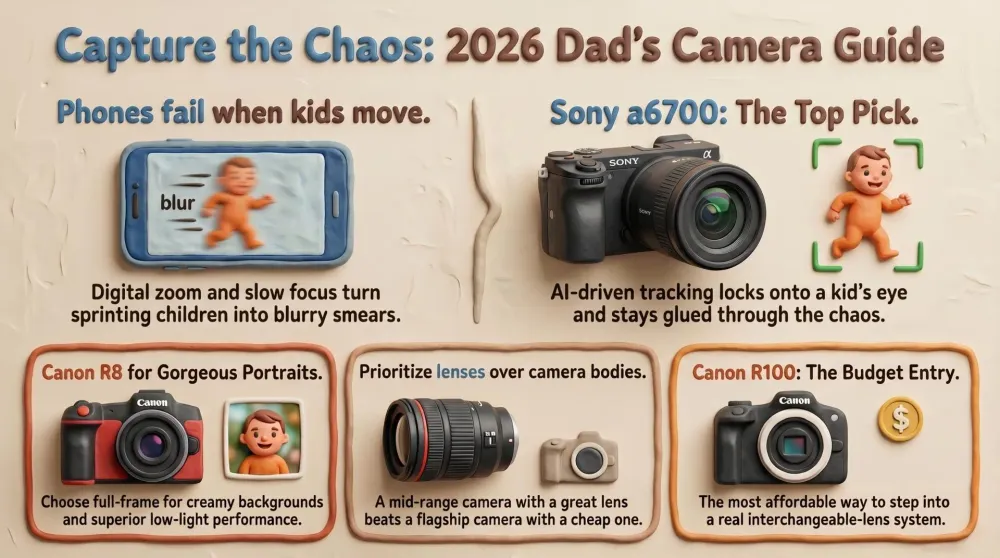
You’ve taken roughly forty thousand photos of your children on your phone, and most of them are fine. The phone is brilliant at the easy stuff: a kid sitting still in good light, a birthday cake, a beach panorama. Then your toddler discovers running, your daughter signs up for football, and the holiday photos start happening at dusk — and suddenly the phone is handing you blurry smears, a face it focused past, and a “zoom” that dissolves into digital porridge the moment the subject is more than a few metres away. The moments you most want to keep are exactly the ones the phone fumbles.
This guide is for one specific dad: the one who wants to capture the kids, the sports, and the holidays better than a phone can, and is ready to buy his first proper interchangeable-lens camera — or to step up from an old one. You don’t need to become a professional. You need a camera that focuses fast on small humans who refuse to hold still, works indoors without turning everyone orange, and reaches across a pitch or a playground. We’ve ranged the picks from the cheapest honest way in (the Canon EOS R100) up to a serious hobbyist all-rounder (the Sony a6700), so there’s an entry point at every budget.
Here’s our honest disclosure before we go a step further: we shoot Nikon ourselves. Patrick’s been a Nikon man since a D90 in 2009, and the current kit is all Z-mount. But we rate gear by whether it perfectly serves the job it was built for, not by the logo on the front — and for a dad getting into mirrorless today, the value, the autofocus pedigree and the sheer availability of deals all point to Canon and Sony. They make superb cameras, and these five are the right picks for most dads. So you’ll notice there isn’t a Nikon body on this list. That’s deliberate. We’re not going to shoehorn our own brand into a guide where it isn’t the honest best answer — that would be exactly the spec-sheet zealotry we can’t stand.
One more thing that matters more than anything below: the body is the smaller half of the decision. The lens does most of the work. A mid-range body with one good lens will out-shoot a flagship body with a cheap kit zoom every single time. Buy the camera that fits your hands and your budget, then put the money you saved into glass. We’ll come back to this, because it’s the mistake we see dads make first.
We’ve ranked these in recommendation order, starting with the camera most dads should buy and ending with the one to start with if budget is the hard constraint. Let’s dig in.
1. Sony a6700 — The Running-Toddler Slayer
If you want one camera that does almost everything a dad needs and gets the shots a phone can’t, this is it. The a6700 is an APS-C body with a 26-megapixel sensor and — the part that actually matters — Sony’s newest AI-driven autofocus brain, the same subject-tracking tech that trickled down from its professional bodies.
AdSony a6700 Mirrorless Camera (Body) (opens in a new tab)
Best overall: APS-C, 26MP, AI-driven subject tracking that locks onto a sprinting toddler and won't let go. The one most dads should buy.

What it does well
The headline is subject tracking, and it’s genuinely transformational for family photos. A dedicated AI processor recognises humans, animals, birds, cars and more, and once it locks onto your kid’s eye it stays glued there — through a sprint across the garden, a wobble down the slide, a face turning away and back. This is the single biggest leap over a phone or an older camera: you stop fighting the focus and start just pressing the button. The keeper rate at a chaotic third birthday party goes from “a few usable” to “almost all of them.”
The 26MP APS-C sensor delivers genuinely lovely image quality with plenty of resolution to crop into, and in-body image stabilisation means handheld shots in a dim living room don’t turn to mush. Video is a real strength too — 4K with the same sticky autofocus — so the same camera that nails the photo of your daughter blowing out candles also shoots the clip you’ll actually rewatch. And because it’s APS-C, the body is compact and the Sony E-mount lens range is enormous, from cheap-and-cheerful primes to serious telephotos.
Where it falls short
Honesty time. The a6700 is the most expensive APS-C body on this list, and Sony’s menu system, while improved, still takes a Tuesday-evening learning session to befriend. The grip is on the small side for dads with large hands — worth holding one before you buy. And it has a single card slot, which a wedding professional would grumble about but which matters not at all for family use.
Who should buy it
The dad who wants to buy one camera and be done for years. If your kids move fast, you shoot indoors a lot, and you want the best autofocus money can sensibly buy without going full-frame, the a6700 is the answer. It’s the camera we’d put in most dads’ hands first.
2. Canon EOS R8 — Full-Frame Without the Full-Frame Backache
If you’ve decided you want full-frame image quality — the bigger sensor, the dreamier background blur, the cleaner low-light shots — the R8 is the smartest way to get there without remortgaging or developing a permanent shoulder ache.
AdCanon EOS R8 Full-Frame Mirrorless Camera (Body) (opens in a new tab)
Best full-frame value: gorgeous low-light image quality and creamy portrait backgrounds in a surprisingly light body.
What it does well
The R8 puts a full-frame sensor in a body that weighs almost nothing — it’s lighter than several of the APS-C cameras here. That bigger sensor is its whole reason to exist: it gathers more light, so the indoor and dusk shots that defeat a phone come out clean and usable, and it renders portraits with that soft, creamy background separation that makes a photo of your kid look like it cost real money. Canon’s Dual Pixel autofocus is excellent and includes the same eye- and subject-tracking that keeps faces sharp. Colours straight out of the camera are flattering, especially skin tones — Canon has spent decades getting this right, and it shows in every family snap.
Where it falls short
Full-frame has a tax, and it isn’t just the body. Full-frame lenses are bigger, heavier and pricier than their APS-C equivalents, so the “light body” advantage shrinks once you hang a proper zoom on the front. The R8 also has a smaller battery than the chunkier bodies, so a full day at a theme park means carrying a spare. And it skips in-body stabilisation, leaning on the lens for that instead — fine with a stabilised lens, less ideal with a cheap prime.
Who should buy it
The dad who specifically wants low-light performance and portrait look, and who’ll mostly shoot people rather than distant action. If your photography is birthday dinners, family portraits and the occasional moody holiday shot — and you care about that full-frame rendering — the R8 is the lightest, most affordable route into it.
3. Canon EOS R7 — The Sideline Specialist
If your weekends are spent on the touchline of a football pitch or chasing a kid across a skate park — or you fancy the occasional bird in the garden — the R7 is built for you. It’s an APS-C body that leans hard into reach and speed.
AdCanon EOS R7 Mirrorless Camera (Body) (opens in a new tab)
Best for action and wildlife: APS-C reach plus a fast burst for kids' sports, soccer sidelines and the occasional bird.
What it does well
The R7’s superpower is reach plus burst. Its APS-C sensor effectively magnifies your lens, so a 100-400mm zoom frames the far goalmouth far tighter than the same lens on a full-frame body — you get closer to the action without buying an enormous, expensive telephoto. Pair that with a genuinely fast burst rate and Canon’s reliable subject-tracking autofocus, and you can fire off a rapid sequence as your kid takes the shot, then pick the single frame where the ball’s leaving their boot. Its 32MP sensor also gives you headroom to crop in afterwards, which is gold when you couldn’t get physically closer. Dual card slots and a deep grip round out a body that feels built for a long day pitchside.
Where it falls short
That high-resolution, fast sensor is hungry for light and demands good lenses — pack the pixels too densely and cheap glass shows its limits, and high-ISO shots are a touch noisier than the lower-resolution a6700. The buffer can fill if you hold the shutter down like a machine gun for too long. And it’s a more specialised tool: for everyday indoor family shots it’s perfectly capable, but you’re paying for action features you won’t always use.
Who should buy it
The sports-and-wildlife dad. If a real chunk of your shooting is kids’ matches, athletics, fast pets or birds, the R7’s reach and speed are worth more to you than a slightly cleaner high-ISO file. For pure all-round family duty, the a6700 still edges it.
4. Sony a6400 — The Smart-Money Step-In
The a6400 is a few years old now, and that’s precisely why it’s here. Its autofocus was class-leading when it launched and remains genuinely excellent, and it shares the same vast E-mount lens ecosystem as the a6700 — for meaningfully less money.
AdSony a6400 Mirrorless Camera (Body) (opens in a new tab)
Best value step-in: proven autofocus and a deep, affordable lens ecosystem at a friendlier price than the a6700.
What it does well
The a6400’s real-time tracking and eye autofocus still embarrass cameras costing more, and for a dad photographing kids, that’s the spec that matters. It’s compact, light and pocketable with a small prime, the image quality from its 24MP APS-C sensor is lovely, and the flip-up screen makes it a friendly little vlogging and to-camera video tool too. Crucially, it plugs into the same enormous, affordable Sony E-mount lens range as our top pick — so the money you save on the body goes straight into glass, which is exactly the right priority.
Where it falls short
It’s the previous generation, so it lacks in-body stabilisation and the newest AI autofocus brain of the a6700 — the tracking is great, just not quite as uncannily sticky on erratic motion. The grip is small, the menus are old-Sony fiddly, and there’s a single card slot. None of these are dealbreakers for family use; they’re the reasons it costs less.
Who should buy it
The dad who wants most of the a6700’s autofocus magic at a friendlier price, and who’d rather spend the difference on a good lens. If your budget is tight but you don’t want to compromise on focusing fast on moving kids, this is the rational, money-smart pick.
5. Canon EOS R100 — The Honest First Camera
The R100 is the cheapest way to genuinely step into a real interchangeable-lens system, and we mean that as praise. It comes with a kit lens, so it’s a complete, ready-to-shoot camera out of the box.
AdCanon EOS R100 Mirrorless Camera with 18-45mm Lens (opens in a new tab)
Best budget first camera: the cheapest honest way into a real interchangeable-lens system, kit lens included.
What it does well
The R100 nails the one job it’s built for: getting a phone-shooter into a real camera for the least money. It’s small, light and dead simple, the 24MP APS-C sensor produces images that comfortably outclass a phone — especially with proper background blur and zoom reach — and it slots into Canon’s modern RF lens mount, so there’s a clear upgrade path when you catch the bug. The bundled kit lens means you can start shooting the moment it arrives, no extra purchase required.
Where it falls short
This is the entry model, and Canon made some cuts. There’s no in-body stabilisation, the screen is fixed (not flip-out), and the autofocus is a step behind the tracking wizardry of the Sony bodies — it’ll get the shot of a moving kid, just less reliably. The viewfinder is basic. It’s a learner’s camera, and if you’re already fairly sure you’ll get serious, you’ll likely outgrow it within a year or two.
Who should buy it
The dad on a strict budget who wants to find out whether a real camera is for him without spending a4 figures to do it. If “I think I want a proper camera but I’m not certain I’ll stick with it” describes you, the R100 is the low-risk on-ramp.
How They Compare: The Spec Showdown
This is where the decision actually gets made. Note the autofocus and best for rows — for a dad shooting moving kids, those two lines matter more than any megapixel number.
| Feature | Sony a6700 | Canon R8 | Canon R7 | Sony a6400 | Canon R100 |
|---|---|---|---|---|---|
| Sensor | APS-C | Full-frame | APS-C | APS-C | APS-C |
| Megapixels | 26MP | 24MP | 32MP | 24MP | 24MP |
| Autofocus | AI tracking (best) | Dual Pixel, great | Dual Pixel, fast | Real-time, great | Basic, capable |
| Burst | Fast | Fast | Fastest here | Good | Modest |
| Best For | All-round family | Low light, portraits | Sports, wildlife | Value all-round | First camera |
| Verdict | Top pick | Full-frame value | Action pick | Smart-money buy | Budget on-ramp |
The table tells a clear story. The two Sony bodies win on autofocus pedigree — the thing that turns a chaotic kid moment into a keeper. The Canon R8 is the outlier that buys you full-frame look and low-light at the cost of pricier lenses. The R7 is the specialist for reach and speed. And the R100 is the honest budget door. There’s no wrong answer here, only the right one for your specific kind of chaos.
How to Choose: A Decision Framework
If you’ve read this far, here’s how to actually decide without spiralling into forum threads at midnight.
If you want one camera to do everything for years — buy the Sony a6700. Its autofocus is the closest thing to a cheat code for photographing children, and APS-C keeps the whole system small and affordable.
If you mostly shoot people, indoors and at dusk, and you love that soft portrait look — buy the Canon EOS R8. Full-frame earns its keep in low light and background blur. Just budget for the bigger lenses.
If your weekends are spent on sidelines and you need reach — buy the Canon EOS R7. The crop-sensor reach plus burst speed is the sports dad’s friend.
If money is tight but you won’t compromise on focusing fast — buy the Sony a6400. It’s most of the a6700’s brain for less, leaving cash for a good lens.
If you’re not yet sure you’ll stick with it — start with the Canon EOS R100. It’s the cheapest honest way to find out, kit lens included.
APS-C vs full-frame, settled simply: unless you specifically crave low-light performance and portrait blur and are willing to pay for it in money and lens size, APS-C is the right call for most dads. Smaller, lighter, cheaper, and more than good enough for everything family life throws at it. Full-frame is a want, not a need, for the vast majority of family shooters.
AdSony a6700 Mirrorless Camera (Body) (opens in a new tab)
Best overall: APS-C, 26MP, AI-driven subject tracking that locks onto a sprinting toddler and won't let go. The one most dads should buy.
And the meta-advice, in proper tech-dad spirit: spend on lenses, not on the body. Whatever camera you pick, your next purchase should be one good lens — a fast 50mm-equivalent prime for indoor portraits, or a telephoto zoom for sports. That single decision will improve your photos more than jumping up a body tier ever would. The body changes how easily you get the shot; the lens changes how the shot looks.
Common Mistakes to Avoid
- Buying the body and skimping on the lens. The number-one beginner error. A mid-range body with one great lens beats a top body with a cheap kit zoom every time. Budget for glass from day one.
- Chasing full-frame you don’t actually need. Full-frame is heavier, pricier and demands pricier lenses. For family photos, a modern APS-C body like the a6700 or a6400 does 95% of the job for a fraction of the total cost and weight.
- Falling for the megapixel myth. More megapixels is not more “quality” — past about 24MP it mostly buys you cropping room and larger files. A 26MP a6700 with brilliant autofocus will get you more keepers than a higher-resolution body that hunts for focus.
- Buying the most camera you can afford and never learning it. The best camera is the one you understand well enough to use one-handed while holding a snack. Buy within your budget, then spend the time learning it.
Pros
- Best-in-class AI subject tracking — locks onto a running kid's eye and holds it
- 26MP APS-C sensor with lovely image quality and in-body stabilisation
- Excellent 4K video with the same sticky autofocus
- Compact body that taps Sony's huge, affordable E-mount lens range
Cons
- Most expensive APS-C body on this list
- Small grip and a learning-curve menu system; single card slot
Conclusion: The Bottom Line
After comparing five cameras across every budget, the honest take is simple: for the dad who wants to capture moving kids, sports and holidays far better than a phone, the camera that gets out of your way and just nails focus is the one to buy.
That’s the Sony a6700 — its AI subject tracking turns chaotic family moments into keepers, and APS-C keeps the whole kit small and affordable. If you want full-frame low light and portrait blur, the Canon EOS R8 is the lightest, smartest way in; if you live on the sidelines, the Canon EOS R7 has the reach and speed; the Sony a6400 is the money-smart step-in; and the Canon EOS R100 is the cheapest honest door into a real system. We shoot Nikon ourselves — but for a dad getting into mirrorless today, these are the right calls, full stop.
The Final Word: most dads should buy the Sony a6700, then spend the next purchase on one good lens. The body gets the shot; the lens makes it beautiful. Period.
Related Dadnology guides: Which Nikon Mirrorless Camera Should I Buy? (2025 Buyer’s Guide · Best Vlogging & Creator Cameras (2026 Buyer’s Guide) · Best Action & Low-Light Cameras (2025)
What is the best mirrorless camera for dads in 2026?
How much should I spend on a mirrorless camera?
Is APS-C or full-frame better for family photos?
Which camera is best for kids' sports and action?
Do I need a fancy camera, or is my phone good enough?
Should I wait for the next model, or buy now?
Keep this in your inbox
One email a week: what we actually watched, built and reviewed — the stuff worth a dad's time. No hype, no daily spam.
Dadnology Weekly
One email a week: the LEGO, gaming and movie news worth a dad's time — plus what we actually reviewed. No hype, no daily spam.
Disclaimer: This review and its visuals were created with the help of AI. Some links may be affiliate links – we may earn a commission if you make a purchase, at no extra cost to you.
You might also like
Prime Big Deal Days October 2026: What a Dad Should Actually Buy
Amazon's October sale runs 6-7 October 2026. Here is what a dad should buy, what to skip, and how to plan the two days without falling for decoy discounts.

Prime Day 2026: 5 Best Robot Vacuums for Family Households
Our dad-focused Prime Day guide to the top 5 robot vacuums in 2026 that keep family homes clean – from self-emptying Roombas to powerful all-in-one stations from Shark, Dreame, and eufy.
Never Get Locked Out Again: 5 Best Smart Locks for Families (Prime Day 2026)
A dad-focused guide to the best smart locks for U.S. family homes in 2026 – including August, Schlage, Yale, Eufy, and Level – with picks for renters, Apple families, fingerprint fans, and more.