
Which Nikon mirrorless camera should I buy? (2025 buyer’s guide – Z50 II, Z5 II, Z6 III, Z7 II & Z8)
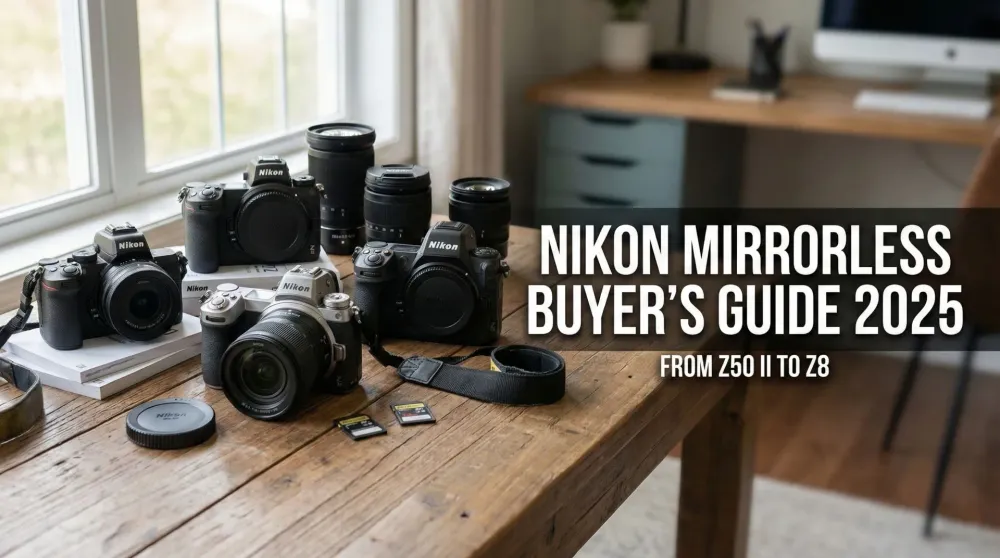
Not sure which Nikon mirrorless camera to buy? This 2025 buyer’s guide compares Nikon Z50 II, Z5 II, Z6 III, Z7 II, and Z8 – from budget beginners to high-end all-rounders.
This post contains affiliate links. We may earn a commission if you make a purchase, at no extra cost to you. As an Amazon Associate, Dadnology earns from qualifying purchases.
📷 This guide is part of the Nikon Brand Hub – explore our full Nikon Z system coverage.
Editor’s note: This guide focuses entirely on Nikon Z mirrorless cameras. It’s written from the perspective of a long-time Nikon shooter who has actually used these bodies for family life, travel, landscapes, action, and low light. The aim is simple: if you want a Nikon and don’t know which one to buy, this should give you a clear, honest answer.
🧭 Step 1 – How to think about buying a Nikon (without going down a spec rabbit hole)
Before diving into individual cameras, it helps to zoom out and ask three brutally simple questions:
- What’s your realistic budget – including a basic lens and memory card?
- What do you actually photograph most of the time?
- How serious do you expect to be about photography in two to three years?
If you skip these and go straight into spec sheets, you’ll end up confused and probably overspending on features you’ll barely use.
A quick reality check:
- If your budget is tight and you’re not sure how deep you’ll go into the hobby, an APS-C body like the Z50 II is the smarter, lower-risk entry.
- If you already know this is more than a passing curiosity, a full-frame body like the Z5 II or higher makes sense as a longer-term platform.
- If you mainly shoot landscapes, resolution and dynamic range matter more.
- If you mainly shoot kids’ sports, events, and low light, autofocus speed and high-ISO performance matter more.
- If you eventually want a “forever camera” that can do everything, the Z8 becomes the end goal, but there’s no shame in working up to it.
Think of the Nikon Z lineup as a ladder:
- Bottom rung: Z50 II – accessible, forgiving, and fun.
- Middle: Z5 II, Z6 III, Z7 II – different flavors of full-frame depending on your style.
- Top: Z8 – the camera you buy after a lot of saving, knowing exactly why you want it.
🔍 APS-C vs full frame – Do you really need full frame right now?
One big anxiety point for many buyers:
“Should I start with full frame, or is APS-C enough?”
A quick breakdown:
APS-C (DX, like Nikon Z50 II)
- Smaller sensor → smaller, lighter bodies and often cheaper lenses.
- Great for travel, hiking, and casual family photography.
- Excellent for beginners who don’t want to carry a brick everywhere.
- Depth of field is a bit deeper for the same framing and f-stop, which can actually be helpful when learning (more things end up in focus).
Full frame (FX, like Z5 II, Z6 III, Z7 II, Z8)
- Better low-light performance and dynamic range.
- Shallower depth of field for the same framing → more “cinematic” background blur possible.
- Preferred for landscapes, serious portrait work, events, and low-light scenes.
- Bodies and lenses are usually larger and more expensive.
If you’re brand new and not sure you’ll stick with photography, APS-C (Z50 II) is the “smart money” choice. If you’re already convinced this is your thing and you want to commit, full frame is a great long-term platform.
🏁 Quick Nikon recommendations at a glance
Here’s the entire guide in one section:
-
Nikon Z50 II → Best entry-level Nikon mirrorless Tight budget, first serious camera, travel, family, everyday use.
-
Nikon Z5 II → Best entry-level Nikon full-frame You want full frame from day one for low light, portraits, travel.
-
Nikon Z7 II → Best Nikon for landscape and detail You love mountains, seascapes, architecture, and big prints.
-
Nikon Z6 III → Best Nikon for action & low light You shoot sports, kids in motion, events, concerts, wildlife.
-
Nikon Z8 → The perfect Nikon all-rounder (if your budget allows) You want one body that can do almost everything at a very high level.
Now let’s slow down and walk through each of them in detail.
💸 Nikon Z50 II – Best Entry-Level Nikon Mirrorless (APS-C)
If your budget is limited or you simply want a compact, capable, first Nikon, the Z50 II is where the journey starts. (We’ve shot it since launch — the full Z50II review covers a year of real family use.)
What the Z50 II does really well
-
Keeps everything light and portable The camera is small enough to slip in a sling bag with a compact zoom or pancake lens. For travel and day trips with kids, this matters far more than you think. A heavy camera often gets left in the apartment – a light one gets carried.
-
Gives you a huge step up from a phone Even with a basic kit lens, you get cleaner files, more natural depth of field, and more control over motion blur. Night scenes, indoor family photos, and travel shots all look more “real camera” and less “over-processed phone”.
-
Makes learning manual settings manageable You have proper dials, a good EVF, and access to all the modes – but the camera doesn’t drown you in pro features. It’s a great playground to understand aperture, shutter speed, and ISO.
-
Uses the Nikon Z mount You’re not buying into a dead end. You can later move to a Z5 II, Z6 III, Z7 II, or Z8 and still use many lenses, especially full-frame Z lenses you might add over time.
Typical day with a Z50 II
Imagine a simple weekend:
- Morning: you take the kids to the playground. The Z50 II with a small zoom captures sharp photos at 1/500s as they fly off the slide. The autofocus keeps up; you’re free to focus on moment and framing.
- Afternoon: a short family hike. The camera is light enough that you don’t think twice about bringing it along. You grab some wide landscapes and a few close-ups of your kids exploring.
- Evening: back at home, the light is dim. You raise ISO, keep the shutter sensible, and still get usable images that look far more natural than your phone’s aggressive noise reduction.
For most people on their first serious camera, the Z50 II provides everything they need to improve dramatically.
When the Z50 II might not be enough
- You know you’ll soon dive into night photography, astrophotography, or heavy editing.
- You want to shoot indoor sports or concerts regularly and need the best possible high-ISO performance.
- You plan to print very large and want as much dynamic range as possible.
In those cases, it’s worth saving longer and starting with the Z5 II or, if your budget allows, one of the higher full-frame bodies.
🌕 Nikon Z5 II – Best entry-level full-frame Nikon
The Nikon Z5 II is often the sweet spot for people who want full frame but don’t need the highest-end features. It’s where many photographers land after outgrowing APS-C or deciding to skip it entirely. (Our Z5 II review has the full picture.)
Why the Z5 II feels like a “real camera”
-
Full-frame sensor You immediately notice cleaner high-ISO images and smoother depth transitions. Indoors and in evening light, the camera simply holds up better than APS-C.
-
Comfortable ergonomics The grip, button layout, and EVF give you a “serious tool” feeling. It’s something you can use for a full day of travel or a long session without feeling toy-like.
-
IBIS (in-body image stabilization) This helps keep shots steady with primes and non-stabilized lenses. For handheld city scenes, interiors, and casual low-light shooting, IBIS makes a huge difference.
-
Dual card slots Not something beginners care about at first, but once you start photographing important events (birthdays, baptisms, small weddings), having a backup card slot is pure peace of mind.
Where the Z5 II shines in real life
-
Family and travel It’s a camera that can accompany you on family trips, city breaks, and holidays for many years. Paired with a 24–70mm or 24–120mm zoom, it becomes a “do-everything” travel companion.
-
Portraits & lifestyle A 35mm or 50mm prime on full frame is magic for portraits. You can blur backgrounds nicely without having to shoot at crazy apertures.
-
Low-light events Dinner with friends, a small indoor concert, or a school event – the Z5 II gives you noticeably more usable files than APS-C at higher ISOs.
Who should choose the Z5 II over the Z50 II
- You already know you’ll stay with photography for years.
- You care a lot about low light and image quality.
- You’re okay with a slightly larger body and higher cost in exchange for better files and more room to grow.
Z5 II vs Z6 III vs Z7 II – where it sits
Think of the Z5 II as the “full-frame entry”, while the Z6 III and Z7 II are specialists:
- Z5 II → best value for all-round stills, not focused on extreme speed or crazy resolution.
- Z6 III → tuned for action and low light.
- Z7 II → tuned for landscapes and detail.
If your budget is limited but you want full frame, the Z5 II is the body that lets you get in the door without sacrificing too much.
🏞️ Nikon Z7 II – Best Nikon for landscape, detail & big prints
The Nikon Z7 II occupies a specific niche: it’s for people who care deeply about detail, dynamic range, and the ability to print big. If your main passion is landscape photography, the Z7 II is designed with you in mind.
What makes the Z7 II a landscape-oriented body
-
High resolution You get enough megapixels to handle large prints and heavy crops. If you can’t get as close as you want to that mountain or lighthouse, the extra resolution gives you more flexibility later.
-
Excellent dynamic range at base ISO You can lift shadows, tame highlights, and still keep clean files. Sunrise, sunset, and blue hour scenes become much more forgiving in post-processing.
-
Fine micro-contrast and color Small details like grass, rock texture, and distant forests render with clarity that lower-res sensors simply can’t match.
A typical use-case for a Z7 II owner
You’re on a family holiday in the mountains:
- During the day, you hike with your family and scout viewpoints. You mark a few promising spots in your map app while everyone enjoys the trail.
- The next morning, you sneak out before sunrise with your tripod and the Z7 II. With the high-resolution sensor at base ISO, you capture clean, detailed images that can later become large prints in your living room.
- In the evening, while the family is relaxing, you head out for blue hour in the village, capturing city lights and reflections with long exposures.
The big difference: when you get home and open those files, they hold up at 100% zoom in a way 24 MP bodies simply can’t match.
When the Z7 II isn’t your camera
- If you mostly shoot indoor sports, kids’ games, live music, or action, the Z6 III or Z8 will serve you better.
- If you do a lot of handheld, fast-paced documentary shooting, sometimes a lower-res sensor is more forgiving, because it doesn’t show every tiny motion blur or focus error.
The Z7 II is at its best with deliberate photography: tripod use, careful compositions, good light, and time to work the scene.
⚡ Nikon Z6 III – Best Nikon for Action & Low Light
The Nikon Z6 III is built for photographers who deal with movement and difficult light on a regular basis. It’s the camera for sports days, evening events, indoor gyms, and concerts.
Why the Z6 III feels different in the field
-
Speed you can feel It reacts quickly, tracks subjects with confidence, and allows you to shoot bursts without the camera choking immediately. That matters when your kid is sprinting for a goal or a bird suddenly takes off.
-
Strong low-light performance High ISO images are clean enough to be useful, and the autofocus continues working when light gets ugly – dim gyms, LED stage lighting, and evening street scenes.
-
Versatile “do-everything” resolution Around 24 MP is a sweet spot for action: enough for printing and cropping, not so much that your files balloon or highlight every tiny mistake.
Typical Z6 III scenarios
-
Sports parent: Weekend: soccer match at 9 AM and basketball in a dim gym at 4 PM. The Z6 III can handle both. You use continuous AF, subject tracking, and a fast shutter – the camera keeps up.
-
Event shooter: You photograph a friend’s wedding, moving from bright outdoor ceremony to darker reception. The Z6 III’s autofocus and high ISO performance let you keep shooting confidently as light changes.
-
Hybrid shooter: You want to film some clips for YouTube or social, plus shoot stills. The Z6 III’s feature set is a comfortable base for both photo and video work, without going all the way to Z8.
Z6 III vs Z7 II – deciding between them
They often live in a similar price region, so it’s less about money and more about who you are:
- Z7 II → You’re a landscape/detail person who occasionally shoots other things.
- Z6 III → You’re an action/low-light person who occasionally does landscapes.
If you find yourself constantly shooting moving subjects or dim locations, the Z6 III is the more natural fit.
🏆 Nikon Z8 – The ultimate Nikon all-rounder (if your budget allows)
The Nikon Z8 is the camera you buy when you’re done compromising. It’s expensive, but once you have it, you can relax knowing you have a body that’s capable of almost anything you throw at it. (It’s the endgame body of our own kit — the full Z8 review explains why.)
What the Z8 actually feels like to own
-
Confidence You stop worrying whether your camera can handle a situation. Landscape, sports, portraits, low light, serious video – the answer is almost always “yes”.
-
Freedom You don’t have to think about body limitations when deciding whether to shoot stills or video, or whether you can push ISO a bit higher. You simply shoot.
-
Headroom 45.7 MP gives you detail for big prints and cropping. The stacked sensor gives you speed and fast readout for action and video. You get a lot of margin on both sides.
Real-world use cases
-
Mixed workday: Morning: landscape sunrise with a tripod. Afternoon: kids’ sports. Evening: event coverage or content creation with video. One body, all day, no “wrong tool for the job” feeling.
-
Ambitious hobbyist: You might not be a full-time pro, but you care so much about photography that you’ve saved for years. Once the Z8 is in your hands, every genre you’re interested in becomes more accessible.
The honest downside: the price
The Z8 is not a rational “first camera” for most people. It’s the camera you buy when:
- You’re sure you love photography.
- You know your main genres (landscape, action, travel, etc.).
- You want a body that you can keep for a very long time without feeling limited.
If your budget is there and you understand why you want it, the Z8 is one of the best “endgame” Nikon bodies you can own.
📊 Nikon Z50 II vs Z5 II vs Z6 III vs Z7 II vs Z8 – Role comparison
Here’s a simple role-focused comparison instead of drowning in specs:
Nikon Z50 II
- Sensor type: APS-C (DX)
- Main role: Entry-level all-rounder
- Best for: Beginners, travel, family, tighter budgets
Nikon Z5 II
- Sensor type: Full frame
- Main role: Entry-level full-frame all-rounder
- Best for: Enthusiasts, low-light family/travel, long-term platform
Nikon Z7 II
- Sensor type: Full frame
- Main role: High-resolution stills specialist
- Best for: Landscapes, architecture, studio, big prints
Nikon Z6 III
- Sensor type: Full frame
- Main role: Action & low-light specialist
- Best for: Sports, events, concerts, kids in motion, hybrid use
Nikon Z8
- Sensor type: Full frame
- Main role: High-end all-rounder (photo + video)
- Best for: Ambitious shooters, mixed genres, “one body for everything”
Use this as a sanity check. If you read the row for one camera and think “that’s me,” you’re probably on the right track.
💰 Budget-based Nikon recommendations – From starter to “Endgame”
Because budget really is the limiting factor, here’s a simple ladder:
1️⃣ Lowest budget – “I want better photos but must keep costs down”
- Pick: Nikon Z50 II
- Why: It gets you into the Nikon Z system with a capable, easy-to-carry body that’s miles ahead of a phone.
2️⃣ Moderate budget – “I’m ready to invest in full frame, but I’m not rich”
- Pick: Nikon Z5 II
- Why: It’s the best value full-frame Nikon. Great image quality, stabilization, and dual card slots in a budget-conscious package.
3️⃣ Mid–high budget – “I know what I shoot and want a specialist”
- Love landscapes & detail → Nikon Z7 II
- Love action, sports & low light → Nikon Z6 III
4️⃣ High budget – “I want one Nikon body that can do everything”
- Pick: Nikon Z8
- Why: It’s your do-it-all camera. Landscape, action, low light, and serious video in one body, with minimal compromise.
🔁 A realistic Nikon upgrade path
If you like to plan long term, here’s how a lot of photographers naturally progress:
-
Start with Z50 II or Z5 II Learn the basics, figure out which genres you love, and build some lenses.
-
Move to a specialist
- If you fall for landscapes and big prints → Z7 II.
- If you fall for sports, wildlife, events → Z6 III.
-
Endgame body when money and experience align
- Once you know photography is a core part of your life and you’ve saved accordingly → Z8 as your all-round flagship.
This path lets you make good decisions at each budget level, instead of buying something too expensive, too soon, and not really using its strengths.
🔗 Nikon Z bodies – Quick access links
Related Dadnology guides: Best Vlogging & Creator Cameras (2026 Buyer’s Guide) · Best Action & Low-Light Cameras (2025) · Best Drones & Action Cameras for Families (2026 Guide)
📌 FAQ – Nikon mirrorless buyer’s guide
I’m completely new. Should I start with the Nikon Z50 II or go straight to full frame (Z5 II)?
Is the Nikon Z5 II worth the extra money compared to the Z50 II for beginners?
How do I choose between Nikon Z6 III and Z7 II?
Is the Nikon Z8 really worth it over the Z6 III or Z7 II?
Will I regret starting with the Z50 II instead of full frame?
How important are lenses when choosing a Nikon body?
Can I buy used to afford a better body like the Z7 II or Z6 III?
What’s the best Nikon camera if I mostly want to photograph my kids and family?
Keep this in your inbox
One email a week: what we actually watched, built and reviewed — the stuff worth a dad's time. No hype, no daily spam.
Dadnology Weekly
One email a week: the LEGO, gaming and movie news worth a dad's time — plus what we actually reviewed. No hype, no daily spam.
Disclaimer: This review and its visuals were created with the help of AI. Some links may be affiliate links – we may earn a commission if you make a purchase, at no extra cost to you.
Current deals in Cameras
Verified live discounts tracked on Amazon

Cameras · Tested by Dadnology
Nikon Z5 Body
5/5“The unbeatable on-ramp to full-frame mirrorless.”Read our reviewPrice as of Oct 17, 09:11 PM UTC


Cameras · Tested by Dadnology
Nikon Z50 Body
5/5“An honest look back at the DX body that started my Z journey.”Read our reviewPrice as of Oct 17, 09:11 PM UTC
You might also like

Nikon on sale: Buy the Z8, think twice about the Z6 II
The Z8, Z6II and Z5 all drop in price on sale days. Which one is worth it, from someone who owns a Z8 and shot a Z5 for years, plus the storage to go with it.
Nikon Z 70-200mm f/2.8 VR S vs VR S II: Which should you buy?
We've shot the original Nikon Z 70-200mm f/2.8 VR S for over five years and rate it a flat 5. Here's how it stacks up against the new VR S II - and which one you should actually buy.
Nikon Z5 II review – Flagship autofocus for full-frame beginners
The original Z5 was my full-frame on-ramp, and it was lovely glass-front and frustrating AF-back. The Z5 II fixes the one thing that held it back: it inherits the EXPEED 7 autofocus from the Z8 and Z9, so eye-detection actually sticks to a running toddler. It is not a Z8 — no stacked sensor, a more modest buffer, no 8K — and it costs more than the old Z5 did. But for its job, getting a dad into full-frame Nikon without flagship money, nothing else in the lineup comes close. A genuine 5/5 for what it's built to do.