
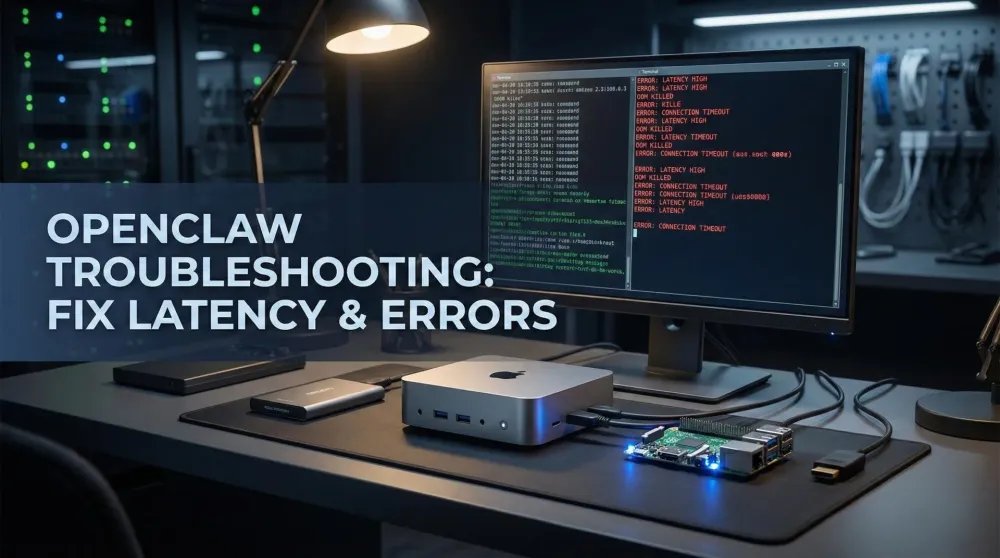
OpenClaw troubleshooting: Fix latency, memory errors, and connection drops
Is your agent ghosting you? From 'Thinking' lag to connection timeouts, here is how to fix the most common OpenClaw issues.
This post contains affiliate links. We may earn a commission if you make a purchase, at no extra cost to you. As an Amazon Associate, Dadnology earns from qualifying purchases.
1. The “thinking” lag: Why is my agent so slow?
🦞 This guide is part of our OpenClaw Master Hub – every guide to running your own AI agent at home, from first install to family automations.
The most common complaint in the OpenClaw community is latency. You send a message via Telegram, and the agent takes 45 seconds to reply. This is usually not a network issue—it’s a Hardware Bottleneck.
The solution: Check your “tokens per second” ($tok/s$)
If you are running a 70B parameter model on a 16GB Mac, the system is likely swapping memory to the SSD, which is incredibly slow.
- The Fix: Switch to a smaller, quantized model (like Llama 3.1 8B “4-bit”).
- The Upgrade: If you need the intelligence of a 70B model without the lag, you need more Unified Memory. Moving from the base M4 to the M4 Pro (48GB) can increase inference speed by up to $300%$.
2. Problem: “OOM” (out of memory) errors
If your OpenClaw logs show “Process killed” or “OOM,” your “Brain” is too big for its “Skull.”
- The Culprit: macOS uses about 4-6GB of RAM just to exist. On a 16GB Mac mini, that leaves only 10GB for your AI.
- The Fix: Use the
ollama listcommand to see what models are loaded. Unload unused models to free up space. - The Hardware Fix: Ensure you aren’t running a browser with 50 tabs open on your server. Keep the machine dedicated. If the problem persists, the M4 Pro is your only permanent solution — see our Mac mini for OpenClaw buying guide for which config actually has headroom.
3. Problem: The “ghosting” bot (connection drops)
Your bot works for an hour, then stops responding until you restart the OpenClaw service. This is often a Socket Timeout or Power Management issue.
The fix: Disable app nap & Wi-Fi sleep
macOS loves to save power, but for a 24/7 agent, “Sleep” is the enemy.
- Terminal Command: Run
sudo pmset -a disablesleep 1to prevent the system from sleeping. - Settings: Go to System Settings > Battery (or Energy Saver) and ensure “Wake for network access” is ON.
- The Stabilizer: Use an HDMI Dummy Plug. We’ve found that headless Macs sometimes “throttle” background processes when no display is detected.
4. Problem: “Permission denied” when accessing files
You ask your agent to read a file, and it says: “I don’t have permission to access the Desktop.”
- The Cause: macOS “Transparency, Consent, and Control” (TCC) security.
- The Fix: 1. Go to System Settings > Privacy & Security > Full Disk Access.
2. Click the
+icon and add your Terminal (or the OpenClaw binary if you are running it as a service). 3. Restart OpenClaw.
5. Problem: Thermal throttling (the silent killer)
Running a Large Language Model is the most intensive task your Mac will ever perform. If your Mac mini feels hot to the touch, it is likely slowing down the clock speed to protect itself.
- The Symptom: Fast performance for the first 5 minutes, followed by a massive slowdown.
- The Fix: Elevate your Mac mini. Using a stand like the Satechi Hub & Stand improves bottom-plate airflow, which is critical since the M4 Mac mini exhausts air through the base.
5.5 Problem: Agent produces wildly different outputs for the same prompt
You ask the same question twice and get two contradictory answers. This is a temperature and model state issue, not a fundamental reliability failure.
- The Cause: LLMs are probabilistic by design. A high “temperature” setting (1.0+) maximizes creative variance but makes responses inconsistent. For a research or analysis agent that needs predictable outputs, this is the wrong default.
- The Fix: In your Ollama model configuration (or the OpenClaw brain settings), set
temperature: 0.3for factual/analytical tasks andtemperature: 0.7for writing/creative tasks. At 0.3, the model still generates natural prose but stays much closer to the highest-probability correct answer. - The System Prompt Fix: Add explicit output format instructions to your agent’s system prompt: “Always respond in the same format: first your conclusion, then your reasoning, then your sources. Do not deviate from this structure.” Structured outputs dramatically reduce the variance dads notice as “inconsistency.”
- When to worry: If the agent gives factually opposite answers to the same question even at temperature 0.3, the underlying model doesn’t have reliable knowledge on that topic. Switch to a larger model or supplement with a verified external source.
6. Problem: Slow model loading on every session
If OpenClaw takes 60+ seconds to respond to the first message after a restart, the model is loading cold from disk on every boot. That’s an Ollama configuration issue, not a hardware one.
- The Cause: By default, Ollama unloads models from RAM after 5 minutes of inactivity to free memory. On a server that restarts nightly, this means a cold load every morning.
- The Fix: Set
OLLAMA_KEEP_ALIVE=-1in your Ollama environment variables. This keeps your primary model resident in memory indefinitely. On 24GB+ RAM, the cost is worth the instant-response benefit. - The Storage Fix: If model loading from the internal SSD still feels slow (>30 seconds for a 7B model), move your Ollama model library to a dedicated fast SSD. In your terminal:
export OLLAMA_MODELS=/Volumes/YourSSD/ollama-models. An NVMe SSD reduces 7B load times from ~45s to under 10s on the same hardware.
7. Problem: Agent keeps repeating the same action
Your bot successfully executes a task — then does it again. And again. This is a runaway loop caused by missing termination conditions.
- The Cause: OpenClaw’s task loop runs until it decides the goal is “complete.” If the completion condition is vague (“monitor prices”) without a clear stop signal, the agent loops.
- The Fix: Always define explicit completion conditions in your prompts: “Check prices once, report the results, then stop.” For scheduled recurring tasks, trigger via cron rather than leaving the agent in a perpetual loop — cleaner and auditable.
- The Safety Net: Enable the
max_iterationslimit in your OpenClaw config (usuallyagent.max_loops = 10). This is the equivalent of a circuit breaker — it kills a runaway agent before it causes damage.
8. Pre-flight checklist: Before you call it a bug
Run through this before posting in the OpenClaw Discord or assuming something is broken:
- Memory: Run
ollama ps— is your model loaded? Is it swapping? (htopwill show swap usage spiking) - Permissions: Did you grant Full Disk Access to Terminal and the OpenClaw binary?
- Sleep: Is
sudo pmset -a disablesleep 1active? Check withpmset -g | grep sleep - HDMI plug: Is it seated correctly? macOS sometimes re-detects on USB power cycle.
- Ethernet: Is the agent on wired, not Wi-Fi? Check with
networksetup -getinfo Ethernet - Model size: Does your model fit in RAM without swapping? Rule: model size in GB × 1.2 ≤ available RAM
- Ollama version: Run
ollama --version. If it’s more than 3 months old, update.
If all boxes are checked and the issue persists, it’s probably a genuine bug — now you have the diagnostics to report it properly.
8.5 Monitoring your agent’s health: Setting up automated alerts
A production-grade agent should alert you when something is wrong — not have you discover it during the next session.
The Monitoring Stack We Use:
CPU and RAM via watch: Add a cron job that runs every 5 minutes and writes system stats to a log file: */5 * * * * /usr/bin/top -bn 1 | head -20 >> ~/logs/system-health.log. Configure OpenClaw to read this log daily and send you a Telegram summary of any sessions where memory pressure exceeded 80%.
Ollama health check: curl -s http://localhost:11434/api/tags | python3 -m json.tool > /dev/null && echo "OK" || echo "FAIL". Run this in a cron job every 15 minutes. If it fails three times consecutively, OpenClaw (if running) should send an alert; if OpenClaw is the thing that’s down, you need a separate healthcheck script that sends via a different channel (e.g., a small Python script using requests to ping your Telegram bot directly).
Disk space warning: Ollama model weights are large (7B models: 4–5GB, 70B Q4_K_M: ~40GB). A cron job monitoring /usr/local/share/ollama and alerting when disk usage exceeds 80% prevents the silent crash where a model fails to load because disk is full.
The one-command health report: Set up a shortcut (a Telegram command like /health) that triggers OpenClaw to run all checks and reply with a structured status: RAM available, active model, current token/sec rate from the last inference session, disk usage, and uptime. Takes 20 minutes to configure and saves hours of reactive debugging. The equivalent of a car’s dashboard — you glance at it occasionally instead of waiting to hear a warning light.
9. Comparison: Hardware fixes vs. Software fixes
When your agent hits a performance wall, you have two choices: apply a quick software “band-aid” or invest in a permanent hardware cure. Use the table below to decide which path is right for your current setup:
| Issue | Quick Software Fix | Permanent Hardware Fix |
|---|---|---|
| High Latency | Use smaller 8B models (e.g., Llama 3.1 8B) | Upgrade to <AffiliateLink productIndex={0}>M4 Pro Unified RAM</AffiliateLink> |
| Slow Loading | Reduce model quantization (4-bit) | Move library to <AffiliateLink productIndex={3}>Fast NVMe SSD Storage</AffiliateLink> |
| Laggy Remote | Lower the VNC/Screen Sharing resolution | Install an <AffiliateLink productIndex={2}>HDMI Dummy Plug 4K</AffiliateLink> |
| Heat Issues | Limit 'max_tokens' per request | Add an <AffiliateLink productIndex={1}>Active Cooling Hub</AffiliateLink> |
9.5 The 30-day stability benchmark
How do you know your setup is actually stable? We use a simple benchmark: 30 consecutive days without a manual restart or intervention. That’s the bar for a production-grade agent, not a dev toy.
In practice, most setups reach this after fixing three or four of the issues in this guide. The typical failure pattern for a new install: days 1–3 go smoothly, day 4 hits an OOM crash (usually because you’ve been running more skills than you initially planned), day 5–7 you fine-tune the model size and memory settings, and from day 8 onwards the system runs cleanly. The 30-day mark is worth celebrating — it means your configuration is genuinely dialed in, not just lucky.
Track it simply: keep a text file with the date of each restart and the reason. After a month, that log tells you whether you’ve solved the root cause or just been fortunate. A log with five entries in 30 days all saying “OOM” means you’ve solved nothing; you need more RAM. A log with zero entries means you’ve built something reliable.
10. Conclusion: Stability is success
An AI agent is only useful if it’s reliable. Most OpenClaw issues aren’t bugs in the code; they are mismatches between the software’s ambition and the hardware’s reality. Once your setup is stable, our coding automation guide covers what to actually build with it. By optimizing your energy settings, granting the correct permissions, and ensuring your Mac can “breathe” with a dedicated stand, you move from an experimental toy to a production-grade digital employee.
Pros
- Most latency and OOM issues have clear, low-cost software fixes
- macOS permission model is consistent — once you know the TCC fix, it works everywhere
- The pre-flight checklist catches 80% of issues before any hardware spend
- OLLAMA_KEEP_ALIVE setting eliminates cold-load lag with zero cost
Cons
- High-latency issues from RAM shortage genuinely require hardware upgrade — no software patch
- Thermal throttling is a real ceiling on sustained 24/7 workloads in confined spaces
- Runaway loop bugs require discipline in prompt design to prevent — no magic setting
Don’t settle for a laggy agent. Most OpenClaw issues can be solved with three things: Correct macOS permission settings, a stable ‘Headless’ environment using a dummy plug, and enough RAM to avoid SSD swapping.
📌 FAQ – Common questions
Why does my agent repeat itself?
Does OpenClaw work better on Ethernet?
Should I leave my monitor on?
How do I keep my model in RAM between sessions?
My agent is looping — doing the same task over and over. How do I stop it?
How do I know if my Mac mini is thermal throttling?
Keep this in your inbox
One email a week: what we actually watched, built and reviewed — the stuff worth a dad's time. No hype, no daily spam.
Dadnology Weekly
One email a week: the LEGO, gaming and movie news worth a dad's time — plus what we actually reviewed. No hype, no daily spam.
Disclaimer: This review and its visuals were created with the help of AI. Some links may be affiliate links – we may earn a commission if you make a purchase, at no extra cost to you.
Current deals in Tech & gadgets
Verified live discounts tracked on Amazon

Tech & gadgets · Tested by Dadnology
Apple AirPods Pro (3rd generation)
5/5“The best noise-cancelling earbuds for Apple families”Read our review
Tech & gadgets · Tested by Dadnology
Samsung T7 Shield 2TB
5/5“Small, fast, and genuinely hard to break”Read our review
You might also like

Hermes Agent's Quicksilver release: What's new in v0.19.0
Hermes Agent shipped v0.19.0 (the Quicksilver Release) on July 20 — an 80% faster cold start, Bitwarden and 1Password integration, and a real security hardening pass.

Hermes Agent hardware requirements: The 24GB sweet spot explained
The real Hermes Agent hardware requirements for running Qwen 3.6 27B locally: why agents need more memory than chatbots, the 24GB sweet spot, and what to buy.

OpenClaw 2.0 is out: Team features, and a real security warning
OpenClaw 2.0 just shipped with team collaboration and a new browser UI - but sandboxing is disabled by default, and that matters if you're running it at home.