
Reacher – Season 4: The Season Without a Single Weak Episode
Season 4 adapts Lee Child's Gone Tomorrow and delivers the show's most even run yet — no dip episode, a tight subway-to-Philadelphia mystery, and Alan Ritchson turning in his most complete performance as Reacher so far.

Photo Credit: Courtesy of Prime. © Amazon Content Services LLC.
This post contains affiliate links. We may earn a commission if you make a purchase, at no extra cost to you. As an Amazon Associate, Dadnology earns from qualifying purchases.
This review is part of the Lee Child – Jack Reacher Book Series hub on Dadnology, where we cover every novel and screen adaptation in order.
📺 Introduction
👊 This review is part of our Jack Reacher Master Hub – every Reacher book, film and season in one place, in the right order.
We finished the season 4 finale today, and the honest first reaction was the same one we’ve had after every strong Reacher run: relief that the show still knows exactly what it is. Gone Tomorrow hands Reacher a city where he’s a stranger and a problem nobody asked him to solve, and the season rides that simple shape through eight episodes without a single hour that feels like a placeholder. That’s the thing worth saying up front, because it’s rare: there is no episode here we’d tell you to skip through.
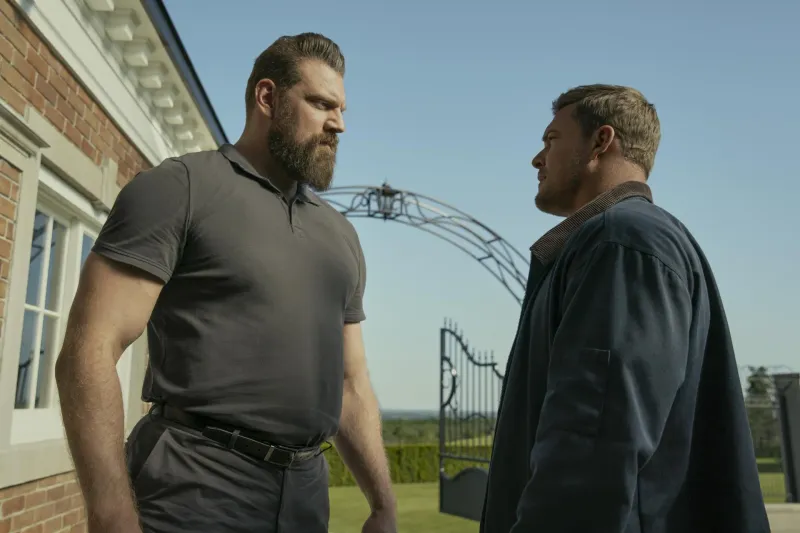
Alan Ritchson remains, four seasons in, the correct answer to a casting question a lot of people doubted when it was first announced. He is exactly the Reacher we pictured reading the books — not a performance chasing the character, but the character arriving fully formed.
AdGone Tomorrow (Paperback) (opens in a new tab)
Lee Child's 13th Reacher novel and the book season 4 is built on. Still the best subway opening in the series.

🧩 Story & Structure – A Stranger’s Problem, Handled Like Math
The setup is pure Gone Tomorrow: Reacher clocks a woman on a late-night train exhibiting every behavioral marker of a suicide bomber, intervenes, and watches the situation collapse into something far stranger than it first appeared. From there the season relocates the novel’s New York setting to Philadelphia and lets the mystery widen in careful, earned steps:
- A clean hook — no unit history, no old grudge, just a stranger reading a room correctly and getting punished for it.
- Escalation by consequence — every new piece of information costs Reacher something, never arrives free.
- A widening conspiracy that never loses its throughline back to that first subway car.
What makes this season’s structure work better than a couple of the show’s earlier ones is that nobody around Reacher is protecting a secret out of pure plot convenience. People lie because lying serves them, and the season lets you see why before it lets Reacher catch them.
The subway opener does a lot of quiet work for the rest of the season. It establishes, in one scene with almost no dialogue, exactly how Reacher processes a room — and every escalation after it plays by the same rule: the show trusts you to have learned that grammar in episode one, so it never has to re-explain it in episode six.
👤 Jack Reacher – The Book Version, Fully Arrived
Four seasons in, it still needs saying: Alan Ritchson is the perfect Reacher. Not “a good take” — the one Lee Child’s readers pictured the whole time. He plays the character as a moral instrument that runs on observation before force: reading a stranger’s shoulders on a train, clocking exits before he clocks faces, doing arithmetic on a threat before the threat has finished forming. When violence comes, it comes because the math already ran and there was no other answer.
The dry humor is intact and never oversold. The courtesy toward decent people is intact. The complete absence of patience for anyone who preys on the weak is intact. It is, four seasons running, the same character — which sounds like a low bar until you remember how rarely long-running adaptations manage it.
If you want the other end of Ritchson’s range — loud, dumb, entirely goofy — our Playdate (2025) review covers that side of him, and Alan Ritchson, action hero explained traces the whole run from wrestler to this.
🧯 Action – Clean, Fast, and Never the Point by Itself
Season 4 keeps the show’s house style: fights read clearly, geography stays coherent, and every exchange ends because someone made a decision, not because the scene ran out of runtime.

- Preemption over spectacle — Reacher ends threats before they become fair fights, because fair fights aren’t the point.
- Environment as a weapon — stairwells, counters, and traffic get used the way a person who actually thinks about violence would use them.
- Restraint where it counts — the show still knows the difference between a fight that needs to be brutal and one that just needs to be over.
Reacher – Season 4 (Watch on Prime Video) (opens in a new tab)
Stream all eight episodes of the show's most consistent season.
🎬 Pacing – Eight Episodes, No Sag
This is where season 4 genuinely separates itself. Every prior season has had at least one stretch where the show visibly treads water — a subplot that runs a beat too long, a reveal you can see coming three scenes early. Season 4 doesn’t have that stretch. Every episode either advances the mystery, deepens a relationship that actually matters to the plot, or raises the cost of what Reacher’s already done. Watched over consecutive nights, it never once felt like the season was buying time until the next real beat.
That consistency is the season’s real achievement, and it’s a harder thing to pull off than a single great episode. A show can coast on one strong hour. Eight strong hours in a row means the writers’ room had a plan and stuck to it.
🎭 Supporting Cast – Strangers Who Feel Like People
Because Reacher knows nobody in this city, the season lives or dies on how quickly the people around him feel real, and it clears that bar. The allies he picks up have their own reasons for staying in a fight that isn’t theirs, and the antagonists operate with a logic you can track even when you don’t agree with it. Nobody exists purely to hand Reacher a clue and disappear.
If you’re catching up on where the show left off before this, our Reacher season 3 review covers the previous run, and Amazon’s spin-off Neagley premiered the same day as this season’s finale — worth queuing up next if season 4 leaves you wanting more of this world.
🏆 Where Season 4 Sits in the Show So Far
Four seasons in, Reacher has settled into a rhythm most streaming action shows never find: it knows exactly what it’s for, and it stops chasing prestige-TV respectability it was never going to get anyway. That’s a compliment. The show doesn’t need moral ambiguity about its protagonist or a novelistic sprawl to be good — it needs to keep its promises episode to episode, and season 4 keeps every one of them.
Ranked against the rest of the series, this is the tightest overall watch of the four. Season 3 still has the single best stretch of episodes the show has produced — that undercover run doesn’t loosen its grip for a second — but season 4 is the one where there’s no episode to brace for. If season 3 is the show’s best sprint, season 4 is its most complete lap.
👨👩👧 A Dad/Fan Perspective – The Easy Recommendation
This is the clearest “just watch it” we’ve given the show since Season 1. No homework, no unit history to remember, no prior-season baggage — a stranger walks into a city and does what Reacher does. That makes it the season we’d hand someone who has never watched the show and wants to know what the fuss is about.
It’s still a 16+ watch — the violence stays fast and grounded, never gratuitous but never soft either — so this is a post-bedtime binge, not a family movie night. What it earns in exchange is eight episodes you can trust: start one, and there’s no dead stretch waiting to test your patience on a school night.
🧱 Where It Stumbles (A Little)
- The wider conspiracy resolves slightly cleaner than the messy, half-answered ending the novel actually goes for — a small trade of ambiguity for closure.
- One recurring antagonist gets less screen time than their role in the plot would suggest they deserve.
Minor notes on a season that otherwise doesn’t put a foot wrong.
Pros
- Every episode earns its place — genuinely no weak hour across all eight
- Alan Ritchson's most complete, book-true performance yet
- Standalone case means zero prior-season homework required
- Clean, legible action that never loses the story underneath it
- A widening mystery that pays off the way it's built, step by step
Cons
- The conspiracy wraps a touch neater than the novel's messier ending
- One key antagonist is underused relative to their importance to the plot
🔩 Conclusion
Reacher Season 4 is the show at its most consistent: eight episodes built around a stranger’s problem in a stranger’s city, and not one of them wastes your time. Alan Ritchson keeps closing the gap between the page and the screen, the action stays legible and purposeful, and Gone Tomorrow gives the whole run a clean, propulsive shape. It sits right alongside Season 3 at the top of the series so far — a clear, easy recommendation.
📺 Catching up before season 5: stream all four seasons of Reacher — plus everything else — on Prime Video, free for 30 days.
📌 FAQ – Frequently Asked Questions
What book is Reacher season 4 based on?
Is season 4 better than season 3?
How violent is Reacher season 4?
Do I need to watch seasons 1 to 3 before season 4?
Should I read Gone Tomorrow before or after watching season 4?
Keep this in your inbox
One email a week: what we actually watched, built and reviewed — the stuff worth a dad's time. No hype, no daily spam.
Dadnology Weekly
One email a week: the LEGO, gaming and movie news worth a dad's time — plus what we actually reviewed. No hype, no daily spam.
Disclaimer: This review and its visuals were created with the help of AI. Some links may be affiliate links – we may earn a commission if you make a purchase, at no extra cost to you.
You might also like
Reacher – Season 3: Persuader Brought to Life With Relentless Clarity
Season 3 adapts *Persuader* with ruthless focus and constant momentum. It’s the best the series has been: tighter than Season 2, more complete than Season 1, and anchored by Alan Ritchson’s most precise Reacher yet. The undercover frame keeps tension high, fights are clean and decisive, and the finale lands hard. We loved the novel—and the season is a tick better on screen. Rating: 4.5/5.

Reacher – Season 1: A Faithful, Heavy-Hitting Start That Finally Feels Like Jack
If the films never matched your mental image of Jack Reacher, Season 1 will. Alan Ritchson looks and moves like the book’s drifter—measured, intimidating, and wry—and the adaptation hits beloved details like the toothbrush and the buy-fresh-clothes habit. Fights are bone-crunching but coherent, the mystery tracks cleanly, and the Southern setting feels lived in. As a screen version of *Killing Floor*, it’s both respectful and brisk. We had a blast watching together. Rating: 4/5.
Reacher Season 4 Is Here, and the Premiere Absolutely Delivers
Reacher season 4 landed with three episodes at once. It adapts Gone Tomorrow, moves the story to Philadelphia, and the opening hour is a statement.