
The Mandalorian Season 3 review – Beautiful, but diffuse
Season 3 gives us Mandalore in full, Bo-Katan completed, and Moff Gideon in Beskar. It also gives us a season where Din and Grogu feel like supporting characters in their own show. 3.5/5.
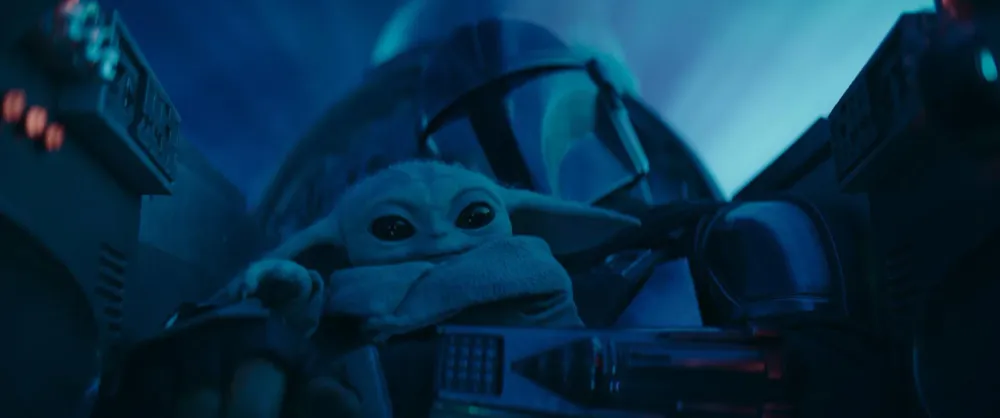
Images courtesy of Lucasfilm / The Walt Disney Company.
This post contains affiliate links. We may earn a commission if you make a purchase, at no extra cost to you. As an Amazon Associate, Dadnology earns from qualifying purchases.
⭐ This review is part of the The Mandalorian Series – watch every season of the perfect dad story in space.
There is a version of The Mandalorian Season 3 that could have been a 9. The raw materials are there: Mandalore itself is the most visually ambitious world the show has ever built. Bo-Katan Kryze’s arc, which began in The Clone Wars and developed through Rebels and Season 2, reaches a completion here that rewards seventeen years of storytelling. Giancarlo Esposito’s Moff Gideon, back in a suit of Beskar armor and operating with a confidence that suggests he has been planning this since the Season 1 finale, remains one of the best villains in Star Wars television.
The problem is simpler and harder to fix than any of that. Season 3 loses track of its protagonists. Din Djarin and Grogu — the two characters around whom every prior episode was organized — become ensemble members in what is nominally their show. Some episodes go stretches of twenty minutes without them. The emotional engine that made Seasons 1 and 2 work — the bond between a man who does not know how to love something and a creature that does not know how to exist without being loved — is still present in Season 3, but it is no longer the fuel. It is one feature among several.
That is a significant loss. Seven out of ten still represents good television. It is not the Mandalorian at its best.
The problem with getting the gang back together too soon
Seasons 1 and 2 built their emotional core on two things: Din’s isolation and Grogu’s presence. The loneliness was the point. A warrior who belonged to a group that demanded isolation, carrying an attachment that violated every rule of that belonging, moving through a galaxy that felt indifferent to him. The found-family theme that the show cultivates works precisely because Din does not have a family by default. He assembles one reluctantly, necessity by necessity.
Season 3 begins with that assembly largely complete. The reunion with Grogu — which happened off-screen in The Book of Boba Fett, in two episodes that function as a stealth Season 2.5 — means the show’s central dynamic is already resolved before the season opens. Grogu chose to return to Din. The goodbye of Chapter 16 was real, and then it was reversed, and while that reversal was earned in the Boba Fett context, it robs Season 3 of the emotional question Season 2 left it. There is no wound to press here. There is only forward movement.
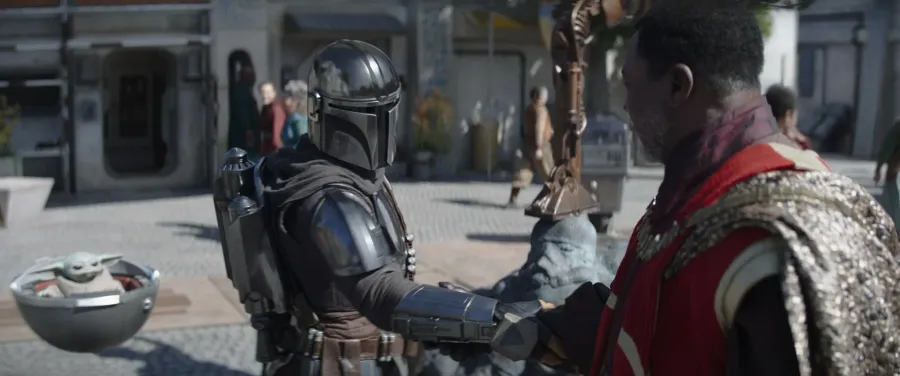
This creative decision — made, it seems, because audiences responded so strongly to the goodbye that the writers wanted to restore what was lost as quickly as possible — is the root cause of everything that diffuses Season 3. The show starts ahead of where the story’s emotional logic placed it, and it spends the whole season trying to find a new source of tension that matches the old one.
It does not entirely succeed. But it tries very hard, and the trying produces some genuinely good television.
Mandalore: The world the season gets right
Whatever else Season 3 struggles with, Mandalore itself is a revelation. The planet that Moff Gideon bombed into glass, that Bo-Katan has been trying to reclaim for seasons, that Din must visit in order to atone for removing his helmet — it is one of the most visually striking environments Star Wars has produced in any medium.
The art direction is extraordinary. A shattered surface over subterranean living waters, ancient ruins partially preserved under a dead sky, Mandalorian architecture that suggests a civilization organized entirely around war as a form of culture. The color palette is cold and beautiful and somewhat oppressive in exactly the right ways — this is a world that was killed, and it looks like it.
The episodes that spend the most time on Mandalore are the season’s strongest. Din’s descent into the living waters to prove the planet is not entirely dead is a sequence that earns its runtime. The moment the waters move — the moment the planet proves it is not as gone as Gideon wanted — lands with the weight of everything the animated series built into Mandalorian mythology since Rebels.
For Vision Pro viewing: the Mandalore surface in spatial display is genuinely the best single environment the show has rendered in three seasons. The scale reads correctly in a way that a flat screen cannot fully convey. If you have the hardware, this is the argument for it this season.
Bo-Katan’s completed arc
The most satisfying character work in Season 3 belongs to Bo-Katan, and it is a testament to Katee Sackhoff’s performance that the arc works as well as it does given how much the season is juggling.
Bo-Katan has been carrying the weight of Mandalore for a long time. She watched it fall. She tried to hold the Darksaber and found it resistant. She asked Din for help and received something she did not know how to accept: the blade, won by someone who did not want it and did not understand it. Season 3 completes the circuit. She earns the Darksaber properly, not through Din handing it over but through the logic of what actually happens in the finale, and she accepts the responsibility of Mandalore not as a prize she was always owed but as a burden she has finally decided she is willing to carry.
It is a good arc. The problem is that it is not Din’s arc. It is Bo-Katan’s season wearing Din Djarin’s title card.
The season-by-season comparison
| Season 1 | Season 2 | Season 3 | |
|---|---|---|---|
| Emotional core | Din's first choice to protect Grogu | Din's goodbye and what it costs him | Din as ensemble member; emotional weight dispersed |
| Din screen time | Every scene, every episode | Every scene, every episode | Shared with ensemble — some episodes feel Grogu-lite |
| Grogu role | The mystery that changes everything | The one being fought toward and surrendered | Apprentice-in-training; less narrative centrality |
| Villain quality | Gideon as threat, revealed at the end | Gideon as off-screen presence, paying off in finale | Gideon in Beskar, present and dangerous — but defeated too cleanly |
| Overall strength | 9 — foundational, restrained, perfect | 9 — expands without losing the core | 7 — good television, diffuse Mandalorian |
The comparison is instructive because it shows how the drop in Season 3 is not about quality of execution but about narrative focus. Every individual episode of Season 3 is well-made. The season just stops telling a focused story about a man and his child and starts telling a broader story about a people reclaiming their homeworld. That is a valid story. It is just not the story the show built its entire audience on.
Moff Gideon returns — and the defeat that should have been bigger
Giancarlo Esposito’s Moff Gideon is back in Season 3 wearing a suit of Beskar armor that the show takes some care to establish as a significant threat upgrade. He has been building something in the Imperial remnant. He has resources and a plan and the specific quality that Esposito brings to every villain he plays: absolute calm. The man never raises his voice because he never needs to.
The problem with Gideon in Season 3 is not the performance. It is the defeat. After three seasons of build, the confrontation in the finale feels underwritten — a resolution that the show reaches because the plot requires it rather than because the characters earned it through the specific shape of their choices. Compare it to the Season 1 finale, where every element of the fight was set up by the season’s episodic groundwork. Season 3’s finale is competent. It should have been inevitable.
There is a specific quality to great villain defeats — they feel like the ending the story was always moving toward. The Gideon finale feels like the ending that was available given the season’s available runtime. Those are different things.
Why the season works as a finale (even if it stumbles)
Here is what Season 3 gets right, stated plainly, because the critical case against it is easy to make and should not obscure the things that land.
Din Djarin formally adopts Grogu as his foundling son. The Mandalorian creed has a framework for this: a foundling who chooses their protector and is chosen in return. By the season’s end, “this is the way” means something different for Din than it did in Season 1 — not a code that isolates him from attachment, but a code that has found a way to accommodate the attachment that rewrote him. That is character development. It is not as dramatically charged as Season 2’s goodbye, but it is the appropriate conclusion to the arc the show started.
Mandalore is reclaimed. Not easily, and not without cost, and with the understanding that reclamation is not restoration — the world is damaged in ways that seasons of television will not undo. But it exists again as a place where Mandalorians can live. That matters.
Bo-Katan rules. Din and Grogu are together, formally, as they were always going to be. Moff Gideon is gone.
The season as a finale is messier than it should be. But it closes what Season 2 opened — and that is not nothing.
The dad angle: After the goodbye
There is something true in what Season 3 is trying to dramatize, even if it does not dramatize it with the precision of the earlier seasons.
Din got Grogu back. And now the question is what kind of father he actually wants to be, now that the emergency is over and the two of them have time to figure out what normal looks like. That is a real question, and it is a harder question than the goodbye was, because the goodbye had an obvious emotional shape — loss — and “what do you do with the child you fought to keep” does not. It is the messy middle of parenthood rather than the crisis point, and messy middles are harder to dramatize compellingly.
The season is less successful at dramatizing this than it is at everything else it is doing. But the instinct to ask the question is right, and it puts Season 3 in the minority of prestige television that understands fatherhood as an ongoing negotiation rather than a singular defining moment.
Pros
- Mandalore is the most visually stunning environment the show has built — genuinely extraordinary art direction
- Bo-Katan's arc reaches a conclusion that honors seventeen years of animated storytelling
- Moff Gideon in Beskar armor is the villain upgrade the show earned
- Din formally adopting Grogu is the right ending for the arc that started in Chapter 1
- Grogu continues to develop — his Force use is more confident, his identity is being established properly
Cons
- Din and Grogu are ensemble members in their own show — some episodes give them less space than supporting characters
- The emotional engine from Seasons 1 and 2 has been resolved before the season starts, leaving the show searching for new tension
- Moff Gideon's defeat after three seasons of build should feel more inevitable than it does
- The Book of Boba Fett prerequisite is a structural problem — key character beats happened off-season
- The season is better as a Mandalore story than as a Mandalorian story
More bricks: Season 3 flies the rebuilt N-1 — see our LEGO UCS Mandalorian N-1 (75442) review and the LEGO Mandalorian & Grogu Anzellan Starship (75445) review.
Conclusion: The world expands. The story diffuses.
The Mandalorian Season 3 is good television that is occasionally great television doing its best work when it is not being the show it was always advertised as. The world it builds — Mandalore as a scarred and beautiful ruin, the creed as a living thing that can adapt without betraying itself, the found family that Din assembled against his will — is richer for existing. The season closes arcs that deserved closure.
But it misplaces Din Djarin and Grogu in a way that the first two seasons never did, and that misplacement is felt. A 7 is honest: this is worth watching, it delivers on several of its promises, and it gives the series a better ending than it might have had. It just does not reach the heights of what preceded it.
This is the way — but the path this season took was bumpier than it needed to be.
📺 Movie night sorted: thousands of films and shows are streaming on Prime Video — free for 30 days. Worth a look before you buy the disc.
Buy now(Ad)
Is Mandalorian Season 3 worth watching?
Does Season 3 wrap up the story?
Should I watch Book of Boba Fett before Season 3?
Is Season 3 the last Mandalorian season?
How does Season 3 end?
Keep this in your inbox
One email a week: what we actually watched, built and reviewed — the stuff worth a dad's time. No hype, no daily spam.
Dadnology Weekly
One email a week: the LEGO, gaming and movie news worth a dad's time — plus what we actually reviewed. No hype, no daily spam.
Disclaimer: This review and its visuals were created with the help of AI. Some links may be affiliate links – we may earn a commission if you make a purchase, at no extra cost to you.
Current deals in Movies & TV
Verified live discounts tracked on Amazon
![The Legend of Korra — The Complete Series [Blu-ray]](https://m.media-amazon.com/images/I/51+1TXyb7aL._SL500_.jpg)
Movies & TV · Tested by Dadnology
The Legend of Korra — The Complete Series [Blu-ray]
4.5/5“A new Avatar, a modern city, a masked revolution”Read our review
Movies & TV · Tested by Dadnology
Zack Snyder's Justice League (4K Ultra HD)
4/5“Four hours. One vision. This is the film.”Read our review
Movies & TV · Tested by Dadnology
Space Jam (4K Ultra HD + Digital)
4/5“It's gonna be a whole new ball game”Read our reviewYou might also like
The Mandalorian Season 1 review: A perfect opening
Eight episodes, one transformation. Season 1 of The Mandalorian is the rare season of television that earns a 4.5 not through spectacle, but through restraint — a silent man in a helmet, a creature who should not be alive, and a bond that forms without a single line of dialogue to explain it. This is the way. Rating: 4.5/5.
The Mandalorian Season 2 review – The goodbye
Season 2 matches Season 1 beat for beat and then raises the stakes with characters who carry decades of animated history into live-action. The mission gives the season direction. The goodbye gives it soul. And Pedro Pascal, still in the helmet, still saying almost nothing, manages to break your heart completely. Rating: 4.5/5.
The Mandalorian – A perfect dad story in space
The Mandalorian is Star Wars at its most honest about what it is really about. Not chosen ones or epic destinies. A man and a small creature who chose each other and refused to stop. Season 1 and 2 are exceptional. Season 3 is good. The whole is irreplaceable. 4/5.