
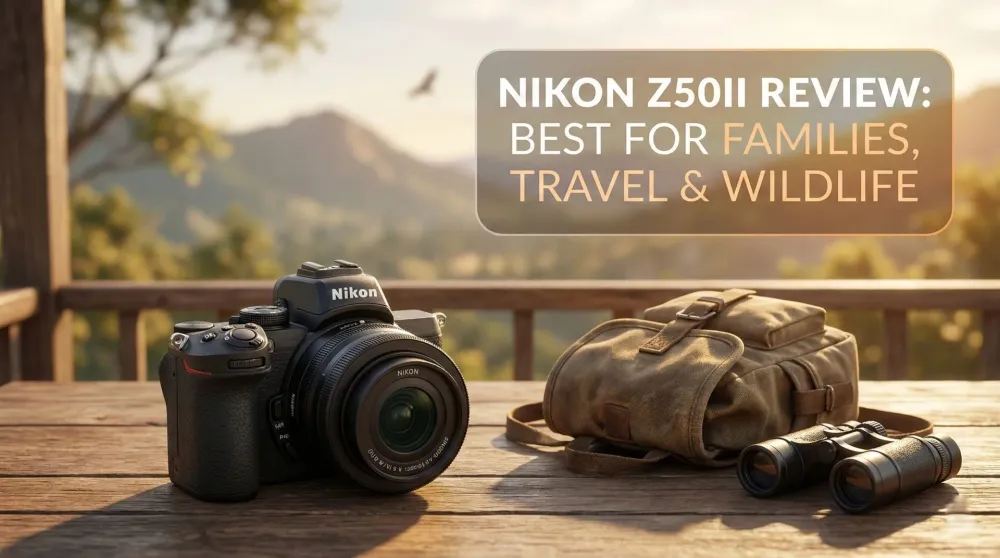
Nikon Z50II review – The best camera for families, travel & wildlife (2025)
The Nikon Z50II is the ideal camera for photographers who want more than smartphone snapshots. Compact, fast, and perfect for families, travel, wildlife, and everyday creativity.
This post contains affiliate links. We may earn a commission if you make a purchase, at no extra cost to you. As an Amazon Associate, Dadnology earns from qualifying purchases.
🛠️ This review is part of the Best Tech for Dads – explore the gear that actually survives family life.
I’ve been a Nikon shooter since 2009. The legendary D90 taught me photography, and I moved up to the D750 from there — DSLRs that felt like honest tools. In February 2025 I made the switch to the Nikon Z50II, and a few months in I did something I didn’t expect: I sold the D500 and my 200-500mm. That combination served me for years, since December 2020. I loved it. And the Z50II outperformed it in the one area where the D500 was supposed to be untouchable — tracking birds in flight. If that sentence means anything to you, you already know this is a serious camera. If it doesn’t, here’s the short version: I’ve been shooting with the Z50II for nine months now, through family sessions, wildlife mornings, travel trips, and hundreds of birthday-party moments, and I still reach for it every time.
This review is not a spec dump. Plenty of those exist. This is what it’s actually like to use the Z50II as a dad who photographs his kids, his backyard birds, and every trip in between — and what nine months of real-world use has taught me about where this camera earns its price and where it doesn’t.
Z50 vs Z50II — The upgrade that actually matters
The original Z50 was already a beloved camera. Compact, sharp, and a genuine entry point into the Z system. But the Z50II isn’t a minor refresh — the EXPEED 7 processor is the same chip Nikon put in the Z8 and Z9. That’s not a marketing slide; you feel it the moment the camera locks onto a subject.
| Feature | Z50 (Original) | Z50II |
|---|---|---|
| Processor | EXPEED 6 | EXPEED 7 (flagship chip) |
| Subject detection | Basic face/eye | Eye, animal, bird detection |
| AF in low light | Drops off noticeably | Reliable into dim interiors |
| Continuous buffer | Limited burst depth | Improved, handles most situations |
| Battery life | ~280 shots CIPA | ~350 shots CIPA (real-world better) |
| Video | 4K with crop | 4K UHD no crop, 4K60 with crop |
| Price (body) | ~$650 | ~$900 |
The two-hundred dollar premium buys you autofocus that doesn’t drop a beat, bird detection that changes what wildlife shooting feels like at this budget, and a processor that keeps up with everything you can throw at it. If you’re upgrading from the Z50, it’s a clear yes. If you’re coming from a DSLR, it will likely change how you think about your gear.
Autofocus in the real world: Three scenarios that tell the story
Spec sheets always say “fast autofocus.” Here’s what that actually looked like in nine months of use.
Birthday party, indoors, 4-year-old at full speed. The lights are mixed, the kid won’t stop moving, and you’ve got about two seconds before the cake is in her face and the moment is gone. The Z50II locked her eyes, held through her spin toward the table, and fired a burst of clean, sharp frames. Not occasionally. Consistently, shoot after shoot, for the entire hour. With the 24mm f/1.7 at f/2, the keeper rate was genuinely startling — this is not something I’d achieved with the original Z50.
Birding session, early morning light. A kingfisher on a branch about twelve meters out, then it dives and returns. The Z50II’s bird detection found it on the branch, held through the dive, and reacquired on return. Not every shot — birds are birds — but the tracking was sticky and forgiving in a way that took real pressure off the technique. Combine the bird detection with the DX crop factor giving me effective reach well beyond what the focal length suggests, and this is a legitimate wildlife camera at a fraction of the price of a Z8 kit.
Travel street shooting, moving crowds. The eye detection handles strangers walking toward you through a busy market with the same reliability as posed portraits. Subject tracking in complex scenes — multiple people crossing frame — stays predictably locked on the closest face or whichever you designated. It removes a layer of technical anxiety from shooting in chaotic environments, which is exactly what you want when you’re tired, jet-lagged, and trying to remember what city you’re in.
Wildlife & bird photography — The DX advantage is real
One of the most underrated strengths of the Z50II is its DX sensor with a 1.5× crop factor. That multiplier is free reach: a 300mm lens becomes an effective 450mm; a 400mm becomes 600mm. For a dad who wants wildlife capability without the weight and price of a telephoto setup, this is genuinely significant.
The bird detection autofocus compounds the advantage. Where the old D500 — a camera Nikon built specifically for wildlife — required precise AF point placement and fast reflexes, the Z50II asks you to point it in the general direction and trust it. That trust is earned: over nine months of morning sessions in the garden and field trips to nature reserves, the Z50II handled everything from small garden birds to larger raptors in a way that kept me reaching for it over bigger, heavier alternatives.
The Nikon Z 100-400mm VR S and the 400mm PF are the natural wildlife partners for this body. Both are optically superb, and the crop factor makes them feel even longer. For photographers who aren’t ready to spend that much on glass, the 18-140mm kit zoom delivers solid reach for distance shots at a fraction of the price — it’s not a wildlife specialist, but it handles garden birds at 140mm with more than enough quality for large prints.
Family photography — The camera you’ll actually use
For parents, the best camera is the one that gets to the shot before the moment ends. The Z50II handles family photography better than any camera I’ve used at this price — and the flip-down touchscreen is a bigger practical advantage than any spec on the sheet.
Get down to a four-year-old’s eye level without lying flat on the floor. Frame from hip height for natural, unstaged portraits. Hand the camera to someone who doesn’t shoot and let them use the touchscreen like a phone — the AF does the rest. This has become my standard approach: 24mm f/1.7, flip screen open, autofocus on eye detection, let the camera worry about the technical side while I worry about being present enough to catch the right expression. If I could only add one lens to a Z50II kit, it would be this one — not the zoom.
The Nikon color science deserves its own mention. Skin tones out of JPEG — particularly the Portrait picture control — are warm, accurate, and flattering in a way that makes post-processing feel optional rather than mandatory. This is not a given at any price. Sony and Fujifilm have their own house colors; Nikon’s portrait rendering has always felt natural to me, and the Z50II continues that tradition.
Indoors in low light — the inevitable birthday party with overhead LED strips and no time to set up — ISO 3200 with the 24mm f/1.7 at f/2 produces images I’m happy to print at A3. That’s not something I could say about every APS-C camera at this price.
Travel photography — The camera you’ll actually bring
There’s a version of a travel camera that lives in a bag and almost makes it out. The Z50II is not that camera. It’s compact enough to hang on a shoulder strap all day, light enough to forget it’s there, and powerful enough that you won’t regret having it when something happens.
With the 18-140mm DX zoom, it covers landscapes, architecture, street portraits, and the occasional wildlife encounter in a single lens. That kind of versatility — everything in one package, nothing to swap, nothing to lose — makes it the lens I leave on for trips where I know I won’t want to be thinking about glass choices. The image quality at 140mm holds up better than you’d expect from a zoom at this focal length spread.
After one year: What I’ve learned that reviews don’t tell you
Battery life is better in practice than on paper. The CIPA rating (~350 shots) undersells the real-world experience. With screen use moderated and image stabilization from lenses doing some of the heavy lifting, I regularly finish a half-day shooting session without reaching for a spare. Bring one anyway — you’ll use it eventually — but it’s not the anxiety it is with smaller mirrorless bodies.
The buffer is the camera’s honest limitation. For sustained burst shooting of fast wildlife, you’ll eventually see the write speed throttle your burst. For family photography and most travel work it’s a non-issue; you’re rarely shooting at maximum speed for more than two or three seconds. For serious birds-in-flight work with a telephoto zoom, you’ll notice it. It hasn’t stopped me from getting the shots I want, but it’s worth knowing before you commit.
No weather sealing — and it hasn’t mattered. I’ve shot in light rain and drizzle without a problem, and I’ve been careful enough not to push it further. For a camera at this price, the absence of sealing is a real spec-sheet gap; in day-to-day use over nine months of shooting, it hasn’t cost me a single shot. Use common sense in the field and it’s a non-issue the vast majority of the time.
The Z-mount grows with you. Starting with the Z50II means every lens you buy goes with you if you upgrade to a Z6III, Z8, or beyond. That’s not a hypothetical — I’ve already started building a small Z-mount collection knowing the glass outlasts the body. Buying into a system that doesn’t punish you for improving later is worth more than any single spec.
Video capabilities — More than enough for most dads
The Z50II is not a cinema camera, and it doesn’t pretend to be. What it is: a camera that shoots clean 4K video with reliable autofocus and Nikon color science, at a price where you’re not paying a video tax. For family clips, travel footage, and the occasional creative project, it delivers well above expectations. The autofocus stays locked during recording without hunting. The flip screen makes vlogging-style shooting natural. The 4K no-crop mode keeps full sensor width. For hybrid shooters, it’s a complete package.
Pros
- EXPEED 7 autofocus — the same processor as the Z8/Z9, and it shows in tracking performance
- Bird and animal detection that genuinely works, not just as a marketing bullet
- DX crop factor gives free telephoto reach — transformative for wildlife on a budget
- Nikon's color science: skin tones are naturally flattering, JPEGs are print-ready
- Compact and light enough to carry all day, powerful enough to justify it
- Full Z-mount ecosystem — every lens works, and your glass investment grows with you
Cons
- No weather sealing — manageable with common sense, but a real gap vs. some competitors
- Buffer throttles sustained burst shooting — relevant for wildlife specialists, not for family/travel
- Single card slot on DX body (no redundancy for critical shoots)
Conclusion: The best DX camera Nikon has ever made
A 5/5 needs defending, so here it is: this rating isn’t against every camera ever built. It’s against everything else you can buy for under $1500 with an APS-C sensor and a serious lens system behind it. In that context, the Z50II is without serious competition. The EXPEED 7 processor delivers autofocus that the original Z50 couldn’t dream of. The DX crop factor gives you reach that larger-sensor bodies can’t match at the same price. The Z-mount ecosystem means every dollar you spend on glass is an investment, not a sunk cost.
After nine months of birthday parties, early-morning bird sessions, and trips where I’ve carried it all day without wishing I’d brought something different, the Z50II hasn’t given me a reason to reach for anything else. The buffer has its ceiling. The weather sealing isn’t there. Those are real. But in the scenarios that define day-to-day shooting — moving kids, birds in trees, late-afternoon portraits — it delivers with a consistency that earns its rating.
If you’re ready to move beyond your smartphone or upgrade from an older DSLR, this is the camera. Not “a” camera. The camera — body or kit, and the 18-140mm if you want one lens to cover a holiday. (How it stacks up against Canon, Sony and Fujifilm rivals: our APS-C beginner guide. Where it sits in the Nikon lineup: the which-Nikon decision guide. And paired with the 180-600mm it’s half of our birding dream setup.)
📌 FAQ – Nikon Z50II
Is the Nikon Z50II good for beginners?
Is the Nikon Z50II good for wildlife and bird photography?
Is it worth upgrading from the original Z50?
Which lenses work best with the Nikon Z50II?
Does the Nikon Z50II shoot good video?
Keep this in your inbox
One email a week: what we actually watched, built and reviewed — the stuff worth a dad's time. No hype, no daily spam.
Dadnology Weekly
One email a week: the LEGO, gaming and movie news worth a dad's time — plus what we actually reviewed. No hype, no daily spam.
Disclaimer: This review and its visuals were created with the help of AI. Some links may be affiliate links – we may earn a commission if you make a purchase, at no extra cost to you.
Current deals in Cameras
Verified live discounts tracked on Amazon

Cameras · Tested by Dadnology
Nikon Z8 Body
5/5“The Endgame body. No more compromises.”Read our reviewPrice as of Oct 17, 09:11 PM UTC

Cameras · Tested by Dadnology
Nikon Z5 Body
5/5“The unbeatable on-ramp to full-frame mirrorless.”Read our reviewPrice as of Oct 17, 09:11 PM UTC

You might also like

Nikon Z50 review – The little DX body that proved Z-Mount could be fun
The original Nikon Z50 was the body that proved Z-mount could be small, light and fun. I bought mine in December 2020 as the DX companion to my Z5 — a brilliant travel and family camera that I never resented carrying. It earned a 5/5 for exactly what it was built to do: get a real camera into your hands without weight or cost in the way. It has limits — no IBIS, a single UHS-I slot, no joystick, EXPEED 6 autofocus that the Z50 II later humbled. I've since replaced mine with the Z50 II. But as a used bargain or a featherweight second body, the original Z50 still earns its keep. A genuine 5/5 for its purpose.

Beach toy photography: How to shoot action figures and LEGO in the sand
The beach is the ultimate outdoor studio for toy photography if you respect the elements. Low ground-level angles turn sand ripples into mountain ranges, golden hour softens harsh plastic reflections, and a helping hand creates breathtaking in-camera dust storms.

Nikon on sale: Buy the Z8, think twice about the Z6 II
The Z8, Z6II and Z5 all drop in price on sale days. Which one is worth it, from someone who owns a Z8 and shot a Z5 for years, plus the storage to go with it.