
Best APS-C mirrorless cameras for beginners (2025) – Nikon, canon, Sony & Fujifilm compared
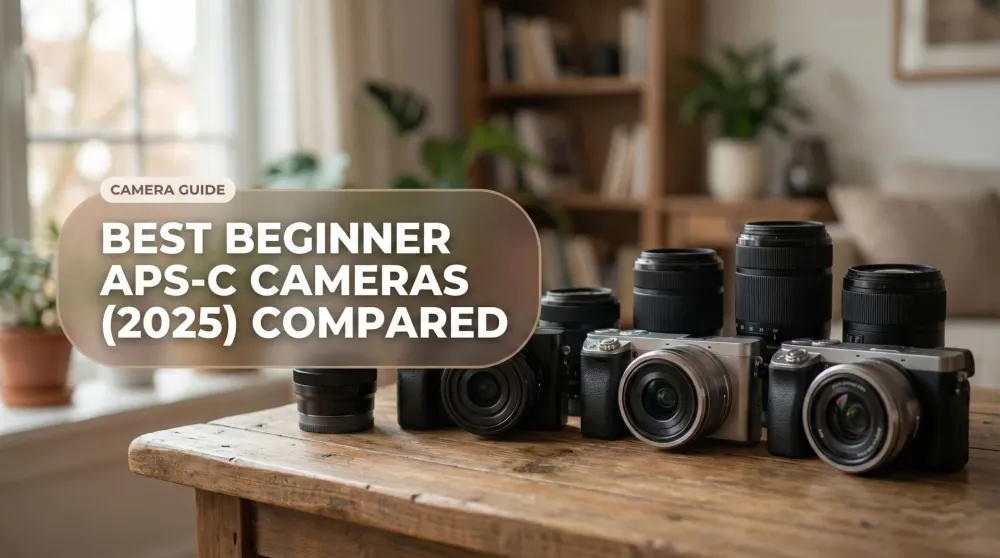
Looking for your first real camera? Here are the best APS-C mirrorless cameras for beginners in 2025 — with hands-on recommendations from Nikon plus strong alternatives from Canon, Sony, and Fujifilm.
This post contains affiliate links. We may earn a commission if you make a purchase, at no extra cost to you. As an Amazon Associate, Dadnology earns from qualifying purchases.
Editor’s note: We’ve used Nikon gear for years and can speak from direct experience about Nikon bodies and lenses. Comparable APS-C cameras from Canon, Sony, and Fujifilm also perform very well—choose the system that fits your hands, budget, and preferred lenses.
Why enthusiast APS-C beats a phone (especially for families)
Smartphones are genuinely impressive. The computational photography inside a modern iPhone or Galaxy handles well-lit group shots and bright daylight scenes competently. But there are three specific situations where the physics of a phone sensor simply gives up — and these are the three situations that matter most for family photography.
Freezing motion in bad light. A 5-year-old’s birthday party in a restaurant. A school gym during the winter play. Indoor football. These aren’t edge cases for families — they’re the most important moments to capture, and phone cameras struggle with all of them. The combination of dim light and fast movement requires a shutter fast enough to freeze motion and a sensor large enough to handle the resulting high ISO cleanly. APS-C sensors are roughly 8–10× larger than a phone sensor. That gap matters in the dark.
Print quality. A 12×18 inch print of a holiday portrait that actually looks like a photograph — rich shadows, clear detail, real depth — requires files that APS-C cameras deliver and phones can’t. The difference isn’t visible on an Instagram feed at 1080px. It’s very visible when you frame something and hang it on a wall.
Subject isolation and depth of field. The creamy background blur that separates a subject from its surroundings — the aesthetic that makes portraits look intentional — requires a physically large aperture on a physically large sensor. Phone portrait modes simulate it with AI algorithms that fail on hair, glasses, and anything moving. A 50mm f/1.8 on an APS-C camera does it in physics, which never glitches.
For families and travel shooters, the lightweight APS-C format hits the sweet spot: meaningfully better than a phone in the situations that count, genuinely portable, and priced in a range that doesn’t require a serious conversation with your partner. With fast eye/subject autofocus and interchangeable lenses, this class of camera also has genuine room to grow as your skills develop.
Our experience-based pick: Nikon Z50II
We’ve used the Nikon Z50 for years and upgraded to the Z50II (full review here) — the difference is obvious in real use: snappier autofocus, smarter subject detection, smoother burst behavior for action. It’s compact, intuitive, and the files grade beautifully in Lightroom. The DX crop factor (1.5×) is an underrated bonus for wildlife and field sports: telephoto lenses act longer without losing their aperture.
For dads specifically: the Z50II is the camera you’ll actually bring. It’s not significantly heavier than a large phone when mounted with a compact prime. It fits in a jacket pocket with the right lens. The grip is substantial enough for adults — not a toy — and the button layout is logical enough that you’re not hunting through menus mid-moment. In Subject Detection mode, it locks onto faces and eyes reliably across the frame. Put it in AF-C, point it at a child running, and press the shutter. You’ll get the shot.
Why it works for beginners and busy parents
- Eye/subject AF that locks onto kids and pets quickly and holds tracking reliably.
- Lightweight body you’ll actually carry on trips and hikes without resentment.
- Z-mount ecosystem that scales from small DX primes to full professional FX glass if you ever upgrade.
- Great value: serious features without full-frame size, weight, or price.
- Simple menu system with the key beginner settings surfaced clearly.
For wildlife and birding dads: the DX crop gives telephoto lenses 1.5× extra effective reach. A 100–400mm becomes a 150–600mm equivalent field of view. That reach without sacrificing lens brightness is a tangible advantage for anyone pointing a camera at birds, zoo animals, or kids on a football pitch.
Day one with the Z50II: what it actually feels like
The first time you take the Z50II out of the box and point it at your kid, something clicks immediately — and it’s not the shutter. It’s the realization that you’re getting sharp images without fighting the camera. Set it to Subject Detection and AF-C, and the autofocus does the heavy lifting. In good light, the hit rate on a moving 6-year-old is embarrassingly high compared to any phone Portrait mode. In dim light — the birthday party, the evening park, the kitchen after dinner — the gap versus your smartphone becomes apparent within the first ten frames. You’ll notice it in the shadows: they’re clean rather than a smear of noise. You’ll notice it in the motion: stopped rather than smeared.
The Z50II is also a capable video camera, which is easy to underestimate when you’re thinking about stills. 4K video with subject autofocus handles family events — first steps, Christmas morning, school performances — better than most parents expect from a stills-first camera. The autofocus in video mode tracks faces and eyes reliably even when you’re handholding and moving around a room. You don’t need to nail focus manually; the camera follows whoever you’re pointing at.
Battery life is practical without being exceptional: roughly 300–400 shots per charge depending on how much you review images on the screen. For a day trip or family event, carry one spare battery and you’re covered. For a week-long holiday, two spares and a USB-C cable (which charges the camera directly) is enough.
The alternatives: Four flavors of the same idea
All four cameras in this comparison do the same fundamental job: take great photos in difficult family conditions, handle beginner-level learning curves, and give you a lens ecosystem that grows with you. The differences are in character, ergonomics, and specific strengths.
Canon EOS R10 — Responsive, friendly, built for action
Canon’s EOS R10 feels like a miniaturized sports camera: small body, confident grip, and an approachable control layout that makes sense immediately. The standout is Canon’s Dual Pixel CMOS AF — it’s legitimately among the best autofocus systems in this price range. It grabs faces and eyes reliably and tracks kids running across a yard with minimal hunting or hesitation.
Image quality is clean and flexible for editing, with Canon’s signature warm skin tones that families tend to love straight out of camera. The R10 lacks in-body image stabilization (IBIS), which matters in very low light when you’re handholding at slower shutter speeds, but for most family action shooting at sufficient shutter speeds it’s a non-issue.
For parents who’ve handled Canon DSLRs before, the R10’s ergonomic familiarity reduces the learning curve to near zero. It’s a camera you can hand to a partner or older child and have them produce usable shots within minutes.
Where the R10 specifically beats the Z50II: fast, burst-heavy action at a lower entry price. If your primary goal is freezing kids at football practice or tracking bikes at a skate park, Canon’s Dual Pixel AF edge at this price point is real. The scenario it’s built for is “I need the shot, now, whatever it takes.” Canon RF-mount lenses cover both APS-C (RF-S) and full-frame (RF) bodies, so any glass you buy now works on a future R-series full-frame upgrade. RF-S lens selection is still smaller than Z-mount or E-mount, but the essential primes and zooms are available. Who should probably not buy this: anyone who shoots a lot in very low-light indoor situations without flash — the missing IBIS is felt in those conditions more than on action.
Sony α6700 — The flagship APS-C for ambitious shooters
The Sony α6700 brings Sony’s latest AI-powered autofocus to the APS-C format. The subject detection is genuinely impressive: it recognizes humans, animals, birds, vehicles, and insects, and its tracking persistence is class-leading. If you’re shooting a dog at a park, a bird in flight, or a kid at a track meet, the α6700 maintains lock more reliably than anything else in this price category.
It includes 5-axis in-body stabilization — one of the most useful features for handholding in dim environments — and its video capabilities have earned it a strong following among hybrid photo/video users. The sensor and processing deliver excellent detail and dynamic range.
The α6700 is priced above the other options in this comparison, which reflects that it’s closer to an advanced enthusiast tool than a true beginner camera. For a dad who’s serious about photography as a hobby and wants a body they can genuinely push, it’s worth the premium. For someone who just wants reliable family snapshots, the Nikon or Canon offers the same core functionality at a friendlier price.
The α6700’s specific winning scenario: wildlife and hybrid creators who need the best APS-C autofocus available and shoot both stills and video seriously. Bird-in-flight tracking, dog sports, stage performance — these are the use cases where the extra money makes a visible difference. Sony E-mount is the widest APS-C lens selection available, covering everything from cheap APS-C (APS-C/E-mount) zooms to the full Sony FE full-frame catalog, Sigma, Tamron, and others. Plenty of affordable options exist. Honest caveat: if this is your first camera and your primary subject is “the kids in the house,” the α6700 is substantial overkill. The extra complexity adds menu depth that a beginner won’t use for months, and you’re paying for features that reward photographers who already know what they want.
Fujifilm X-S20 — Stabilized, fun, and film-simulation friendly
The Fujifilm X-S20 is the camera that makes photography feel playful rather than technical. It pairs a capable APS-C sensor with 5-axis IBIS and Fuji’s famous Film Simulations — baked-in looks inspired by classic film stocks like Provia, Velvia, and Classic Chrome. For beginners, this means your JPEGs already look like they’ve been professionally edited before you open Lightroom.
For dads who enjoy the aesthetic of film photography but want digital convenience, this is a particularly appealing choice. The Film Simulations aren’t just Instagram presets — they’re tuned to render color and contrast in specific ways that give your photos a consistent visual character. If you want your family photos to look like something rather than just documenting what happened, the X-S20 gives you that out of the box.
Battery life is legitimately excellent — often a full day of family shooting without a swap, which is more than can be said for some competitors.
The X-S20’s standout scenario: any dad who cares about how photos look, not just whether they’re sharp. If you find yourself fussing with Instagram filters trying to get a consistent aesthetic, Fujifilm’s Film Simulations solve that problem in-camera with more taste than any algorithm. For travel photography specifically, the combination of IBIS and Film Simulations means you bring home images that feel like they were made rather than captured. Worth noting on the system: Fujifilm’s X-mount is APS-C only — there’s no Fujifilm full-frame camera, and X-mount lenses don’t adapt to their medium-format bodies. If you eventually want to move to full frame, the lenses don’t follow you. The X-mount lens catalog is extensive and excellent, but that future-upgrade limitation is worth knowing upfront. Skip it if your five-year plan involves upgrading to a full-frame body.
The simple starter lens kit that actually works
The biggest mistake beginners make is buying too many mediocre lenses. Start with two that cover 90% of what families actually photograph. Everything else can wait until you know what you’re reaching for and not finding.
Lens 1: A small, bright prime for people and indoor scenes
Nikon Z 24mm f/1.7 (DX): This is a natural perspective indoors — roughly equivalent to what your eyes see — with a wide maximum aperture that handles dim rooms, restaurants, and evening events without flash. At f/1.7, background blur is subtle but present: enough to separate a portrait subject from a kitchen background without looking artificial. It’s compact enough that the Z50II with this lens fits in a jacket pocket. For birthday parties, living room play, school events, and travel walks, this is the lens that lives on the camera.
Lens 2: A versatile travel zoom
Nikon Z DX 18–140mm: This one lens covers wide establishing shots, environmental portraits, and compressed telephoto shots without any swapping. For family holidays, day trips, and parks, this is the lens you don’t want to be without. The 18–140mm range on DX gives you the equivalent of roughly 27–210mm full frame — from room-wide family shots to pulling in detail across a beach or field. It’s not as optically perfect as a prime, but it’s sharp enough for large prints and far better than the variable aperture kit lenses most beginners start with.
Wildlife, sports, and the DX reach advantage
If you’re interested in photographing anything at distance — soccer sidelines, birds at a nature reserve, animals at a zoo — the APS-C crop factor is unexpectedly valuable. The 1.5× multiplier means a 100–400mm zoom behaves like a 150–600mm equivalent in terms of framing reach, while keeping its f-stop and autofocus performance intact.
For dad-photographers at kids’ football matches, this is the practical argument for APS-C over full frame at a beginner level: you get more reach for the same money spent on glass. The Nikon Z 100–400mm S is the lens that turns a Z50II into a credible sideline sports and wildlife kit.
Settings that make beginners look like pros
Modern autofocus handles most of the technical difficulty. These settings get the rest right:
- AF-C + Subject/Eye Detect for anything moving: kids, pets, athletes. Let the camera do the tracking work.
- Auto ISO with a minimum shutter speed: set your minimum to 1/500s for active kids (faster for sports), and let the camera raise ISO automatically to get there. A sharp photo at ISO 6400 beats a blurry one at ISO 400 every time.
- Aperture Priority at f/1.7–f/2.8 indoors, f/5.6–f/8 outdoors in sunlight. One dial, most situations covered.
- RAW + JPEG while you’re learning: JPEG for instant sharing, RAW for editing headroom once you’re comfortable in Lightroom.
- Use the viewfinder whenever possible. Eye to camera equals one more point of contact, equals less camera shake, equals sharper images.
Printing and sharing: Why this class excels
APS-C files print clean and detailed at A3 (30×42cm) and beyond. For photo books, wall canvases, and gift calendars — the format where family photos actually have emotional permanence rather than just scrolling past on a phone screen — this class of camera produces files that look genuinely photographic. The difference between a printed photo from a phone and a printed photo from an APS-C camera is visible, immediate, and worth the investment if you care about the archive.
🔗 Ecosystem lock-in and upgrade paths
APS-C is not a photographic dead end. Every manufacturer in this guide makes full-frame cameras on the same mount — meaning the lenses you buy today work on the body you buy in three years.
Nikon Z-mount covers both DX (APS-C) and FX (full-frame) bodies. The Nikon Z 24mm f/1.7 DX lens above is APS-C-only, but the overwhelming majority of Z-mount glass is full-frame compatible, and a Z50II shooter can move to a Z6 III or Z8 body without abandoning a single lens. The same logic applies to Canon RF (the R10 and a future R6 Mark III share one lens catalog) and Sony E-mount (the α6700 and a future a7 series body use the same FE lenses). Three of the four systems in this guide are genuinely future-proof.
The exception is Fujifilm. X-mount lenses are designed for APS-C sensors and there is no Fujifilm full-frame camera. Fujifilm’s GFX system uses a different, larger medium-format mount. This matters if your long-term plan includes moving to full frame — your X-mount glass stays behind. For photographers who are happy staying in the APS-C format (which is a completely rational choice — the image quality ceiling is well above where most dads shoot), this is irrelevant. But it’s worth knowing before you spend on a growing X-mount collection.
One practical consequence: buy the best glass you can afford now, even if it means the body is one tier down. Lenses retain their value and their capability across body generations. A body gets replaced every four to six years; a good prime lens is still good twenty years later.
⚠️ First-camera mistakes new buyers make
These are the four things that separate beginners who are frustrated by their first camera from beginners who are immediately delighted by it.
1. Trusting the kit zoom wide open at maximum zoom. The zoom lens bundled with most kit deals is optically weakest at the longest focal length and widest aperture — exactly where beginners instinctively use it. If your early photos look soft or flat, this is probably why, not the camera. The fix costs around $200: a 35mm f/1.8 prime (or the 24mm f/1.7 above) delivers a dramatic improvement in low-light sharpness and rendering quality. Swap to a prime for indoor shooting and the camera starts to feel like what you paid for.
2. Shooting JPEG-only and losing every edit opportunity. RAW files preserve all the sensor data — blown-out skies can often be recovered, white balance shifts corrected, and exposure mistakes fixed in ways JPEG won’t allow. RAW editing sounds intimidating, but the basic tools in Apple Photos, Google Photos, or Lightroom Mobile handle 90% of common fixes with sliders rather than technical skill. The habit takes about two evenings to form and pays dividends forever.
3. Not setting up back-button focus. Out of the box, cameras use the shutter button for both autofocus and the shot, which creates hesitation when tracking moving subjects. Moving AF to the rear AF-ON or AEL button decouples the two functions: you focus continuously with your thumb, you capture with your index finger. Every camera in this guide has this option in the menu. It takes ten minutes to set up and makes a material difference when photographing anything that moves.
4. Agonizing over the choice. The Nikon, Canon, Sony, and Fujifilm cameras in this guide all produce images that will exceed your current smartphone by a wide margin, immediately, out of the box, in Auto mode. Your skill level is the current bottleneck — not the gear. Any of these bodies has a higher image-quality ceiling than you’ll reach in the next two or three years. Pick the one that fits your budget and your hands and start shooting.
Pros
- Massive image quality improvement over smartphones, especially in dim indoor conditions
- Eye/subject autofocus on all four cameras makes sharp portraits accessible to beginners
- APS-C crop factor provides free telephoto reach for sports, wildlife, and zoo photography
- Interchangeable lens ecosystem lets the kit grow with your skill level
- All four systems offer excellent compact travel lenses
- Print-quality files that look genuinely different from phone images at large sizes
Cons
- Learning curve for manual settings — typically 2–4 weeks before Aperture Priority feels natural
- Total system cost (body + two starter lenses) is meaningfully higher than a phone camera
- Heavier to carry consistently than a phone — requires habit change
- APS-C lenses occasionally more limited in range than full frame equivalents
Budget comparison
| Camera | Best For | Approx. Price (Body) |
|---|---|---|
| Canon EOS R10 | Speed, AF, action | Budget of the four |
| Fujifilm X-S20 | Creative, IBIS, film look | Mid-range |
| Nikon Z50II | All-round family/travel | Mid-range |
| Sony α6700 | Advanced AF, hybrid video | Premium APS-C |
All are capable of producing excellent family and travel photography. Choose the system whose lenses, ergonomics, and color science appeal to you most — not the one with the highest spec sheet number.
Bottom line: Your best first camera in 2025
APS-C mirrorless is the right starting point for any parent or hobbyist moving beyond smartphone photography. From years of Nikon use, the Z50II is our first recommendation: compact, fast, intuitive, and part of an ecosystem that scales as your ambitions grow. Canon’s R10, Sony’s α6700, and Fujifilm’s X-S20 are all excellent in their own right — pick the system that fits your hands.
The important thing is to start. The photos you’ll make in the next six months will look categorically different from anything your phone can produce in the situations that matter.
Related Dadnology guides: Best Entry-Level Full-Frame Mirrorless Cameras for Beginners (2025) · Best High-End All-Round Full-Frame Cameras (2025) · Best High-Resolution Full-Frame Cameras for Landscape Photography (2025)
📌 FAQ — Enthusiast APS-C for beginners
Why choose APS-C over full frame as a beginner?
Is Nikon Z50II better than Canon, Sony, or Fujifilm for beginners?
What two lenses should I buy first?
Can I get professional-looking results with APS-C?
How steep is the learning curve for a first mirrorless camera?
Keep this in your inbox
One email a week: what we actually watched, built and reviewed — the stuff worth a dad's time. No hype, no daily spam.
Dadnology Weekly
One email a week: the LEGO, gaming and movie news worth a dad's time — plus what we actually reviewed. No hype, no daily spam.
Disclaimer: This review and its visuals were created with the help of AI. Some links may be affiliate links – we may earn a commission if you make a purchase, at no extra cost to you.
Current deals in Cameras
Verified live discounts tracked on Amazon

Cameras · Tested by Dadnology
Nikon Z8 Body
5/5“The Endgame body. No more compromises.”Read our reviewPrice as of Oct 17, 09:11 PM UTC

Cameras · Tested by Dadnology
Nikon Z5 Body
5/5“The unbeatable on-ramp to full-frame mirrorless.”Read our reviewPrice as of Oct 17, 09:11 PM UTC

You might also like

Nikon on sale: Buy the Z8, think twice about the Z6 II
The Z8, Z6II and Z5 all drop in price on sale days. Which one is worth it, from someone who owns a Z8 and shot a Z5 for years, plus the storage to go with it.
Nikon Z 70-200mm f/2.8 VR S vs VR S II: Which should you buy?
We've shot the original Nikon Z 70-200mm f/2.8 VR S for over five years and rate it a flat 5. Here's how it stacks up against the new VR S II - and which one you should actually buy.

Beach toy photography: How to shoot action figures and LEGO in the sand
The beach is the ultimate outdoor studio for toy photography if you respect the elements. Low ground-level angles turn sand ripples into mountain ranges, golden hour softens harsh plastic reflections, and a helping hand creates breathtaking in-camera dust storms.