
Nikon Z5 II review – Flagship autofocus for full-frame beginners
The original Z5 was my full-frame on-ramp. The Z5 II is what I'd point a dad to today: EXPEED 7 flagship autofocus in an affordable full-frame body.
This post contains affiliate links. We may earn a commission if you make a purchase, at no extra cost to you. As an Amazon Associate, Dadnology earns from qualifying purchases.
📷 This review is part of our Nikon Brand Hub — every Nikon Z body and lens we’ve tested, from wildlife glass to landscape and family photography kits.
I’ve been a Nikon shooter since 2009, and the original Z5 was the camera that taught me mirrorless. So when I tell you the Nikon Z5 II is the body I’d point a dad to today for getting into full-frame Nikon, that’s not a spec-sheet opinion — it’s the verdict of someone who lived with its predecessor, loved it, and knew exactly the one thing it got wrong. The Z5 II fixes that one thing. And in doing so, it becomes something a little remarkable: an entry-level full-frame body with a flagship’s brain.
Here’s the honest verdict up front: for what it’s built to do — get you into full-frame Nikon without flagship money — the Z5 II is a 5/5. Not because it out-specs a Z8 (it doesn’t, and it isn’t trying to), but because it does its specific job flawlessly. It is the most sensible full-frame on-ramp Nikon has ever made, and the EXPEED 7 autofocus is the reason.
This is not a spec dump — Nikon’s website does that better than I can. This is what it actually means for a dad to buy this camera as their first serious full-frame body: what you gain over an APS-C Z50 II, what you give up versus a flagship, and why the autofocus is the part that quietly changes everything.
Why I’m the right person to tell you this
Let me lay my cards on the table, because it matters. My road through Nikon has been long and deliberate: a D90 in 2009 that taught me photography, a D750 in 2014 that taught me full-frame. In December 2020 I sold most of the DSLR kit and went all-in on mirrorless Z — and the Z5 was my full-frame on-ramp (I kept the D750 as a backup and picked up a D500 with a 200-500mm the same month for birding). I shot it for years alongside a Z50, building out a lens kit: the 14-30 f/4, the 24-70 f/2.8, the 70-200 f/2.8. In 2025 I finally upgraded to the Nikon Z8 and a Z50 II, sold the D500 and 200-500mm, and added a 180-600mm for wildlife.
So I haven’t owned the Z5 II for years — it’s new. But I know this system intimately, I know exactly what the original Z5 felt like to live with, and I know precisely what the EXPEED 7 autofocus does because it’s the same brain that’s now in my Z8. That combination — having loved the predecessor and shooting the new AF daily in a flagship — is the right vantage point to assess this camera honestly. I’m not guessing what changed. I lived the before, and I shoot the after.
The original Z5’s one flaw — And how the II fixes it
The original Z5 was a lovely camera with one real weakness: its autofocus. The files were gorgeous, the full-frame look was there, the ergonomics were classic Nikon. But the AF was contrast-leaning and it hesitated — exactly when you didn’t want it to. Track a toddler running at the camera and it would hunt. Try to nail a candid at a birthday party and you’d get a soft frame more often than you’d like. It was a great camera held back by a single, frustrating limitation.
The Z5 II takes that limitation and deletes it. It inherits the EXPEED 7 processor — the same brain family that powers the Z8 and Z9 — and with it comes the subject-detection autofocus from those flagships. Eye-detection on people and animals that locks and holds. The green box snaps to your kid’s eye and stays there as they run. This is not a marginal firmware tweak; it’s the flagship AF system, brought down to an affordable body. For a dad photographing fast, unpredictable family life, that one change transforms the keeper rate more than any other single upgrade could.
That’s the whole pitch in a sentence: the Z5 II is the camera the original Z5 should have been, because Nikon finally gave the entry full-frame body the autofocus it always deserved.
Family, travel & low light: Where this camera lives
This is the heart of why I’d recommend the Z5 II to a dad. Full-frame entry bodies live and die on real family life, not lab charts.
For family, the EXPEED 7 eye-detection is the star. Kids don’t pose and don’t give you a second take. With the Z5 II, I frame, the box finds the eye, and it holds while they move. The dual card slots mean that when you’re shooting a birthday or a christening — moments you genuinely cannot reshoot — you have an automatic backup. That’s a “real camera” feature the entry bodies didn’t always offer, and it buys real peace of mind.
For travel, the full-frame sensor and in-body stabilization earn their keep. Paired with the Nikon Z 24-70mm f/2.8 S — or a more modest 24-120 if the budget’s tighter — it becomes a genuine do-everything companion: wide enough for the room, long enough for a portrait, and stabilized enough for handheld shots in a dim cathedral or a sunset street scene.
Nikon has since released the Z 24-70mm f/2.8 S II, a second-generation version with an internal zoom design. If you are buying today, look at that one first; the original stays a proven choice while stock lasts.
For low light, this is where full-frame visibly pulls ahead of APS-C. The 24.5MP BSI sensor produces clean, usable files at high ISO — the dim living room at bath time, the school play in terrible lighting, the dinner with friends. Combined with IBIS, you can hand-hold in conditions that would force a phone into a noisy, over-processed mess.
It won’t out-burst a Z8 for birds in flight, and it isn’t pretending to. But for the photography that actually fills a dad’s memory card — family, travel, portraits, the everyday — the Z5 II covers all of it properly, and the autofocus means you actually come home with the shots.
Z5 II vs Z6 III vs the original Z5: The honest comparison
You don’t buy a Z5 II in a vacuum. The real questions are: is it worth more than the old Z5, and should you stretch to a Z6 III instead?
| Feature | Nikon Z5 II | Nikon Z6 III | Original Z5 |
|---|---|---|---|
| Sensor | 24.5MP BSI (non-stacked) | 24.5MP partially-stacked | 24.3MP (older) |
| Processor / AF | EXPEED 7 (flagship AF) | EXPEED 7 (flagship AF) | Older, contrast-leaning |
| Subject detection | People, animals, birds, vehicles | People, animals, birds, vehicles | Limited |
| Burst speed | Solid, modest buffer | Faster, deeper buffer | Slow |
| Video | 4K, capable | 6K RAW, pro-grade | 4K (cropped) |
| Stabilization | 5-axis IBIS | 5-axis IBIS | 5-axis IBIS |
| Price tier | Entry full-frame | Enthusiast / action | Discontinued |
| Best for | First full-frame, family, travel | Action, sports, serious video | Was the on-ramp |
Versus the original Z5, it’s not close — the Z5 II’s flagship autofocus alone justifies the upgrade, and everything else (burst, viewfinder, video) is improved too. The old Z5 was the on-ramp of its day; the II is its rightful successor.
Versus the Z6 III, be honest with yourself. The Z6 III is the better camera on paper — partially-stacked sensor, faster readout, deeper buffer, far stronger 6K RAW video. But it costs meaningfully more, and most of those gains only matter if you shoot serious action or video. If your life is family, travel, portraits, and low light, the Z5 II does all of it for less, and the autofocus is the same EXPEED 7 system. The Z6 III is the right buy only when you’ve identified a specific need for its speed. For most dads getting into full-frame, the Z5 II is the smarter spend.
One more variant worth knowing about: Nikon has since announced the Z5IIC, which takes this same sensor and EXPEED 7 autofocus and strips out the electronic viewfinder entirely, composing everything on the back screen for $300 less. It’s not a replacement for the Z5 II reviewed here — losing the viewfinder is a real trade-off, not a free discount — but if that trade sounds fine for how you actually shoot, it’s the cheaper way into the same autofocus system.
Long-term reality: What you give up (and why it’s fine)
Let me be straight about the cons, because a 5/5 only means something if you’re honest about the limits.
The first is price creep. The Z5 II costs more than the original Z5 did at launch. That’s a real thing to acknowledge — this isn’t the bargain-basement full-frame entry the old Z5 became at the end of its life. But you’re paying for the flagship autofocus, and that’s money genuinely well spent.
The second is that it is not a Z8, and you shouldn’t expect it to be. The sensor is non-stacked, so the readout is slower — you won’t get the Z8’s 20fps RAW or its near-immunity to rolling shutter. The buffer is more modest, so sustained bursts of fast action fill it sooner. There’s no 8K, no internal RAW video. The EVF and shutter aren’t flagship-class. None of this is a flaw — it’s the correct set of trade-offs for the price. A dad buying this to photograph their family does not need a stacked sensor. Asking the Z5 II to be a Z8 is asking the wrong question.
What you don’t give up: the EXPEED 7 autofocus, in-body stabilization, dual card slots, full-frame image quality, and Nikon’s superb ergonomics and menu logic. That’s the part that matters most, and it’s all there.
And here’s the long-term reassurance: it’s the same Z mount. Every lens you buy for the Z5 II comes with you if you ever upgrade to a Z6 III or a Nikon Z8 down the road. You’re not buying into a dead end — you’re buying into the system, at the most sensible point of entry. (If you want the full lineup laid out, my Which Nikon mirrorless should you buy guide walks through every body.)
Pros
- Inherits the EXPEED 7 flagship autofocus from the Z8 and Z9 — eye-detection that actually holds on a running toddler
- Fixes the original Z5's single biggest weakness (its hesitant AF) completely
- Full-frame image quality with clean high-ISO files for real family low light
- In-body stabilization plus dual card slots — proper grown-up features at an entry price
- Same Z mount, so every lens comes with you when you eventually upgrade
Cons
- Costs more than the original Z5 did — the affordable entry point has crept up
- Non-stacked sensor and modest buffer — no 20fps bursts or 8K video like the Z8
- EVF and shutter aren't flagship-class; serious action and video shooters want a Z6 III or Z8
Conclusion: The full-frame on-ramp, done right
The original Z5 was my own way into full-frame mirrorless, and I loved it despite its one frustration. The Nikon Z5 II takes that frustration — the hesitant autofocus — and replaces it with the EXPEED 7 system from the Z8 and Z9. For a dad photographing family, travel, portraits, and low light, that single change is transformative.
It’s not a flagship, and it costs more than the old Z5 did. Those are honest caveats. But this camera isn’t trying to be a Z8 — it’s trying to be the best possible on-ramp into full-frame Nikon, and at that exact job it is flawless. If you want full frame without flagship money, this is the body I’d put in your hands.
The Final Word: The Nikon Z5 II brings a flagship’s autofocus to an entry-level body. For getting a dad into full-frame Nikon the right way, nothing else comes close — a genuine 5/5 for what it’s built to do.
Is the Nikon Z5 II worth it?
What's the difference between the Nikon Z5 II and the original Z5?
Should I buy the Nikon Z5 II or the Z6 III?
Is the Nikon Z5 II good for photographing kids and family?
Do I need the Z5 II's video features, or is it just for stills?
Keep this in your inbox
One email a week: what we actually watched, built and reviewed — the stuff worth a dad's time. No hype, no daily spam.
Dadnology Weekly
One email a week: the LEGO, gaming and movie news worth a dad's time — plus what we actually reviewed. No hype, no daily spam.
Disclaimer: This review and its visuals were created with the help of AI. Some links may be affiliate links – we may earn a commission if you make a purchase, at no extra cost to you.
Current deals in Cameras
Verified live discounts tracked on Amazon

Cameras · Tested by Dadnology
Nikon Z5 Body
5/5“The unbeatable on-ramp to full-frame mirrorless.”Read our reviewPrice as of Oct 17, 09:11 PM UTC


Cameras · Tested by Dadnology
Nikon Z50 Body
5/5“An honest look back at the DX body that started my Z journey.”Read our reviewPrice as of Oct 17, 09:11 PM UTC
You might also like

Beach toy photography: How to shoot action figures and LEGO in the sand
The beach is the ultimate outdoor studio for toy photography if you respect the elements. Low ground-level angles turn sand ripples into mountain ranges, golden hour softens harsh plastic reflections, and a helping hand creates breathtaking in-camera dust storms.

Filter holder system vs screw-in filters: Why I carry both
Why a landscape photographer carries a 100mm holder kit AND a screw-in polarizer — what each is actually for, and when each one wins.
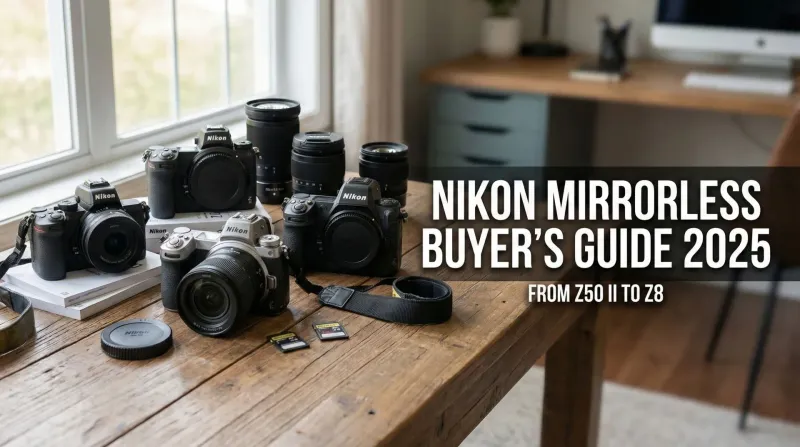
Which Nikon mirrorless camera should I buy? (2025 buyer’s guide – Z50 II, Z5 II, Z6 III, Z7 II & Z8)
Not sure which Nikon mirrorless camera to buy? This 2025 buyer’s guide compares Nikon Z50 II, Z5 II, Z6 III, Z7 II, and Z8 – from budget beginners to high-end all-rounders.