
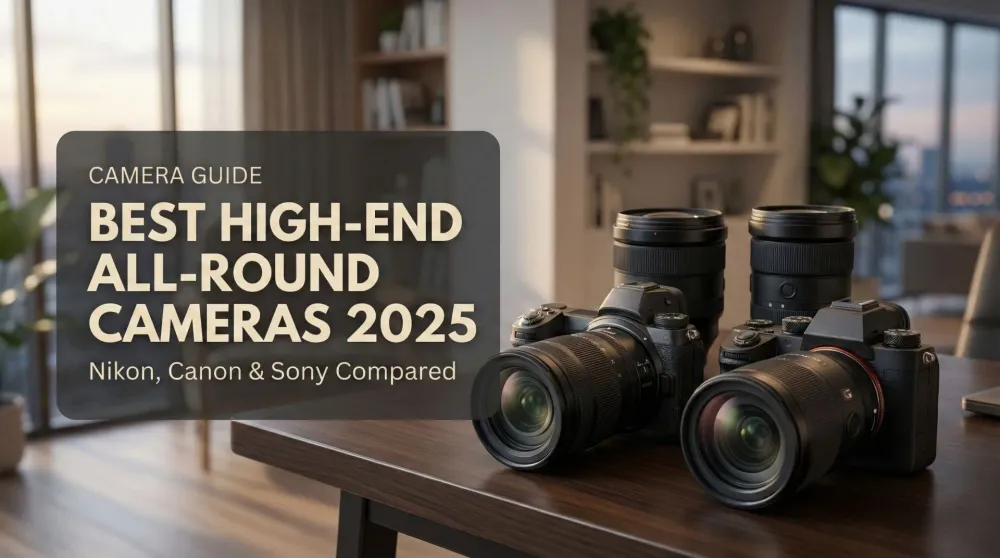
Best high-end all-round full-frame cameras (2025) – Nikon Z8 vs Canon R5, R3 & Sony Alpha 1
Looking for the one camera that can truly do it all – landscapes, sports, low light, and pro video? We compare the Nikon Z8 with Canon EOS R5, Canon EOS R3, and Sony Alpha 1 to help you choose your long-term high-end body.
This post contains affiliate links. We may earn a commission if you make a purchase, at no extra cost to you. As an Amazon Associate, Dadnology earns from qualifying purchases.
Editor’s note: After years of shooting Nikon and slowly upgrading through different bodies, the Nikon Z8 was the camera that required real saving and patience. But once it arrived, it instantly felt like the “endgame” body – the one camera that can confidently handle whatever you throw at it: landscape, action, low light, family life, and serious video work. This guide reflects that perspective: the Z8 as an all-round workhorse, compared fairly with Canon and Sony’s top all-rounders.
🧠 Why go high-end all-round instead of a “specialist” camera?
At some point, many photographers – especially parents who shoot a bit of everything – hit the same wall:
- Your entry-level full frame or high-res landscape body is amazing for some things…
- …but you run into its limits for fast indoor sports, low-light events, or video work.
Maybe you have a Z5 for family and travel, a Z7 II for landscapes, or a Z6 III for action. All great choices. But sometimes you just want one camera that never feels like a compromise:
- Landscape trip at sunrise? No problem.
- Kids’ basketball in a dim gym? No problem.
- 4K/8K video projects? Also no problem.
- Occasional paid work or long-term personal projects? Still no problem.
High-end all-round bodies like the Nikon Z8, Canon EOS R5/R3, and Sony Alpha 1 are built for exactly that: no excuses, no obvious weak spot, and performance that will stay relevant for many years.
🏆 Our main pick: Nikon Z8 – The “Endgame” all-round camera
The Nikon Z8 (45.7 MP, stacked full-frame) essentially puts Nikon’s flagship Z9 performance into a smaller, more affordable body. It’s fast, sharp, robust, and deeply capable for both photo and video.
Why the Z8 feels like a “no-compromise” camera
If you’ve come from cameras like the Z5, Z6, or Z7 series, the Z8 immediately feels different:
- 45.7 MP stacked full-frame sensor: High resolution for landscapes and prints, with lightning-fast readout for action and video.
- Up to 20 fps continuous shooting with full AF/AE: More than enough speed for kids’ sports, wildlife, and fast action – without feeling like a separate “sports camera”.
- Flagship-level autofocus: Subject recognition for people, animals, birds, vehicles, and more. It just locks on and tracks, even in bad light.
- Excellent low-light performance: Clean high-ISO files and strong AF in dark environments make night street photography, concerts, and indoor sports far easier.
- Serious video capabilities: 8K, 4K/60 and beyond, high-quality codecs, and robust heat management. The Z8 can genuinely be your main video camera, not just “good enough for clips”.
- Pro-level build & ergonomics: Weather sealing, a deep comfortable grip, dual card slots (CFexpress + SD), and controls designed to be customized for your shooting style.
All of that adds up to a body where you rarely catch yourself thinking, “I wish I had a different camera for this.” You just pick up the Z8 and shoot.
👨👩👧 Real-life use: A Pro-level camera that still works for dads
You don’t have to be a full-time professional to appreciate what the Z8 can do. In a dad-and-family context, it shines because it adapts to whatever the week brings:
- Saturday morning: Kids’ indoor sports – fast AF, 20 fps bursts, clean ISO 6400+ files.
- Saturday afternoon: Family hike – shoot landscapes and environmental portraits with 45.7 MP detail.
- Evening: Record 4K video of a birthday or family gathering with sticky face/eye AF.
- Vacation trips: From sunrise seascapes to street scenes and quick handheld long exposures, one body covers it.
Is it overkill for pure casual use? Absolutely. But if photography is your big hobby (and maybe side business) and you’ve been saving for years, this is the kind of camera that finally makes you stop worrying about what the camera can do and focus on the creative side.
🧳 A practical Nikon Z8 kit that covers everything
You can go wild with lenses at this level, but a realistic all-round Z8 kit looks like this:
1) Nikon Z 24–70mm f/2.8 S – The everyday workhorse
The Nikon Z 24–70mm f/2.8 S is the lens that stays on the camera 90% of the time:
- Lives on the camera most of the time.
- Covers family life, events, travel, and even landscape work.
- f/2.8 helps indoors and gives nice background separation for portraits.
Nikon has since released the Z 24-70mm f/2.8 S II, a second-generation version with an internal zoom design. If you are buying today, look at that one first; the original stays a proven choice while stock lasts.
2) Nikon Z 70–200mm f/2.8 S – Sports, wildlife & compressed landscapes
For reach, the Nikon Z 70–200mm f/2.8 S is indispensable:
- Ideal for kids’ sports, wildlife on trips, and soft background portraits.
- Great for compressing mountain ranges, cityscapes, and details in the distance.
- AF performance + f/2.8 + Z8’s stacked sensor = excellent action combo.
Nikon has since released the Z 70-200mm f/2.8 VR S II, a lighter second-generation version. If you are buying today, it is the one to price up first; the original stays a proven choice while stock lasts.
3) Optional: Ultra-wide or fast prime
- Ultra-wide zoom (14–24mm or 14–30mm): For serious landscapes and dramatic travel shots.
- Fast primes (35mm/50mm f/1.8 or f/1.2): For low-light city scenes, shallow depth-of-field portraits, and cinematic video.
With this trio, the Z8 comfortably spans family, travel, sports, landscapes, and professional work.
🧩 Where the Z8 fits in the Nikon lineup
If you’ve read our other guides, you’ve seen how Nikon’s full-frame bodies each have a “theme”:
- Z5 / Z5 II: Affordable, reliable entry-level full frame.
- Z6 III: Action & low light specialist for sports/events.
- Z7 II: High-resolution landscape and detail specialist.
- Z9: Full flagship with integrated grip and maximum stamina.
The Z8 is the one that says: “I’ll do nearly everything the Z9 does, but in a smaller body that’s easier to carry on real trips.”
If you’re mostly a landscape shooter → Z7 II might be smarter. If you’re focused on action on a budget → Z6 III makes sense. If you want one camera that can be your main body for anything → that’s the Z8.
⚔️ High-end all-round rivals – Canon & Sony
Not everyone is in Nikon’s ecosystem, and even if you are, it’s good to know what the rivals offer at this level.
Canon EOS R5 – High-resolution hybrid rival
The Canon EOS R5 (45 MP) is Canon’s closest equivalent to the Z8 as a high-res hybrid camera, though it’s a bit older and slightly more constrained for heavy video.
- Why it’s a serious Z8 rival: Comparable resolution (45 MP), fast electronic bursts, excellent Dual Pixel AF, and class-leading IBIS.
- Trade-offs: Thermals can be an issue in heavy 8K/4K120 recording compared to the Z8.
- Ideal for: Photographers who want a high-res hybrid camera and love Canon color/ergonomics.
Canon EOS R3 – Action-focused Pro tank
The Canon EOS R3 (24 MP, stacked) is more of a sports and news specialist, but it absolutely belongs in the high-end all-round conversation.
- What makes it special: Insane speed (30 fps), Eye-Control AF, and built-in vertical grip toughness.
- Compared to Z8: Lower resolution (24 MP vs 45.7 MP) means less cropping room, but faster and cleaner files in extreme low light.
- Ideal for: Dedicated sports/wildlife shooters who need maximum speed and ruggedness.
Sony Alpha 1 – No-compromise flagship
The Sony Alpha 1 (50 MP stacked) was the original “do everything, no compromise” mirrorless flagship.
- Why it’s legendary: Huge resolution (50 MP) AND extreme speed (30 fps) in one body.
- Trade-offs: Significantly higher price tag than Z8 or R5. 50MP files at 30fps eat storage.
- Ideal for: Photographers who genuinely need everything at once – national-level sports, commercial work, and 8K video – and have the budget for it.
🎛️ Getting the most out of a high-end all-round body
If you decide to step into Z8/R5/A1 territory, a few habits make a huge difference:
- Create dedicated banks / shooting modes: E.g., Bank A for Landscape (base ISO, single shot), Bank B for Action (Auto ISO, 20 fps).
- Use subject detection aggressively: Let the camera track eyes and faces; fine-tune the settings instead of fighting them.
- Invest in fast cards & storage: CFexpress cards are mandatory to get the most out of these buffers and video modes.
- Dial in custom buttons: Map a button to instantly override AF area or switch to video mode for “dad life” moments.
🗣️ Which high-end all-round camera should you actually buy?
If you want one camera that can truly do everything and you’re ready to invest at the high end, here’s how we’d summarize:
- Nikon Z8 – Our main recommendation: Best balance of resolution, speed, AF, video, and price. A genuine “endgame” camera for ambitious hobbyists and pros.
- Canon EOS R5: Outstanding all-rounder for Canon shooters, especially strong in IBIS and stills.
- Canon EOS R3: The choice for pure speed and toughness if you don’t need 45MP resolution.
- Sony Alpha 1: The ultimate “everything at once” flagship if budget is no object.
For many ambitious dads and serious hobbyists who have been upgrading step by step, the Nikon Z8 is the camera where you can finally say:
“I don’t really need anything more – now it’s about my skills and my time in the field.”
Pros
- 45.7 MP stacked full-frame sensor delivers both the resolution of a landscape specialist and the speed of an action camera in one body
- Up to 20 fps with full AF/AE tracking — fast enough for kids’ indoor sports, wildlife, and whatever a busy family weekend throws at you
- 8K video, 4K/60, and robust heat management make the Z8 a genuine hybrid camera, not just ‘video-capable’
- Pro build quality with weather sealing, dual card slots, and ergonomics designed for customization and extended shooting sessions
- Canon R5, Canon R3, and Sony Alpha 1 are all outstanding rivals — competition at this level means every body earns its price tag
Cons
- The Z8 is a serious financial commitment — for most shooting needs, a Z5 II or Z6 III is objectively sufficient
- 45 MP file sizes and CFexpress card requirements mean a meaningful investment in storage, cards, and computing power
- Canon EOS R3 and Sony Alpha 1 still lead on pure speed (30 fps) for the most demanding sports and wildlife use cases
- Canon R5 can have thermal limitations in extended 8K/4K120 recording sessions — worth testing before a critical video job
- This class of camera punishes poor lens choices: pairing a Z8 with budget glass wastes most of the investment’s potential
The Nikon Z8 is the camera that ends upgrade cycles for most ambitious photographers — not because it’s perfect, but because it’s capable enough that your creative ceiling becomes your skills and your time in the field, not your equipment. For Nikon shooters in particular, it’s the body where the system investment finally makes full sense. The Canon R5 is the right answer if you’re deep in Canon glass and want a battle-tested all-rounder. The Canon R3 wins if your primary subject is fast-moving sport or wildlife and resolution takes second place. And the Sony Alpha 1 is the pinnacle of the no-compromise approach — if budget genuinely isn’t the constraint, it remains one of the most impressive cameras ever made. Any of them will be with you for the next decade.
Related Dadnology guides: Best High-Resolution Full-Frame Cameras for Landscape Photography (2025) · Best Mirrorless Cameras for Dads (2026 Buyer’s Guide) · Which Nikon Mirrorless Camera Should I Buy? (2025 Buyer’s Guide
📌 FAQ – High-end all-round full-frame cameras
Is a Nikon Z8 overkill if I’m just an ambitious hobbyist dad?
How does the Nikon Z8 compare to the Nikon Z7 II and Z6 III?
Do I really need 45–50 MP for everyday shooting?
If I mainly shoot 4K video, is a Z8 better than an R5 or Alpha 1?
What’s the smarter upgrade path: better lenses or a high-end body like the Z8?
Keep this in your inbox
One email a week: what we actually watched, built and reviewed — the stuff worth a dad's time. No hype, no daily spam.
Dadnology Weekly
One email a week: the LEGO, gaming and movie news worth a dad's time — plus what we actually reviewed. No hype, no daily spam.
Disclaimer: This review and its visuals were created with the help of AI. Some links may be affiliate links – we may earn a commission if you make a purchase, at no extra cost to you.
Current deals in Cameras
Verified live discounts tracked on Amazon

Cameras · Tested by Dadnology
Nikon Z5 Body
5/5“The unbeatable on-ramp to full-frame mirrorless.”Read our reviewPrice as of Oct 17, 09:11 PM UTC


Cameras · Tested by Dadnology
Nikon Z50 Body
5/5“An honest look back at the DX body that started my Z journey.”Read our reviewPrice as of Oct 17, 09:11 PM UTC
You might also like

Nikon on sale: Buy the Z8, think twice about the Z6 II
The Z8, Z6II and Z5 all drop in price on sale days. Which one is worth it, from someone who owns a Z8 and shot a Z5 for years, plus the storage to go with it.
Nikon Z 70-200mm f/2.8 VR S vs VR S II: Which should you buy?
We've shot the original Nikon Z 70-200mm f/2.8 VR S for over five years and rate it a flat 5. Here's how it stacks up against the new VR S II - and which one you should actually buy.

Beach toy photography: How to shoot action figures and LEGO in the sand
The beach is the ultimate outdoor studio for toy photography if you respect the elements. Low ground-level angles turn sand ripples into mountain ranges, golden hour softens harsh plastic reflections, and a helping hand creates breathtaking in-camera dust storms.