
Best action & low-light cameras (2025) – Nikon Z6 III vs canon R6 II, Sony α7 IV & Fujifilm X-H2S
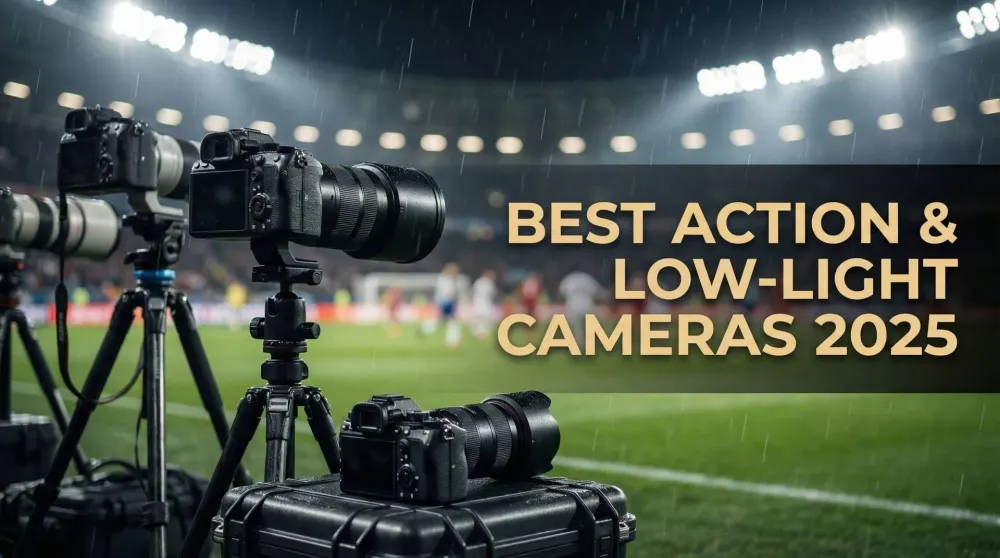
Want cleaner high-ISO files and sharper action shots? We compare the best mid-range cameras for action and low light in 2025 – with Nikon's Z6 III as our top pick, plus strong rivals from Canon, Sony, and Fujifilm.
This post contains affiliate links. We may earn a commission if you make a purchase, at no extra cost to you. As an Amazon Associate, Dadnology earns from qualifying purchases.
Editor’s note: We’ve been Nikon users for years and appreciate the ergonomics and color science. The Z6 III is positioned as the “action specialist” in the mid-range lineup. This guide reflects that perspective, but we provide fair, detailed comparisons with Canon, Sony, and Fujifilm so you can choose the best system for your needs.
Why action & low-light performance deserve their own category
High-resolution cameras — 45MP and above — are fantastic tools for landscape photographers, studio portraitists, and commercial work. But if your photography involves chaos, speed, and bad lighting, megapixel count is often secondary to an entirely different set of specifications.
This distinction matters especially for dads. The situations where family photography is hardest are precisely the situations where these cameras excel: a school gymnastics display in a dim sports hall, a birthday party in a restaurant where the lighting was designed by someone who hates photographers, a soccer match at 5pm in November when the light is dropping fast, or a bird that’s decided this is the moment to actually do something interesting.
These scenarios share three demands:
- High ISO performance — the ability to raise sensitivity without the image dissolving into grain.
- Fast, continuous autofocus — subject detection that stays locked through chaos rather than hunting across the frame.
- Burst speed — enough frames per second to guarantee one sharp image out of every unpredictable sequence.
The cameras in this guide prioritize all three. They’re not the highest resolution cameras available, and they’re not designed for still-life product shoots. They’re designed to get the shot when the conditions are difficult and the subject isn’t cooperating.
Those three scenarios above — the dim sports hall, the under-lit birthday restaurant, the November soccer pitch — are also the situations where a standard 24MP kit camera with a variable-aperture zoom will fail you in ways that are genuinely infuriating. The gymnastics display is over in forty minutes and you can’t reshoot it. The birthday happens once per year. When the light is bad and the action is fast, average equipment produces average results at best and useless blurry frames at worst. What differentiates the cameras in this guide is not that they make bad light look like studio conditions — they don’t — but they maintain usability where other cameras simply stop working. That distinction, for a family photographer, is worth every penny of the price difference over a consumer body.
This guide focuses on the “mid-range performance” category — cameras that deliver 90% of flagship-level action capability for a fraction of the Z9 or R3’s price and weight.
Nikon Z6 III – The sweet spot for action & low light
The Nikon Z6 III (24.5 MP full-frame) is our primary recommendation for shooters who need speed and clean files above everything else. It occupies the perfect position within Nikon’s lineup: faster and more responsive than the resolution-focused Z7 II, but smaller and significantly cheaper than the Z8.
Why it excels at action
The Z6 III uses a partially stacked sensor with high-speed readout, which enables:
- High-speed bursts: up to 14 fps mechanical or considerably higher in electronic mode, ensuring you capture the decisive moment rather than the frame before or after it.
- Pre-Release Capture: the camera buffers images before you fully press the shutter — a genuine game-changer for unpredictable wildlife, fast break moments in basketball, and the exact split-second a child does something worth keeping.
- Focus in near-darkness: Nikon’s AF algorithms (trickled down from the Z8/Z9) maintain subject lock in near-darkness, rated to -10 EV capability. In practical terms: it focuses in conditions where you’re genuinely wondering if the camera can even see anything.
Why pixel count isn’t the priority here
The Z6 III’s 24.5 MP is a deliberate trade-off, not a limitation. Larger individual pixels on the sensor gather more light — which means cleaner high-ISO files. ISO 6400 is genuinely usable for printing, and ISO 12800 is workable for web. These are the ISO values you’ll need regularly in dim gymnasiums, evening sports venues, and concert halls.
Compare this to shooting a 45MP sensor in the same conditions: the smaller pixels gather less light per pixel, noise appears earlier, and you need to spend more time in post correcting it. For action and low-light work, fewer megapixels often means better usable output.
Ergonomics and practical daily use
The Z6 III’s grip is deep and confident — a camera you can hold for three hours at a sideline without your hand cramping. The button layout reflects Nikon’s decades of ergonomic refinement: commonly used settings are accessible without leaving the viewfinder. The control wheel positions allow aperture, shutter, and ISO changes to happen by muscle memory. For anyone who’s used Nikon before, this feels immediately familiar.
Z6 III vs the Nikon lineup
Picking between Z models is a common source of confusion. Here’s the hierarchy in plain terms:
- Z5 II: Entry-level. Good for still subjects and well-lit scenes, but the autofocus speed and burst rate struggle when things move fast. Not the right tool for indoor sports.
- Z7 II: Resolution-focused. Exceptional for landscapes and architecture, but its slower readout speed means more rolling shutter in electronic mode and lower usable burst rates. Not built for action.
- Z6 III: The action specialist. Faster readout, superior high-ISO autofocus, manageable file sizes. The right tool for the scenarios this guide covers.
- Z8: The professional all-rounder. Does everything the Z6 III does plus 45MP resolution and 8K video, but at a significantly higher price and in a larger, heavier body. Worth it for professionals; harder to justify for an enthusiast who mainly shoots sport and events.
For most parents and enthusiast photographers shooting sports, events, and wildlife, the Z6 III is the logical choice in the Nikon system.
A practical lens kit for action and low light
A fast camera needs fast glass. Variable aperture kit lenses (f/4–6.3) handcuff your low-light performance before you’ve taken a single shot. These two lenses unlock what the Z6 III was built for:
Nikon Z 70–200mm f/2.8 S — The event and sports workhorse
The f/2.8 aperture across the entire zoom range is the critical specification. It lets in twice as much light as an f/4 lens at the same focal length. In practice: instead of shooting at ISO 12800 with a kit zoom in a dark gymnasium, you’re at ISO 6400 with the 70–200 f/2.8. The image quality difference at those two ISOs is substantial. The telephoto range covers sideline sports, school stage performances, and wildlife without needing to crop aggressively.
Nikon Z 24–70mm f/2.8 S — The versatile fast standard
For events and indoor situations where you need wider coverage — venue-wide shots, environmental portraits, group photos — the 24–70 f/2.8 replaces a kit zoom with a lens that doesn’t compromise in dim light. The f/4 version is a competent lightweight alternative for photographers who shoot mostly outdoors; if events and concerts are part of your use case, the f/2.8 pays for itself in image quality.
Canon EOS R6 Mark II – The speed demon
The Canon EOS R6 Mark II is a direct competitor and legitimately impressive in raw speed terms.
- Up to 40 fps in electronic shutter mode. This is genuinely overkill for most action scenarios, but in chaotic, unpredictable situations — a child making an unexpected face, a bird landing on a branch — the sheer volume of frames guarantees the shot is in there somewhere.
- Canon Dual Pixel CMOS AF II: the tracking on the R6 II is celebrated specifically for its “stickiness” — once it locks a subject, it follows with unusual persistence. Eye tracking on humans and animals is among the best in this price category.
- The trade-off: the R6 II uses SD card slots rather than CFexpress, which limits buffer clearing speed during sustained heavy bursts. For most shooting scenarios this is invisible; for continuous 40 fps wildlife bursts, it can become a real-world constraint.
For Canon system users already invested in RF glass, the R6 II is the natural choice for action and events. For brand-neutral buyers, it’s a compelling option if maximum autofocus tenacity is the priority.
Sony α7 IV – The high-resolution hybrid
The Sony α7 IV takes a different approach: prioritizing resolution and versatility over pure burst speed.
- 33 MP gives it a cropping advantage. When a lens isn’t quite long enough to fill the frame from the sideline, the α7 IV lets you crop significantly without destroying image quality — producing a usable tight shot from footage you’d otherwise discard.
- Sony’s Real-time Tracking AF remains the industry benchmark for reliability. It’s not necessarily the fastest to acquire a subject, but its persistence and accuracy once locked are exceptional.
- The trade-off: maximum burst speed tops out at around 10 fps for full-resolution uncompressed RAW. This is adequate for most family sports and events but falls meaningfully short of the Z6 III and R6 II for situations that genuinely require rapid-fire sequences.
- Hybrid credentials: the α7 IV is an equally capable video camera. For creators who produce both still and video content, this versatility makes it the single-camera solution the Z6 III and R6 II are not.
For the photographer who splits shooting time 50/50 between action and landscape/portrait/video work, the α7 IV’s balance makes it the right single-body investment.
Fujifilm X-H2S – The APS-C speed demon
The Fujifilm X-H2S is an APS-C camera that competes directly with full-frame action bodies — thanks to a technology that usually lives only in $5,000+ cameras.
- Stacked BSI sensor: unlike standard back-illuminated sensors, the X-H2S uses stacked architecture with integrated memory, enabling readout speeds fast enough to eliminate rolling shutter distortion at 40 fps. This is the same fundamental technology in the Nikon Z9 and Sony A9 III, appearing here at a dramatically lower price point.
- The 1.5× crop advantage for reach: on an APS-C sensor, focal lengths multiply. A 70–200mm lens frames like a 105–300mm equivalent. For outdoor sports and wildlife — situations where reach matters more than absolute low-light ceiling — this extra framing compression is genuinely useful and cost-efficient.
- The trade-off: the smaller sensor physically gathers less total light than a full-frame competitor. In a well-lit outdoor environment, the difference is minimal. In a dark indoor gym at ISO 12800, the X-H2S produces more noise than the Z6 III or R6 II. This isn’t a fatal flaw, but it’s the reason full-frame bodies dominate indoor sports photography.
- Fujifilm’s color science: the Film Simulation engine in X-H2S produces JPEGs with a distinctive aesthetic that many photographers find requires minimal post-processing. For event photographers who shoot in JPEG for fast turnaround, this is a real workflow advantage.
For wildlife, outdoor sports, and birding photographers where reach matters more than low-light ceiling, the X-H2S offers stacked-sensor speed at an accessible price.
💰 Building a working kit: The true cost beyond the body
Buying a camera body is the smallest decision in the process. The conversation that actually matters is about the system you’re buying into — and that conversation has a much larger price tag attached.
The real number: Body + glass + cards + batteries
A Z6 III body costs around €2,500. A Z 70–200mm f/2.8 S adds another €2,700. A Z 24–70mm f/2.8 S is €2,400. Two CFexpress Type B cards (because losing a card once will teach you this lesson) run €100–200 each. Two spare batteries. A decent bag. You are now four to five times the body price into this ecosystem before you’ve taken a single shot.
This isn’t a criticism — it’s arithmetic that applies to every system equally. But it’s the number that rarely appears in camera reviews, which focus almost entirely on the body.
Why f/2.8 glass is the actual investment decision
Fast prime and zoom lenses are what unlock the capabilities that this guide is about. The Z6 III with a kit f/4–6.3 zoom is a mediocre indoor sports camera. The Z6 III with an f/2.8 zoom is an excellent one. The difference isn’t the body — it’s the glass. Before buying a body, look at what fast lenses cost in that mount. If the glass budget doesn’t exist, the performance gap doesn’t either.
System lock-in: The hidden switching cost
Once you own two or three quality lenses in a mount, you are not in a practical position to switch systems. You’d be selling €5,000–8,000 of glass at a significant loss to start over. This is why camera forum debates about “best system” are almost always the wrong question for someone just starting. The better question is: which system has the lenses I want to own, at a price I can reach, with a roadmap I trust?
For third-party lens options, Z-mount and E-mount (Sony) have the strongest third-party ecosystems in 2025 — Sigma, Tamron, and Viltrox offer fast primes and zooms at meaningful discounts. RF mount has been more restrictive, with Canon historically limiting third-party RF lens support, though this is evolving. Z-mount and E-mount photographers can meaningfully reduce system cost by mixing first and third-party glass; RF shooters rely more heavily on Canon’s own lineup.
The long view: Glass outlasts bodies
A quality f/2.8 zoom purchased today will be in your bag in 2035. Camera bodies iterate every three to four years; lenses iterate every decade or longer. The Z 70–200 f/2.8 S you buy for a Z6 III will mount on the Z8, Z6 IV, and whatever Z-body Nikon produces in 2030. The lens is the infrastructure investment. The body is the component you’ll eventually upgrade.
For a family photographer making their first serious camera investment: you are not buying a camera. You are choosing a lens ecosystem. Pick the one you can afford to build properly over time. The body inside it will matter far less than the glass in front of it.
Real-world settings for action & low light
Whichever camera you choose, these are the settings that separate good action results from great ones:
- Auto ISO with a cap: set your Auto ISO to cap at ISO 12800 or ISO 25600. Modern cameras handle these values well. A sharp, slightly grainy photo is always better than a beautifully exposed blur.
- Aperture wide open: shoot at f/2.8 or the maximum aperture your lens allows. Every stop of light counts in dim environments.
- Minimum shutter speed by subject: 1/500s for children running, 1/1000s for basketball and soccer, 1/2000s+ for motorsports or birds in flight. Set this as the floor in your Auto ISO setup.
- Back-button focus (AF-ON): separate your focus activation from the shutter button. This lets you track a subject continuously and fire only when the moment is right, without the camera hunting for focus each time you press the shutter.
- Subject Detection mode always on: in 2025, there is almost no reason to turn off subject detection for action work. Let the camera decide what to track — it’s faster than manual area selection in most situations.
Pros
- Z6 III's partially stacked sensor delivers professional-grade burst speed at a mid-range price
- All four cameras offer reliable subject/eye detection autofocus in real action conditions
- Pre-Release Capture on the Z6 III means you never miss the frame before the decisive moment
- R6 II's 40 fps provides an extraordinary safety net for unpredictable subjects
- α7 IV's 33 MP allows significant cropping — useful when reach is limited by your glass
- X-H2S's stacked APS-C sensor delivers zero-rolling-shutter speed at an accessible price point
Cons
- R6 II's SD-only storage limits buffer clearing during the heaviest sustained bursts
- α7 IV's 10 fps burst ceiling is adequate for most scenarios but lags dedicated action bodies
- X-H2S APS-C sensor trails full-frame competitors in very dark indoor environments
- Fast f/2.8 lenses (the ideal pairing for these bodies) add meaningful cost to the total kit
Which action camera should you buy?
- Go Nikon Z6 III if you want the best all-rounder for low light and action combined. It balances resolution, speed, and ISO performance for events, indoor sports, and wildlife.
- Go Canon R6 Mark II if you need sheer burst speed (40 fps) and the stickiest autofocus tracking above all else — and are already comfortable in the Canon ecosystem.
- Go Sony α7 IV if you want 33 MP for cropping flexibility and plan to shoot equal amounts of action, landscape, portrait, and video with a single body.
- Go Fujifilm X-H2S if you shoot outdoor sports and wildlife where reach matters more than absolute low-light performance, and want Fuji’s distinct color science.
The right tool for difficult light
Action photography and low-light photography both punish the wrong equipment. A camera that hesitates, hunts for focus, or dissolves into noise at ISO 3200 doesn’t matter how many megapixels it has — you’ll come home with frames you can’t use. The cameras in this guide were designed specifically for these conditions. The Nikon Z6 III is our recommendation for most shooters: balanced, fast, clean at high ISO, and priced below the professional tier without sacrificing what matters. Choose your system’s version of this tool and invest the remaining budget in fast glass.
Related Dadnology guides: Best Drones & Action Cameras for Families (2026 Guide) · Best Instant Cameras & Photo Printers for Families (2026 Guide) · Best First Cameras & Creative Tech for Kids (Screen-Free Creativity)
📌 FAQ – Action & low-light cameras
Why choose the Nikon Z6 III over the Nikon Z7 II or Z8?
Is 24 MP enough for sports and wildlife?
Do I really need f/2.8 lenses?
Full Frame vs APS-C: Which is better for low light?
Can I use these cameras for family and everyday photography too?
Keep this in your inbox
One email a week: what we actually watched, built and reviewed — the stuff worth a dad's time. No hype, no daily spam.
Dadnology Weekly
One email a week: the LEGO, gaming and movie news worth a dad's time — plus what we actually reviewed. No hype, no daily spam.
Disclaimer: This review and its visuals were created with the help of AI. Some links may be affiliate links – we may earn a commission if you make a purchase, at no extra cost to you.
Current deals in Cameras
Verified live discounts tracked on Amazon

Cameras · Tested by Dadnology
Nikon Z8 Body
5/5“The Endgame body. No more compromises.”Read our reviewPrice as of Oct 17, 09:11 PM UTC

Cameras · Tested by Dadnology
Nikon Z5 Body
5/5“The unbeatable on-ramp to full-frame mirrorless.”Read our reviewPrice as of Oct 17, 09:11 PM UTC

You might also like

Nikon on sale: Buy the Z8, think twice about the Z6 II
The Z8, Z6II and Z5 all drop in price on sale days. Which one is worth it, from someone who owns a Z8 and shot a Z5 for years, plus the storage to go with it.
Nikon Z 70-200mm f/2.8 VR S vs VR S II: Which should you buy?
We've shot the original Nikon Z 70-200mm f/2.8 VR S for over five years and rate it a flat 5. Here's how it stacks up against the new VR S II - and which one you should actually buy.

Beach toy photography: How to shoot action figures and LEGO in the sand
The beach is the ultimate outdoor studio for toy photography if you respect the elements. Low ground-level angles turn sand ripples into mountain ranges, golden hour softens harsh plastic reflections, and a helping hand creates breathtaking in-camera dust storms.