
Best Nintendo Switch Games & Gear for Family Game Night (2026 Buyer's Guide)
Our dad-tested guide to the best Nintendo Switch games and gear for family game night: couch party games, co-op, and the one storage card every Switch 2 needs.
This post contains affiliate links. We may earn a commission if you make a purchase, at no extra cost to you. As an Amazon Associate, Dadnology earns from qualifying purchases.
🎮 This guide is part of our Amazon Prime Day 2026 Deals Hub — our curated buying guides of the gear actually worth a dad’s money.
The Real Goal: One Screen, Everyone Around It
Family game night has a single, deceptively hard objective: get everyone off their own screen and around one TV. You know the scene. One kid is on a tablet, the other is half-watching YouTube on a phone, and you are doom-scrolling on the couch pretending that counts as quality time. The Nintendo Switch is the one console in the house genuinely built to fix this, because it was designed from the start for people sitting in the same room, passing controllers and shouting at each other in a good way.
This guide is for one specific dad: the one who owns (or is about to own) a Switch and wants it to actually pull the family together, not just give the kids one more solo device. You don’t need the biggest library or the rarest collector’s editions. You need three or four games that work with multiple controllers, span a range of ages, and survive the chaos of a Tuesday-night session that has to end at bedtime. And — if you’ve got a Switch 2 — you need exactly one piece of gear so the console doesn’t fill up and start nagging you mid-game.
Here’s the honest disclosure on how these picks were chosen. We weighted heavily toward local, same-room, couch play over online matchmaking, because the whole point of family game night is that everyone is physically present. We picked titles that a five-year-old and a tired forty-year-old can both enjoy without one of them rage-quitting, plus one brilliant single-player epic for the after-bedtime shift, and the one accessory every Switch 2 family will eventually need. We’re a tech-dad blog with opinions, not a list of whatever’s trending — so where a “family classic” is actually a frustration machine for young kids, we’ll say so.
We’ve ranked the games in the order you should actually buy them for a family, then the one piece of gear that quietly makes the whole thing work. Let’s dig in.
1. Super Mario Party Jamboree — The Undisputed Game Night King
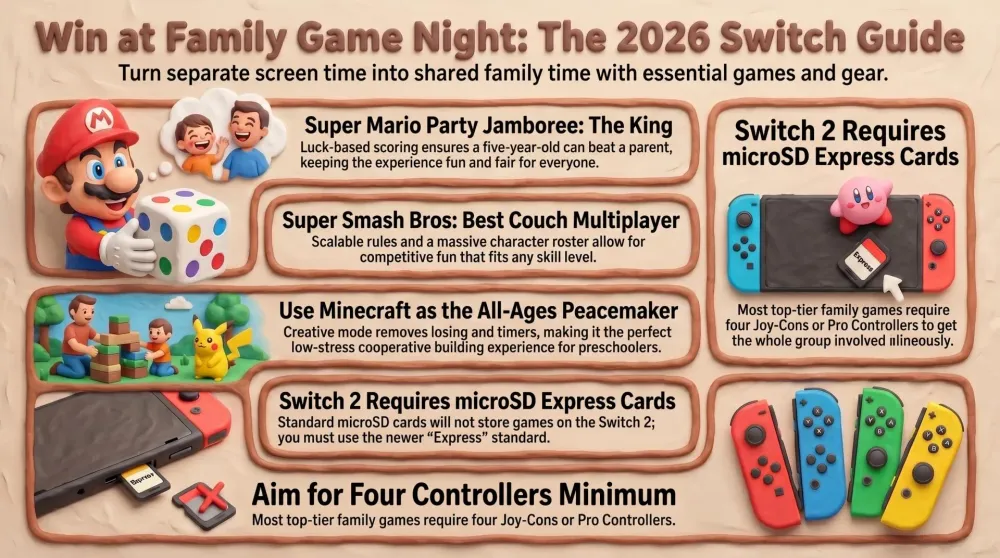
If you buy exactly one game for family game night, buy this one. Super Mario Party Jamboree is the most reliable “everyone is laughing within ten minutes” purchase on the entire Switch. It’s a digital board game wrapped around a firehose of short minigames, and it is engineered — almost cynically, in the best way — so that skill is not the whole story.
AdSuper Mario Party Jamboree (Nintendo Switch) (opens in a new tab)
Best Overall for Family Game Night: four-player board-game chaos that the whole family can play and a five-year-old can win.
What it does well
The magic is the luck layer. In most multiplayer games, the dad who’s been gaming for thirty years simply wins, and the five-year-old learns that game night means losing to Daddy. Jamboree fixes this. The board-game structure throws bonus stars, random events and reversals at the end, so a kid who’s been in last place all evening can snatch victory on the final turn — and the look on their face is the entire reason you bought a Switch. It genuinely levels the playing field across ages and skill.
It’s also built for four players on one screen out of the box, with each person needing only a single Joy-Con for most minigames, so the controller-cost barrier is low. The minigame variety is enormous — reflex tests, tug-of-wars, button-mashers, the occasional motion-control round — which keeps a session feeling fresh across a whole evening. And crucially, the session length is flexible: you can set a short board game for a school-night 25-minute window, or a long one for a weekend. Nobody is trapped in a two-hour campaign that has to be abandoned at bedtime.
There’s a deep bench of extra modes too, including larger-group and motion-heavy modes, but you don’t need any of them. The core four-player board game is the killer app, and it’s the one your family will return to week after week.
Where it falls short
Honesty time: the luck that makes Jamboree so family-friendly is the same thing that frustrates competitive teens and grown-ups who want their skill to actually matter. If your “kids” are 15 and want a real contest, the random reversals can feel cheap. It’s also, mechanically, a fairly busy game — the youngest players will need a couple of sessions (and a parent reading the prompts) before the board-game flow clicks. And like most Nintendo first-party titles, it holds its price; this is not a game you’ll find in a bargain bin.
Who should buy it
The dad with a mixed-age crew — say a six-year-old, a ten-year-old, and two adults — who wants the single most reliable “we all played together and laughed” experience. If your number-one goal is getting everyone around one TV on a school night, this is the game built precisely for your living room.
2. Super Smash Bros. Ultimate — Best Couch Multiplayer
If Jamboree is the board game everyone plays, Smash is the fighting game everyone plays. Super Smash Bros. Ultimate is the deepest, most generous local multiplayer game on the Switch, with a roster so large that every family member ends up with a character they’re weirdly loyal to.
AdSuper Smash Bros. Ultimate (Nintendo Switch) (opens in a new tab)
Best Couch Multiplayer: a roster so big everyone finds a character they love, with rules you can dial to any skill level.
What it does well
The headline is scalability across skill. Smash isn’t a button-memorization fighting game; you can flail and still land hits, which means a young kid genuinely participates instead of just getting demolished. And the rules are gloriously adjustable — turn on items for chaos, turn them off for a “real” match, set stamina or time or stock, tilt the handicap so the youngest player has a fighting chance. You can tune a single session to make it fair for a seven-year-old and then, after they’re in bed, tune it back up for a serious 1-on-1.
The roster is the other masterstroke. With dozens upon dozens of fighters from across gaming history, every kid claims a favorite — the Pikachu kid, the Kirby kid, the one who only plays Link — and that ownership is half the fun. It supports up to eight players in some modes (four is the comfortable couch sweet spot), and matches are short and self-contained, so it fits a school-night window as neatly as a long weekend.
Where it falls short
The flip side of “infinitely deep” is that the depth is real, and the gap between a button-masher and someone who’s learned the systems is enormous. Without turning on handicaps or items, a skilled player will dominate, which can sour it for the youngest. It also has a slightly steeper “what am I even doing” on-ramp than Jamboree’s board game — the very youngest players (four and under) often do better with Minecraft. And four controllers is the practical minimum for a proper family brawl, so factor in the controller cost.
Who should buy it
The family with kids roughly six and up who want a competitive, replayable mainstay — and the dad who’s happy to set up fair rules so a little one stays in the game. It’s the best pure couch-multiplayer title on the console, full stop.
3. Minecraft — Best Creative Co-op (and the All-Ages Peacemaker)
Not every game night should be a competition. Some of the best evenings are cooperative — everyone building one thing together — and for that, nothing on the Switch beats Minecraft. It’s the quiet workhorse of family gaming: split-screen, all ages, no timer, no losing, and effectively no end.
AdMinecraft (Nintendo Switch) (opens in a new tab)
Best Creative Co-op: split-screen building for all ages, with no timer, no losing, and effectively no end.
What it does well
In Creative mode, Minecraft removes every source of childhood frustration. There’s no health to lose, no enemies to fear, no failure state, and no clock. A four-year-old can place blocks happily next to a ten-year-old engineering a redstone contraption next to a parent building the family house, and everyone is contributing to the same world on the same screen. It is the most genuinely all-ages game in this guide — the only one a preschooler can fully join without supervision-by-frustration.
It runs split-screen co-op locally, so you don’t need an online subscription for couch play, and the shared-world dynamic teaches the good stuff: collaboration, planning, taking turns on the cool job. Session length is whatever you want — five minutes or two hours — and because the world persists, “we’ll build the rest tomorrow” is a real, low-drama way to end game night. If your evenings tend to dissolve into arguments over who won, Minecraft is the antidote: nobody wins, so nobody loses.
Where it falls short
The openness that makes it brilliant for young kids makes it directionless for some. There’s no built-in “tonight we play this scenario” — you have to bring the goal yourself, and on a low-energy night that’s real work for a parent. Survival mode adds stakes and monsters that can genuinely upset the youngest, so know which mode you’re in before bedtime. And split-screen on a single TV gets cramped with four players, each squinting at a quarter of the screen.
Who should buy it
The family with a wide age spread, especially with a child under six who can’t yet handle competitive games, and the dad who values cooperation over competition. It’s also the safest “first game” for a Switch household — universally enjoyed, impossible to age out of.
4. The Legend of Zelda: Tears of the Kingdom — Best Single-Player Epic
This one breaks the couch-multiplayer rule on purpose, because every Switch family eventually wants one masterpiece for the grown-up. Tears of the Kingdom is the game dad plays after the kids are in bed — and, surprisingly, one the whole family loves to gather around and backseat-engineer together.
AdThe Legend of Zelda: Tears of the Kingdom (Nintendo Switch) (opens in a new tab)
Best Single-Player Epic: the one dad plays after bedtime, and the one the family loves to watch and backseat-engineer together.
What it does well
As a solo experience it’s one of the finest games ever made: a vast, physics-driven open world where the build-anything mechanic turns every problem into a creative puzzle. But the family-game-night angle is real and underrated — it’s a fantastic watch-together game. One person drives, and everyone else throws out wild ideas for the next contraption, spots the shrine on the hill, or yells about the Korok you missed. It becomes a shared problem-solving session disguised as a video game, and kids who can’t yet play it themselves absolutely love directing the action.
It’s also the title that justifies the console for the adult in the room. After a week of party games, it’s the deep, considered experience that reminds you why the Switch is worth owning at all. Sessions are as long or short as you’ve got, and progress saves anywhere.
Where it falls short
Let’s be clear: this is not couch co-op. It’s a one-controller, one-player game, so it can’t be the centerpiece of a four-person game night the way Jamboree or Smash can. As a watch-along it depends on the audience being into it — younger kids will tap out faster than you’d like. And it’s a serious time investment to finish; this is a marathon, not a 25-minute school-night session.
Who should buy it
Every Switch household, but for a different slot than the others. Buy it for the after-bedtime shift and for the occasional family watch-and-help evening — not as your go-to “everyone grab a controller” game. It’s the depth pick, and the one that makes the console feel like more than a party box.
How They Compare: The Game Night Showdown
This is where the family decision actually gets made. Pay attention to the co-op or versus row and the age row — for a mixed-age household, those two lines matter more than any review score.
| Feature | Mario Party Jamboree | Smash Bros. Ultimate | Minecraft | Tears of the Kingdom |
|---|---|---|---|---|
| Players (local) | Up to 4 | Up to 8 (4 ideal) | Up to 4 split-screen | 1 |
| Age range | 5+ | 6+ | All ages | 10+ (great to watch) |
| Co-op or versus | Versus (party) | Versus (fighting) | Co-op (creative) | Solo / watch-along |
| Session length | 25 min to 2 hr | Short matches | Anything, persistent | Long marathon |
| Best for | Whole-family chaos | Competitive couch play | Building together | After-bedtime depth |
| Verdict | Game night king | Best multiplayer | All-ages peacemaker | The epic |
The table tells a clear story. The first three are your actual game-night arsenal — Jamboree for everyone, Smash for the competitive crowd, Minecraft for the youngest and the cooperative nights. Tears of the Kingdom sits slightly apart: a phenomenal game that serves the grown-up and the watch-along, not the four-controller free-for-all. A complete family library is one of each.
How to Choose: A Decision Framework
If you’ve read this far, here’s how to actually decide without overthinking it.
If you can only buy one game, buy Super Mario Party Jamboree. It’s the most reliable path to “everyone played together and laughed,” and it works across the widest age range with the lowest controller cost.
If your kids are six-plus and crave competition, add Smash Bros. Ultimate. It’s the deep, endlessly replayable couch fighter that adjustable rules keep fair for the little ones.
If you have a child under six (or hate the arguing), add Minecraft. Creative split-screen is the all-ages peacemaker — nobody loses, so nobody melts down.
If you want one masterpiece for yourself, add Tears of the Kingdom — just know it’s the after-bedtime and watch-along pick, not the party centerpiece.
And if you own a Switch 2, buy a microSD Express card before you buy a fourth game. A full console can’t install the games you just bought, and — critically — the old microSD card in your drawer will not work (more on that below).
AdSuper Mario Party Jamboree (Nintendo Switch) (opens in a new tab)
Best Overall for Family Game Night: four-player board-game chaos that the whole family can play and a five-year-old can win.
The meta-advice, in proper tech-dad spirit: don’t over-buy games. A family will get more joy from three titles played a hundred times than from a backlog of twenty bought in sales and never touched. The real cost of game night isn’t software — it’s controllers and storage. Sort those, get the three core games, and you’re set for years.
5. The One Piece of Gear: Samsung microSD Express for Switch 2
Every Switch family eventually hits the same wall: the console fills up, and a download stalls at 90% with a storage warning. The fix is a memory card — but on the Nintendo Switch 2, this is the single most common and most expensive buying mistake, so read this carefully.
AdSamsung microSD Express 256GB (for Nintendo Switch 2) (opens in a new tab)
Best Essential Gear: the Switch 2 needs microSD Express for game storage — a normal microSD card will not work.
What it does well — and why the spec matters
Here’s the crucial fact: the Nintendo Switch 2 requires microSD Express cards for game storage. This is not the same as the regular microSD or microSDXC cards that worked in the original Switch. A normal microSD card will physically slide into the Switch 2’s slot and look like it fits — but the console will refuse to use it for storing games. microSD Express is a newer, far faster standard (it uses a PCIe/NVMe interface, the same family of tech as an SSD) and the Switch 2’s faster games genuinely need that speed to load properly.
The Samsung microSD Express is the card that does it right. At 256GB it holds a serious stack of large modern games, the read speeds are in a different league from old cards, and it slots into the Switch 2 with zero fuss — the console recognizes it immediately as valid game storage. For a family that buys games digitally (and most do now), this is the difference between “download whatever the kids want” and “delete a game every time you buy one.”
Where it falls short
It costs more than a normal microSD card of the same size — that’s the price of the faster Express standard, and there’s no way around it for a Switch 2. It’s also genuinely overkill for the original Switch and Switch Lite, which can’t use the Express speed and run perfectly well on a cheaper standard microSD card. So match the card to the console: Express for Switch 2, standard microSD for the older models.
Who should buy it
Every Switch 2 owner, full stop — ideally before the console fills up and ruins a game night with a storage error. If you bought a Switch 2 and a microSD Express card isn’t already in it, that’s the next thing in your basket.
Common Mistakes to Avoid
- Buying the wrong microSD card for a Switch 2. This is the big one. A Switch 2 needs microSD Express — a regular microSD card from your old Switch (or your phone) will not store games on it, even though it fits the slot. Buy a card that explicitly says microSD Express.
- Assuming a single-player game suits game night. Tears of the Kingdom and other solo epics are brilliant, but they’re one-controller games. They are watch-along material, not “everyone grab a controller” material. Don’t build family night around a game only one person can hold.
- Assuming “local co-op” means couch co-op. It often doesn’t. Splatoon Raiders on Switch 2 advertises four-player local co-op, but “local” there means local wireless — every player needs their own console and their own copy. There’s no split-screen and no sharing one system. Always check whether a co-op game supports single-console play before you promise a shared-screen night.
- Forgetting you need four controllers. A Switch ships with two Joy-Con. For four-player Jamboree or Smash you need four controllers — usually one extra Joy-Con pair or two Pro Controllers. Budget for it before game night, not during it.
- Over-buying games and under-buying play. Three great titles played weekly beat a sale-bought backlog of twenty. Spend on controllers and storage, not on a fourth party game you’ll open once.
Pros
- Luck-based scoring genuinely levels the field across ages — a five-year-old can win
- Four players on one screen out of the box, single Joy-Con per player keeps controller cost low
- Enormous minigame variety keeps a whole evening fresh
- Flexible session length fits a 25-minute school night or a long weekend
- The single most reliable get-everyone-laughing purchase on the Switch
Cons
- Random reversals can frustrate competitive teens and adults who want skill to decide
- Busy enough that the youngest players need a parent reading prompts at first
- Holds its price like most Nintendo first-party games — rarely deeply discounted
Conclusion: The Bottom Line
After ranking four games and the one piece of gear that holds them, the honest take is simple: family game night is solved by getting the right couch games, not the biggest library. Three titles cover almost every household — and one of them does the heavy lifting.
For sheer reliability at getting the whole family off separate screens and around one TV, the Super Mario Party Jamboree is our winner. The luck layer keeps it fair across ages, four players play out of the box, and it fits a school night or a weekend equally. Add Smash Bros. Ultimate for the competitive crowd, Minecraft for the youngest and the cooperative nights, and Tears of the Kingdom for your own after-bedtime shift. And if you run a Switch 2, the Samsung microSD Express isn’t an upsell — it’s the only card type the console will actually use for games.
The Final Word: most families should buy Jamboree first, then a couple of extra controllers, then sort their storage. Get those three things right and game night runs itself for years. Period.
Related Dadnology guides: Best Family Board & Card Games for Game Night · Best Family Co-Op Games · Best Game Controllers for Every Setup
What is the best Nintendo Switch game for family game night?
What is the best Switch game for younger kids and mixed ages?
Does the Nintendo Switch 2 use normal microSD cards?
Are single-player games like Zelda good for family game night?
How many controllers do I need for family game night?
Do I need to buy these games on Prime Day, or any time?
Keep this in your inbox
One email a week: what we actually watched, built and reviewed — the stuff worth a dad's time. No hype, no daily spam.
Dadnology Weekly
One email a week: the LEGO, gaming and movie news worth a dad's time — plus what we actually reviewed. No hype, no daily spam.
Disclaimer: This review and its visuals were created with the help of AI. Some links may be affiliate links – we may earn a commission if you make a purchase, at no extra cost to you.
You might also like
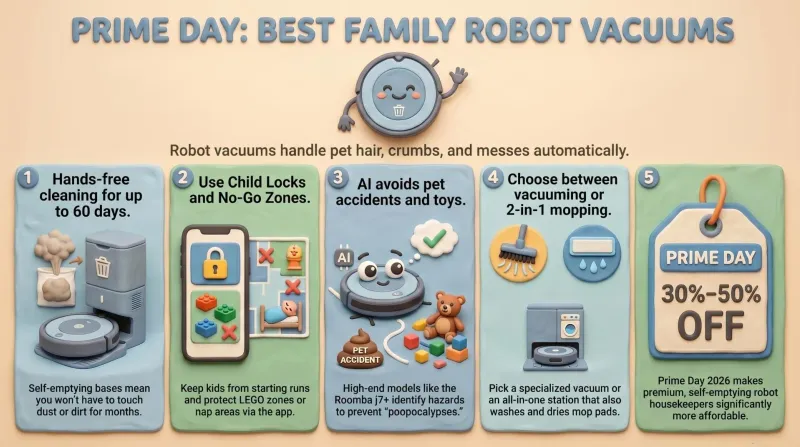
Prime Day 2026: 5 Best Robot Vacuums for Family Households
Our dad-focused Prime Day guide to the top 5 robot vacuums in 2026 that keep family homes clean – from self-emptying Roombas to powerful all-in-one stations from Shark, Dreame, and eufy.
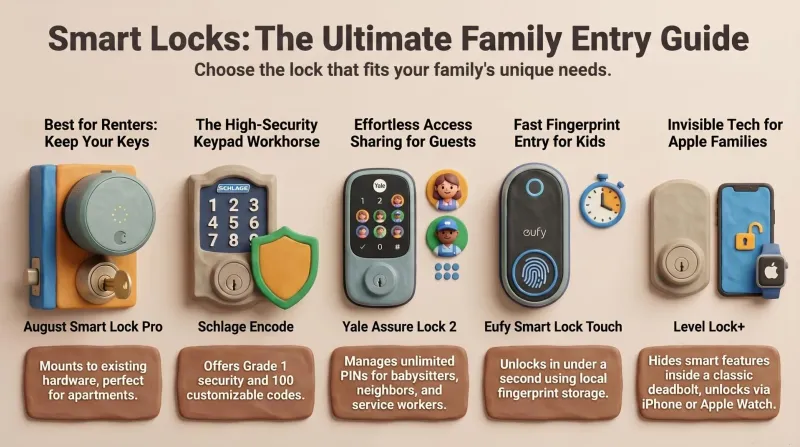
Never Get Locked Out Again: 5 Best Smart Locks for Families (Prime Day 2026)
A dad-focused guide to the best smart locks for U.S. family homes in 2026 – including August, Schlage, Yale, Eufy, and Level – with picks for renters, Apple families, fingerprint fans, and more.
LEGO Zelda: Link & Epona Revealed, 1,750 Pieces
Nintendo's 40th Anniversary Zelda Direct revealed a third LEGO Zelda set: a brick-built Link riding Epona from Ocarina of Time, 1,750 pieces, spring 2027.