
Best First Cameras & Creative Tech for Kids (Screen-Free Creativity)
Our dad-tested guide to the best first cameras and creative tech for kids in 2026: a real first camera, instant-print fun, a screen-free doodle board, a karaoke mic and a pretend-phone. Top pick: the Hangrui Kids Camera.
This post contains affiliate links. We may earn a commission if you make a purchase, at no extra cost to you. As an Amazon Associate, Dadnology earns from qualifying purchases.
🧒 This guide is part of our Amazon Prime Day 2026 Deals Hub — our curated buying guides of the gear actually worth a dad’s money.
What Creative Tech Is Actually Worth Giving a Kid?
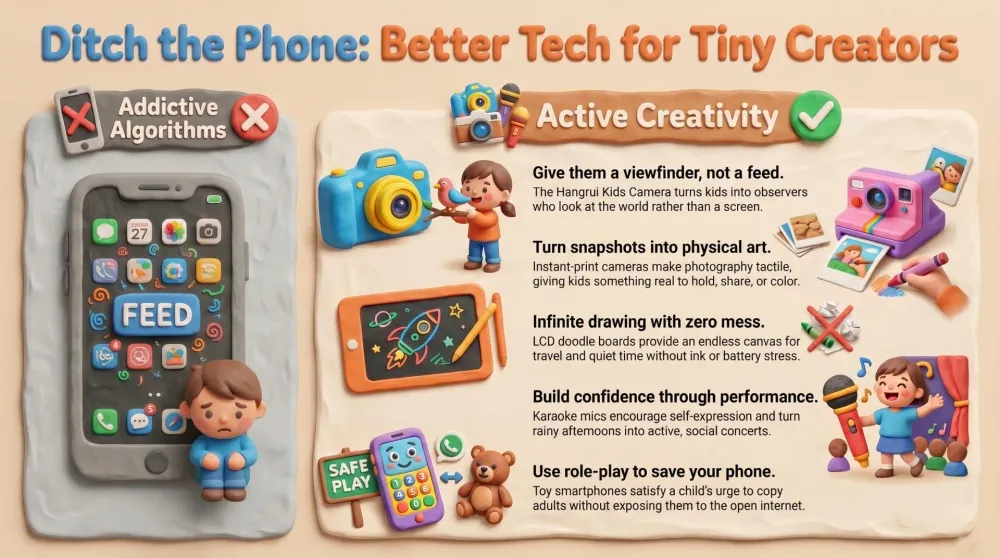
Here is the dad reality: the moment a kid wants to “make something” or “take a photo” or “call grandma,” the path of least resistance is to hand over your phone. And it works, for about ninety seconds, until you are watching a four-year-old swipe with alarming confidence toward your email, your banking app, and the autoplaying video rabbit hole that is engineered to never let go. Giving a kid creative tech that isn’t your phone is not anti-tech snobbery — and coming from this blog, that should mean something. It is the simple, slightly grumpy observation that a single-purpose creative gadget does one good thing and then stops, while your phone is an open door to an algorithm built to hook them.
The reason a first camera or a doodle board beats the phone is boringly straightforward: it hands the kid a creative job instead of a feed to consume. A real camera turns a kid into someone who looks at the world — the dog from below, your knees, forty-one blurry photos of the carpet, and then, occasionally, something that genuinely stops you. A doodle board turns a restaurant wait into drawing instead of a screen. A karaoke mic turns a rainy Sunday into a concert. That is active, creative, independent play — the kid is making something, not watching something. And every one of these gadgets has exactly zero interest in keeping them engaged for the next twelve hours, because it physically cannot.
And then there is the unglamorous dad metric: durability and your sanity. These gadgets are built to be dropped on tile, sat on, and left in the rain, which your actual phone is emphatically not. They are cheap enough that the inevitable death-by-toddler is an annoyance, not a four-figure insurance claim. And they buy back your own device — a kid with their own camera and their own pretend-phone stops reaching for yours every five minutes. This guide is a creative-tech starter list across the toddler-to-early-primary range: five gadgets that, between them, cover a first camera, instant-print fun, screen-free drawing, sing-along performing, and pretend-phone role-play. Every pick is judged against one honest question — does this build creativity and independence, or is it just another screen with a kid-shaped sticker on it?
We’ve ranked these in the order most families should consider them — the broadest, most universally satisfying pick first, then the specialists. Let’s get into it.
1. Hangrui Kids Camera — The One That Gives Them Their Own World
If you buy exactly one gadget off this page, make it this one. A first camera hits the rarest sweet spot for the toddler-to-early-primary years: it’s a real creative tool that hands a kid their own viewfinder on the world, asks nothing of you beyond charging it occasionally, and survives being dropped, chewed and inherited. It’s the gadget that turns “give me your phone” into “where’s my camera,” which is exactly the trade you want.
AdHangrui Kids Camera (Ages 3-8) (opens in a new tab)
Best first camera: a durable, dead-simple point-and-shoot that lets a kid capture their own world without you handing over a phone.

What it does well
The magic is that it does one thing, and the kid does the rest — which is the entire point. There’s no app, no feed, no “right” way to use it. It’s a camera, a button and a tiny screen, and the kid supplies everything else: the subjects, the angles, the relentless documentation of the cat, the floor, your nostril from below. That single-purpose simplicity is what makes it genuinely creative rather than passive — the kid is looking and deciding and making, not scrolling through what an algorithm served them. A three-year-old fires off two hundred accidental photos; a six-year-old starts framing things on purpose. Same camera, growing with the kid.
It’s also built for actual kid life, which is to say it’s built to be abused. It’s chunky, rubbery and rugged enough to bounce off tile instead of shattering like the phone you were tempted to hand over instead. The controls are stripped to the essentials, so a four-year-old can shoot without a tutorial and without “accidentally” buying something. And it’s genuinely theirs — a kid with their own camera that lives in their own bag develops a real sense of ownership and independence, and stops treating your pocket as a toy dispenser.
Where it falls short
Let’s keep some Haltung here. The image quality is, charitably, a kid’s camera — these are not crisp, frameable shots, they’re enthusiastic, slightly potato-grade snapshots, and that is completely fine for what it’s for but worth knowing if you imagined a tiny prodigy’s portfolio. It runs on a rechargeable battery you’ll be topping up, and the tiny built-in screen and storage are functional rather than lovely. And the appeal does have an age ceiling: an older, screen-savvy kid who’s used a real phone camera may find it basic fast. Match it to the 3-to-8 range it’s built for and it nails the brief; aim it older and it underwhelms.
Who should buy it
The dad who wants one durable, low-stakes creative gadget that hands a kid their own viewfinder, survives the drops, and buys back his own phone. If “I want my kid to make something and look at the world, not just press buttons on my device” describes you, this is the one built for exactly that.
2. Hangrui Kids Camera Instant Print (1080P) — The Snapshot You Can Hold
Some kids don’t just want to take a photo — they want to have it, right now, in their hand. For that kid, the instant-print camera is a small miracle: it shoots a photo and prints it on the spot on thermal paper, so a fleeting moment becomes a physical thing a kid can hold, draw on, hand to grandma, or stick on the fridge. In an age where every photo vanishes into a cloud nobody opens, that physicality genuinely lands.
AdHangrui Kids Camera Instant Print (1080P) (opens in a new tab)
Best instant-print camera: prints a photo on the spot on thermal paper, turning a snapshot into a physical thing a kid can hold.
What it does well
This is where the creative loop gets immediate and tactile. The kid frames a shot, presses the button, and a printed photo whirs out seconds later — that instant cause-and-effect is pure delight for a young kid, and it turns photography from an abstract “it’s on the screen” into a concrete craft. The prints become things: a kid hands you a portrait of your ear, decorates the fridge, builds a little gallery, or scribbles over a print with a marker. That’s creative play a phone camera simply can’t offer, because a phone photo never exists anywhere a four-year-old can touch it.
It also steps up the 1080P capture over a basic first camera, so the digital shots are a notch better, and it keeps the same rugged, kid-proof, dead-simple-controls philosophy. For the kid who’s obsessed with the result — the having, the showing, the sticking-on-things — it’s a far more satisfying gadget than a camera whose photos disappear into storage they’ll never look at.
Where it falls short
Here’s the honest catch, and it’s a real one: ongoing cost. Thermal paper is a consumable, and a kid who discovers printing will burn through rolls printing the carpet forty times, so factor refill rolls into the real price — this is not a one-and-done purchase. Thermal prints also fade over time, so treat them as instant magic, not an archive; the keepers should be photographed or properly printed. And like any kid camera, the image quality is enthusiastic-toddler grade, not gallery work. Buy it for the on-the-spot delight, go in clear-eyed about the paper bill, and it’s wonderful.
Who should buy it
The dad of a kid who loves the result — the holding, showing and sticking-up of a real photo — and who’s fine treating refill rolls as the cost of the magic. If your kid would rather have a printed picture in their hand than a perfect shot on a screen, this is the one that delivers that, drops and all.
3. ORSEN Writing Tablet / Doodle Board — Endless Drawing, Zero Mess
Now the gadget that does the most creativity for the least hassle. Every kid wants to draw, and every parent has met the consequences: marker on the wall, a felt-tip lid lost forever, a tablet drawing app that’s one tap from a game. The ORSEN doodle board sidesteps all of it — it’s an LCD writing tablet the kid draws on endlessly, clears with a button, and starts again, with no ink, no mess and effectively no batteries to babysit.
AdORSEN Writing Tablet / Doodle Board (Dinosaur) (opens in a new tab)
Best screen-free doodle: endless drawing on an LCD board with no mess, no ink and no batteries to babysit.
What it does well
It’s drawing reduced to pure creative play. The kid scribbles, writes, draws a dinosaur eating a house, presses the clear button, and does it all again — infinite drawing with zero setup and zero cleanup. That instant, consequence-free canvas is exactly what gets a kid actually making things, because there’s no friction and no “we’re out of paper.” It grows beautifully with the child too: it starts as toddler scribbles, becomes shapes, then letters, then real drawings, so the same cheap board earns its place for years.
The dad-killer feature is the no-mess, no-screen-guilt reality. There’s no ink to end up on the sofa, no app one tap from a game, no notification, and the coin battery lasts so long you’ll forget it has one. It’s also brilliantly portable — it slips into a bag for the restaurant, the car, the waiting room, and it quietly buys you a screen-free twenty minutes without handing over a phone or opening any other doors. It does exactly one thing, instantly, and that’s its whole genius.
Where it falls short
It is, by design, a single color and you can’t save anything — the drawing exists until the kid clears it, then it’s gone forever, which is freeing for play but means no keepers and no rainbow art. The screen is the fragile bit: it’s an LCD, so it won’t love being stood on, and a cracked one is a dead one. And it’s a solo, quiet activity — it won’t deliver the noise and performance of the karaoke mic or the role-play of the pretend-phone. It’s the calm, mess-free creative tool, not the showstopper, and that’s exactly what makes it the one that lives in the bag.
Who should buy it
The dad who wants a cheap, mess-free, screen-free creativity tool that travels anywhere and grows with the kid from scribbles to letters. If you want endless drawing without the marker-on-the-wall tax or a tablet’s open door to everything else, the doodle board is the no-brainer that earns its spot in every bag.
4. Jeefu Karaoke Machine for Kids — The Living-Room Concert
Some kids don’t want to draw quietly in the corner — they want the stage. They want a microphone, an audience, and the chance to belt a song with their whole chest. For that kid, a karaoke machine is creative gold: it’s performance, confidence-building and pure joyful noise, and it turns a flat rainy afternoon into a concert the kid headlines.
AdJeefu Karaoke Machine for Kids (opens in a new tab)
Best for performers: a sing-along mic that builds confidence and turns a rainy afternoon into a living-room concert.
What it does well
This is where creativity gets loud, social and confidence-building. Singing into a real mic, hearing your own voice amplified, performing for the room — that’s a genuine boost to a kid’s confidence and self-expression, and the shy kid who’ll sing into a mic but not without one is a real and lovely thing. It’s also a brilliant shared, screen-free activity: the kid performs, the family is the audience, siblings take turns, and everyone’s off their devices and actually in the room together. That’s a rare win on a tired evening, and it’s the kind of play that creates the chaotic-good memories.
It’s also a reliable party hit — at a birthday or a playdate it’s the thing every kid queues up for, and it gives a group of kids a structured, joyful activity that runs itself. The mic-and-music format is instantly understood, needs no tutorial, and delivers the performance buzz a born entertainer is constantly chasing.
Where it falls short
The flip side of “joyful noise” is noise, full stop. This is, by a wide margin, the loudest gadget here, and your tolerance for the same song at full volume forty times is the real spec to check — there’s a reason this one earns the side-eye after the hundredth chorus. It’s also the most personality-specific pick: the born performer adores it, while a quieter, drawing-in-the-corner kid may use it twice and drift back to the doodle board. And as a more electronic gadget it leans on batteries or charging and a bit more setup than the gloriously simple doodle board. Match it to the kid who already sings into hairbrushes, not the one who’d rather draw.
Who should buy it
The dad of a confident little performer (roughly 3 and up) who lives to sing, perform and command a room — and who can handle the volume. If your kid is already belting songs into anything microphone-shaped, this gives that instinct a proper stage, builds real confidence, and reliably steals the show at any party.
5. BESTOONE Kids Smartphone Toy — The One That Saves Your Actual Phone
Buying a pretend-phone sounds like the most cynical toy on earth until you’ve lived the alternative: a kid who wants to “call grandma” or “take a selfie” or just do whatever you’re doing, reaching for your real, expensive, algorithm-loaded device every five minutes. The pretend-phone is the honest fix — it gives a kid the role-play they’re genuinely after, with none of the open doors of your actual phone.
AdBESTOONE Kids Smartphone Toy (Ages 3-8) (opens in a new tab)
Best pretend-phone: a toy phone that gives a kid the role-play they want without you surrendering your actual device.
What it does well
It is role-play that solves a real problem. Little kids copy what they see, and what they see is you on a phone, so the urge to have their own is constant — the BESTOONE toy phone hands them a device to “call,” “message” and play with that is theirs, kid-safe, and crucially not your phone. That imaginative play — pretend conversations, taking pretend photos, running a pretend little life — is exactly the kind of copy-the-grown-ups creativity toddlers thrive on, and it does it without exposing them to a real feed, a real camera roll, or your work email.
The dad payoff is getting your own device back. A kid with a satisfying pretend-phone of their own stops grabbing yours, which is worth the purchase price on its own. It’s also pitched right for the 3-to-8 range — chunky, simple, kid-proof, and built to be dropped, so the inevitable throw-across-the-room is an annoyance rather than a disaster. It scratches the “I want a phone” itch years before that becomes a genuinely fraught conversation.
Where it falls short
It is, by nature, the most gimmick-adjacent pick here — a toy phone leans on lights, sounds and pretend functions, and the line between “great role-play prop” and “battery-powered noise” is thinner than with a camera or a doodle board, so it lives or dies on whether your kid actually role-plays with it. The play is more fixed than open-ended drawing — there’s a set of functions to discover and then it’s discovered. And it does run on batteries with the usual beeps. Buy it for the kid who’s constantly miming phone calls; for the kid who isn’t, it’ll gather dust.
Who should buy it
The dad of a 3-to-8 kid who is forever trying to swipe his real phone and loves copying grown-up routines. If “please, anything to stop them grabbing my actual device” is a daily thought, the pretend-phone gives them a satisfying one of their own — and quietly hands you yours back.
How They Compare: The Creative-Tech Showdown
Five gadgets, five completely different creative jobs. This is where you match the gadget to your actual kid and situation — pay attention to the Screen-free? and Running costs rows, because those two lines decide more about long-term peace of mind (and your wallet) than the sticker price does.
| Feature | Hangrui Camera | Instant-Print Camera | ORSEN Doodle | Jeefu Karaoke | BESTOONE Phone |
|---|---|---|---|---|---|
| Age | 3-8 | 3-8 | Toddler+ | 3+ | 3-8 |
| Creative use | Photography, looking | Photography, printing | Drawing, writing | Singing, performing | Pretend role play |
| Screen-free? | Tiny screen, no feed | Tiny screen, prints out | Yes, no internet | Yes, no internet | Toy screen, no internet |
| Running costs | Recharge only | Thermal paper refills | Coin battery (years) | Batteries / charging | Batteries |
| Best For | First real camera | Instant physical photos | Mess-free travel art | Born performers | Saving your phone |
| Verdict | Best first camera | Best instant-print | Best screen-free doodle | Best for performers | Best pretend-phone |
The table tells the real story: there is no single “best creative gadget,” only the best one for the creative job you’re hiring it to do and the kid you actually have. The Hangrui camera is the durable first viewfinder on the world; the instant-print version trades a paper bill for physical-photo magic; the doodle board is the mess-free travel artist; the karaoke mic is the stage for the performer; and the pretend-phone is the role-play prop that buys back your real device. Note the running-costs row — that’s the column that quietly separates the buy-once gadgets from the one with an ongoing tab.
How to Choose: A Decision Framework
If you’ve read this far, here’s how to actually decide without standing paralyzed in the aisle (or the Prime Day cart).
Start with age. The Hangrui cameras and the BESTOONE pretend-phone are built for the 3-to-8 range, and aiming them much older risks a screen-savvy kid finding them basic. The ORSEN doodle board is the broadest — it works from toddler scribbles upward and grows into letters and drawing for years. The Jeefu karaoke machine suits the confident performer from around 3 and up. Matching age honestly is the single biggest factor in whether a gadget gets used or abandoned in a week.
Then pick the creative focus. If your kid wants to capture the world, go camera — the standard Hangrui for the pure act of shooting, the instant-print version if they crave a physical photo to hold. If they want to make and draw, the doodle board is the mess-free, endless canvas. If they want to perform, the karaoke mic is the stage. If they mostly want to copy you and stop grabbing your phone, the pretend-phone solves exactly that. Buy for the kid’s actual instinct, not the talent you wish they’d develop.
Finally, weigh the running costs — and don’t get ambushed. Most of these are buy-once-and-charge gadgets, but the instant-print camera is the exception: thermal paper is a consumable you’ll keep rebuying, and the prints fade, so go in knowing the real price includes refill rolls. The doodle board is the opposite extreme — a coin battery that lasts so long you forget it exists. If you want zero ongoing tab, the camera, doodle board or pretend-phone deliver; the instant-print magic costs a little more forever.
AdHangrui Kids Camera (Ages 3-8) (opens in a new tab)
Best first camera: a durable, dead-simple point-and-shoot that lets a kid capture their own world without you handing over a phone.
The meta-advice, in proper tech-dad spirit: stop reaching for your phone as the default kid-pacifier. Your phone is a single device that does a thousand things, most of which a four-year-old should be nowhere near, fronted by an algorithm whose literal job is to not let go. A first camera, a doodle board, a mic — each does one creative thing, hands the kid the job, and then politely stops. That’s the metric. One creative gadget the kid owns beats one shared phone that owns the kid.
Common Mistakes to Avoid
- Buying too young or too old. A 3-to-8 camera handed to a toddler who’ll just chew it, or a pretend-phone given to a screen-savvy eight-year-old who wants the real thing, are both money wasted. The age ranges aren’t suggestions — they’re where the gadget actually clicks. Match them honestly and it gets used.
- Forgetting the thermal-paper cost on the instant-print camera. This is the ambush. The camera is cheap; the never-ending rolls of thermal paper are the real bill, and a kid who loves printing will burn through them fast. Budget for the refills up front, or the magic curdles into a running expense you didn’t sign up for.
- Buying battery junk that’s ignored in a week. The flashing, multi-function plastic gadget that promises ten features and does none of them well is the fastest route to a forgotten drawer. The picks that last do one creative thing properly — shoot, draw, sing, role-play. Ask what the kid actually creates with it, not how many lights it has.
- Treating a kid gadget like a quality device. These are built to be dropped, not framed. Expect potato-grade photos and a doodle board that won’t survive being stood on. Judging a 3-to-8 camera against your phone’s sensor misses the entire point — the value is that it’s theirs and survives, not that it’s sharp.
Pros
- Hands a kid their own viewfinder on the world — real, active creative play
- Rugged and kid-proof: shrugs off the drops that would kill your phone
- Dead-simple controls a 4-year-old uses without a tutorial
- No feed, no algorithm, no open door to anything it shouldn't reach
- Genuinely theirs, so they stop grabbing your actual phone
Cons
- Image quality is enthusiastic-toddler grade, not frameable
- Tiny screen and storage are functional rather than lovely
- An older, screen-savvy kid may find it basic fast
Conclusion: The Bottom Line
After lining up five very different creative gadgets, the honest take is simple: there’s no universal “best creative tech,” only the right tool for the creative job and the kid — but if you want the one that does the most for the most families, it’s the durable first camera that hands a kid their own world to capture.
For a screen-light creative gadget that survives the drops, builds real independence, and gets a kid off your phone, the Hangrui Kids Camera is our overall pick. The instant-print version is the call for the kid who needs a photo in their hand; the ORSEN doodle board is the mess-free, travel-anywhere art tool; the Jeefu karaoke machine is the stage for the born performer; and the BESTOONE pretend-phone is the role-play prop that quietly buys back your own device.
The Final Word: start with the creative gadget that’s genuinely the kid’s own and hands them a job to do — for most dads, that’s the Hangrui Kids Camera. Add one specialist alongside it, and stop defaulting to your phone.
Related Dadnology guides: Best APS-C Mirrorless Cameras for Beginners (2025) · Best Entry-Level Full-Frame Mirrorless Cameras for Beginners (2025) · Best High-End All-Round Full-Frame Cameras (2025)
What is the best first camera for a kid?
Are instant-print cameras for kids worth it?
Why give a kid their own gadget instead of just handing over my phone?
What age are these creative gadgets for?
Is a doodle board better than a drawing app on a tablet?
What creative gadget should I avoid wasting money on?
Keep this in your inbox
One email a week: what we actually watched, built and reviewed — the stuff worth a dad's time. No hype, no daily spam.
Dadnology Weekly
One email a week: the LEGO, gaming and movie news worth a dad's time — plus what we actually reviewed. No hype, no daily spam.
Disclaimer: This review and its visuals were created with the help of AI. Some links may be affiliate links – we may earn a commission if you make a purchase, at no extra cost to you.
You might also like
Prime Big Deal Days October 2026: What a Dad Should Actually Buy
Amazon's October sale runs 6-7 October 2026. Here is what a dad should buy, what to skip, and how to plan the two days without falling for decoy discounts.
Prime Day 2026: 5 Best Robot Vacuums for Family Households
Our dad-focused Prime Day guide to the top 5 robot vacuums in 2026 that keep family homes clean – from self-emptying Roombas to powerful all-in-one stations from Shark, Dreame, and eufy.
Never Get Locked Out Again: 5 Best Smart Locks for Families (Prime Day 2026)
A dad-focused guide to the best smart locks for U.S. family homes in 2026 – including August, Schlage, Yale, Eufy, and Level – with picks for renters, Apple families, fingerprint fans, and more.